
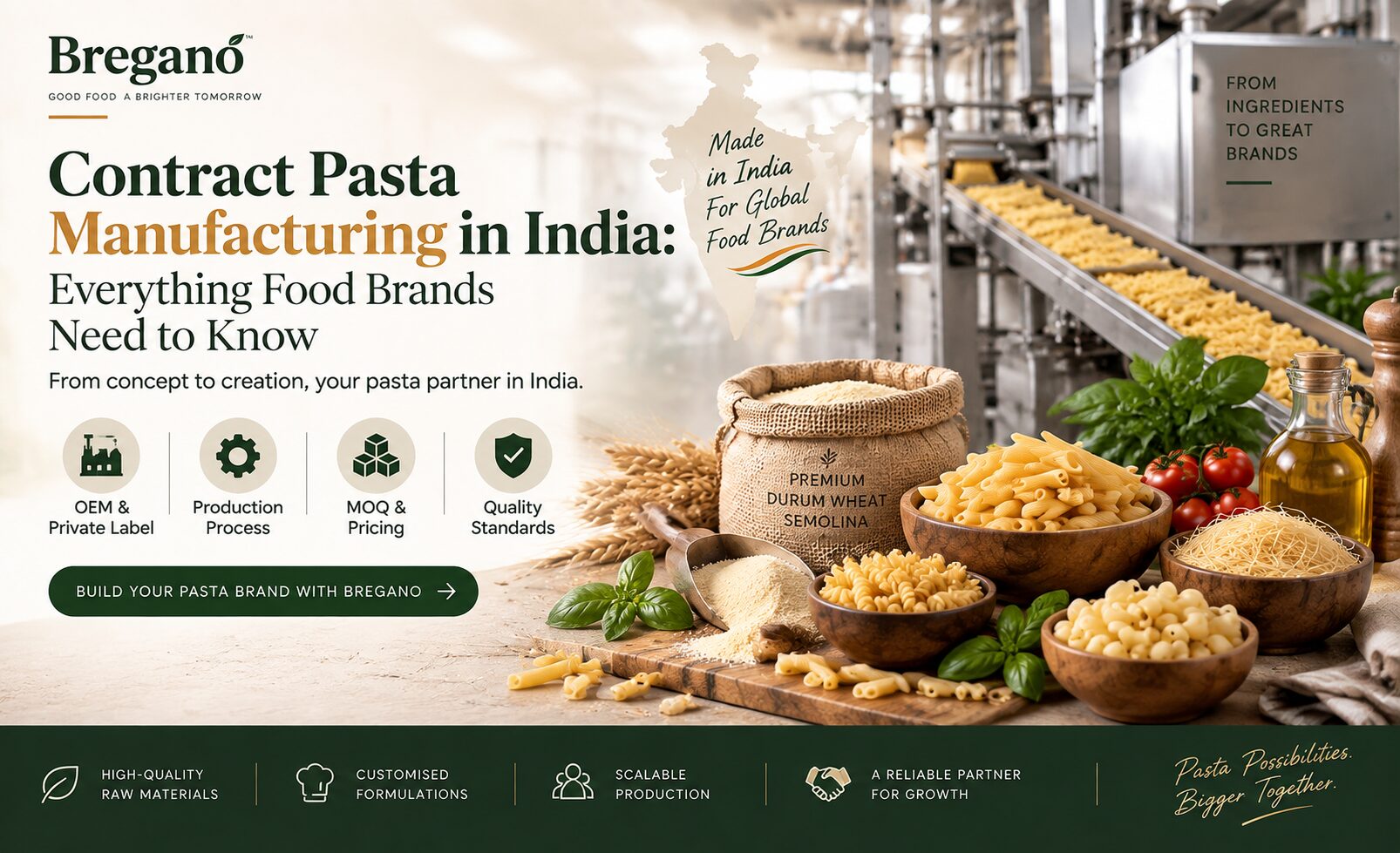
Contract Pasta Manufacturing in India: Everything Food Brands Need to Know
Every packaged food brand eventually faces the same question: do we build a factory, or do we get someone else to make it for us?
For most brands, the answer is the second one. Building a pasta plant means machinery, land, an FSSAI manufacturing licence, a technical team, utility costs and eighteen months before a single pack ships. Working with a contract pasta manufacturer in India means production starts in weeks, capital stays in your business, and you spend your money on brand and distribution rather than on dryers and extruders.
But contract manufacturing is a commercial relationship, not a purchase. It runs on an agreement, a capacity commitment and a shared quality standard. Brands that treat it as “just find a supplier” usually end up renegotiating within a year.
This guide covers how pasta contract manufacturing actually works in India: the process, what drives your cost, what belongs in the agreement, and how to pick a partner who will still be reliable when your volumes triple.
Contract manufacturing means a third party produces your product, to your specification, under your brand, at agreed volumes and pricing. You own the brand, the recipe direction, the packaging and the market. They own the plant and the production responsibility.
In India the terms overlap, so here is the practical distinction.
| Contract Manufacturing / OEM | Private Label | White Label | |
| Specification | Yours, defined by you | Manufacturer’s base, customised | Manufacturer’s existing product |
| Recipe control | Full | Partial | None |
| Exclusivity | Yours, usually contracted | Usually yours | Shared with other brands |
| Capacity booking | Often committed in advance | Order-to-order | Order-to-order |
| Agreement | Formal, detailed | Moderate | Minimal |
| MOQ | Highest | Medium to high | Lowest |
| Best for | Brands with a defined product and steady volume | Brands building their own label | Brands wanting speed |
Third party pasta manufacturing and outsourced pasta manufacturing are the same idea described differently. OEM pasta manufacturing India usually signals a stricter, specification-driven version where the manufacturer builds exactly to your brief.
If you are still deciding which model suits you, our guide to private label pasta manufacturing covers the lighter-commitment route. Contract manufacturing is the step up: more control, more paperwork, more volume.
Step 1: Requirement and feasibility. You share your product specification, target volume, pack formats and timelines. The pasta contract manufacturer confirms what their plant can and cannot do. Not every shape, blend or pack format is possible on every line, and an honest partner tells you this early.
Step 2: Sampling and specification lock. Samples get produced and tested. You cook them, check firmness after boiling, shape retention, water clarity and taste. Once approved, the specification is documented: raw material composition, shape, dimensions, moisture level, net weight, shelf life and acceptable tolerance ranges. This document becomes the reference point for every future batch.
Step 3: Costing and commercial terms. Pricing slabs by volume, payment terms, lead time, freight responsibility, and how raw material price movement will be handled. Semolina is an agricultural input and its price moves, so agree the mechanism now rather than arguing later.
Step 4: Agreement. The contract manufacturing agreement is signed. What goes into it is covered further below and it matters more than most brands expect.
Step 5: Packaging. Your artwork is checked for legal compliance and print readiness, then packaging material is printed and delivered to the plant. This is usually the longest lead-time item in the whole process.
Step 6: Pilot batch. A limited first run. You approve physical output, not a mock-up. Check fill weight, seal integrity, print quality, batch coding and the product itself.
Step 7: Scheduled production. Regular runs against your purchase orders, with an agreed production calendar, batch traceability and quality documentation per lot.
The case for pasta manufacturing without own factory is usually made on capital cost alone. That is the smallest part of it.
| Own Factory | Contract Manufacturing | |
| Upfront capital | High: land, machinery, utilities, licences | Low: packaging and first order |
| Time to first dispatch | Typically 12 to 18 months | Weeks |
| Fixed cost when sales dip | Continues regardless | Falls with volume |
| Technical team needed | Yes, production and QC staff | No |
| Compliance burden | Manufacturing licence, audits, inspections | Brand licence only |
| Flexibility to test new SKUs | Low, machinery is committed | High |
| Per-unit cost at high volume | Lower | Higher |
| Control over production priority | Full | Shared with other clients |
The honest trade-off: contract manufacturing costs more per kilogram, and you do not control the production queue. Your own factory costs less per kilogram at scale, but only at scale, and it punishes you every month your sales are below capacity.
For most brands under a certain volume, that fixed-cost risk is the deciding factor, not the capital.
For a new brand, third party pasta manufacturing for startups removes the two things that kill early food ventures: capital lock-in and inventory risk on unproven SKUs.
What it lets a startup do:
Launch a range, not a product. You can test penne, fusilli, macaroni and vermicelli without buying a separate production line for each. Whatever sells, you scale. Whatever does not, you drop with no stranded machinery.
Keep money in demand generation. In packaged food, distribution and marketing decide who wins, not who owns the plant. Capital spent on a factory is capital not spent on getting on shelves.
Stay compliant without becoming a manufacturer. You need an FSSAI licence in your brand’s name. You do not need a manufacturing licence, plant audits or a food technologist on payroll.
Scale without a step change. Growing from 10 MT to 50 MT a month with a pasta production partner India is a conversation about slabs and scheduling. With your own plant it is a capex cycle.
One realistic caution for startups: MOQ still applies. Contract manufacturing for pasta brands is a volume business, and a manufacturer who agrees to a very small run is usually repacking rather than producing. Plan your launch volume around what you can actually sell within shelf life, and build your costing before committing.
This is where brands get hurt, and it is almost always because something was assumed rather than written.
Specification and quality standard. The agreed raw material composition, shape, moisture level, net weight and shelf life, with acceptable tolerances. Without documented tolerances, “the batch is not right” is an opinion, not a claim.
Exclusivity. Is your formulation and shape exclusive to you, or can the same product be supplied to another brand? Agree this explicitly. Many disputes start here.
Capacity commitment. How much monthly capacity is reserved for you, and what notice each side needs to change it. In peak season, a brand without a booked allocation goes to the back of the queue.
Pricing and revision mechanism. How and when prices change with semolina rates. A defined formula or review cycle is better than an open-ended clause.
Lead time and dispatch schedule. Committed timelines, and what happens when they are missed.
Quality failure and rejection. Who bears the cost of a batch that fails specification, how rejection is determined, and what the replacement timeline is.
Packaging material ownership. Who pays for printing plates, who stores unused printed material, and what happens to it if you revise your design or exit.
Batch traceability and records. Batch coding and retention of production records, which you need if a consumer complaint or a regulatory query ever arrives.
Liability and recall. Who carries responsibility if a manufacturing defect triggers a recall.
Confidentiality and IP. If you bring a formulation, blend or process, protect it. If the manufacturer brings it, understand you may not own it.
Term, notice and exit. Contract duration, notice period, and what happens to your packaging stock and pending orders on exit.
None of this is unusual. A food contract manufacturer India who works with established brands will already have most of it in their standard agreement, and their willingness to discuss these clauses tells you a lot about how they operate.
Brands often ask for a single per-kilogram number. The number is real, but understanding what moves it is more useful.
Raw material. The largest component. Durum wheat semolina content is both the main quality driver and the main cost driver. Cheaper quotes usually mean more maida in the blend, which shows up as sticky, breakable pasta in the customer’s kitchen.
Volume. Per-unit cost drops across slabs. This is why MOQ exists and why higher committed volume is worth negotiating around.
Pack size. Smaller consumer packs carry more packaging cost per kilogram than bulk formats.
Packaging material. Printed film in your design, usually with its own minimum print quantity, which is often higher than the production MOQ.
Shape and line complexity. Some shapes run slower or need dedicated changeovers, which costs time on the line.
Freight. Dry pasta is light and bulky, so freight is a genuine component of landed cost. Plant location relative to your market matters.
Order predictability. A brand with a scheduled monthly offtake is cheaper for a plant to serve than one placing irregular emergency orders, and pricing usually reflects that.
Confirm they manufacture. Ask for the FSSAI manufacturing licence and check the plant address on it against the invoicing address. Ask to visit. A genuine contract pasta manufacturer for food brands has no reason to refuse.
Check the raw material. Ask what percentage of the blend is durum wheat semolina and where it is sourced. Vague answers here become quality problems later. Our guide on choosing a pasta manufacturer in India goes deeper on this.
Test batch consistency. Get samples from two different production dates and cook them side by side. Colour, cooking time and firmness should match.
Look at capacity headroom. Not just whether they can serve you today, but whether they can serve you at three times the volume in peak season. Ask what their peak load looks like and how they prioritise between clients.
Ask about their existing client base. How many brands do they currently produce for? Have they handled artwork coordination, scheduled dispatches and quality documentation before?
Review the paperwork discipline. Did they send a proper quotation with written specifications, or a rate on WhatsApp? A pasta manufacturing partner who is organised before the order will be organised after it.
Check the plant location against your distribution map. Freight savings from a well-placed plant often exceed the per-unit price difference between two quotes.
Production queue priority. You do not control the line. Manage it with a booked capacity allocation and a rolling forecast, not with urgent phone calls.
Quality drift over time. Batch one is always good. Manage it with documented tolerances, periodic sample checks against your specification and batch retention.
Single-supplier dependency. If one plant makes everything you sell, a shutdown is your shutdown. Larger brands eventually qualify a second source. Smaller brands should at least know who their fallback would be.
Raw material price swings. Agree a revision mechanism upfront so a semolina rate movement does not become a monthly negotiation.
Confidentiality. If your blend or process is a differentiator, protect it contractually before you share it.
Bregano is a food brand under the Dwarika Group, manufacturing from its unit in Rudrapur, Uttarakhand.
We produce pasta, vermicelli, dalia, besan and semolina based products for our own brand and for partner brands on a contract and private label basis. Production is in-house, so specification, quality and dispatch conversations happen directly with the plant rather than through a trading layer.
We work with food brands, D2C and marketplace sellers, distributors moving into own-brand, modern trade suppliers and exporters. Engagements start from 10 metric tons, with slabs through 25 MT, 50 MT and above.
daily production capacity in MT, certifications held (FSSAI number, ISO 22000 / HACCP if applicable), years in operation, number of contract or private label clients currently serviced, shapes and pack formats available, typical lead time in days, states and export markets served. Delete any line that cannot be verified.
What is contract pasta manufacturing?
A third party manufacturer produces pasta to your specification, under your brand, at agreed volumes and pricing. You own the brand, packaging and market. They own the plant and production responsibility.
How much does pasta contract manufacturing cost in India?
There is no single rate. Cost depends on durum wheat semolina content in the blend, order volume, pack size, packaging material, shape complexity and freight. Ask for slab-wise pricing against your actual expected volume rather than a headline per-kilogram number, and confirm how price revisions will be handled when semolina rates move.
What is the minimum order quantity for pasta manufacturing in India? Production-scale pasta manufacturing MOQ in India typically starts around 10 metric tons. Very low MOQs usually indicate repacking rather than actual production. At Bregano, enquiries start from 10 MT and move through 25 MT, 50 MT and above.
Can I sell pasta without owning a factory?
Yes. You need an FSSAI licence in your brand’s name, your own packaging, and a contract or private label manufacturer to produce for you. You do not need a manufacturing licence or a production team of your own.
What is the difference between contract manufacturing and private label?
Contract manufacturing is specification-driven, usually with a formal agreement, committed capacity and higher volume. Private label typically starts from the manufacturer’s existing product with customisation. Contract manufacturing gives more control, private label gives faster and lighter entry.
How long does it take to start contract manufacturing?
Sampling and specification take a few days. Packaging printing is usually the longest step. Plan for a few weeks from first enquiry to first commercial dispatch, with shorter cycles on repeat orders.
Do I need my own FSSAI licence?
Yes. The manufacturer holds the plant’s manufacturing licence, but as brand owner you need your own FSSAI registration or licence, and your number must appear on the pack.
Is my recipe protected in contract manufacturing?
Only if the agreement says so. Include confidentiality and exclusivity clauses before sharing any formulation or blend you consider proprietary.
Contract manufacturing is not the cheap option. It is the low-risk option.
You pay more per kilogram than a fully utilised own factory would cost, and in exchange you avoid fixed costs, capital lock-in, compliance burden and the risk of building capacity for demand that has not arrived yet. For most brands below a certain scale, that trade is clearly worth making.
What decides whether it works is the partner and the paperwork. Check the semolina, confirm they manufacture rather than trade, test consistency across batches, and get specification, exclusivity, capacity and pricing written down before the first commercial run.
Planning contract manufacturing, a private label launch, bulk supply, distribution or export?
Share your product, estimated quantity and purpose through our enquiry form. Our team will respond with specifications, pack options and commercial terms. Enquiries start from 10 metric tons.