
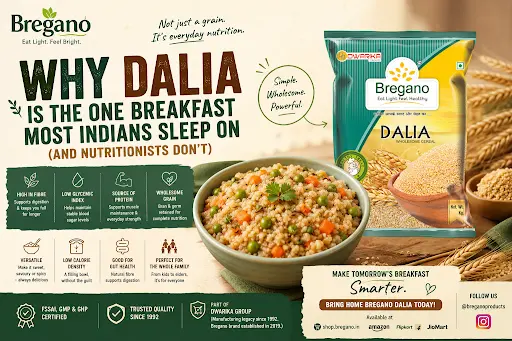
Most Indian kitchens have a packet of dalia somewhere in the back of the shelf.
Not the front, where the oats are, or the cornflakes with the bright box. The back. Behind the atta. Next to the forgotten packet of dalchini. It sits there for weeks, sometimes months, occasionally making its way into a khichdi that someone made when they were sick.
This is a nutritional injustice.
Dalia is a genuinely exceptional food. Not by Instagram food standards where everything gets called a superfood. By actual numbers: fiber content, glycemic index, protein relative to calories, digestive benefits, how it behaves in the body over sustained daily use. By these measures, dalia quietly outperforms most of what India is eating for breakfast.
The question is why nobody talks about it this way. And what happens when you actually start eating it consistently.
Dalia is broken wheat, also called cracked wheat. It is made by coarsely milling whole wheat grains. The key word there is coarsely. Unlike atta (which is finely milled), and very unlike maida (which strips the bran and germ completely), dalia retains everything. The bran. The germ. The endosperm. The whole grain, just cracked open and broken into smaller pieces.
This is not a minor distinction. The bran is where most of the fiber lives. The germ is where the vitamins and healthy fats are. When you mill wheat into fine flour, especially refined flour, you lose these layers. What you get is mostly starch. Dalia gives you the whole story.
The texture is coarser than fine rava. Coarser than anything that comes from refined wheat. When cooked, it has a slight nuttiness, a weight to it that feels substantive without being heavy. It absorbs whatever you cook it with, which is why it works equally well in a sweet kheer-style preparation with milk and jaggery as it does in a savoury khichdi with vegetables and jeera.
This versatility is part of why nutritionists like it. A food that works at breakfast, lunch, and as a light dinner, that carries spices as well as it carries sweetness, is practically useful in a way that specialized health foods often are not.
Dry dalia per 100 grams: 340 to 360 kilocalories. 11 to 13 grams of protein. 12 to 15 grams of fiber. Glycemic index of 41 to 55. Low fat, no cholesterol.
Those numbers in isolation do not mean much until you compare them to what most people are actually eating for breakfast.
Two parathas with butter: 600 to 700 kilocalories. Bread toast with butter and jam, four slices: 450 to 500 kilocalories. A bowl of cornflakes with full-fat milk: roughly 350 to 400 kilocalories but with very low fiber and a high glycemic index. Packaged instant oats: varies, but often with added sugar and flavourings that shift the nutrition profile.
Now the cooked dalia picture, because nobody eats dalia dry.
When you add water and cook dalia, it absorbs liquid and expands significantly: 2.5 to 3 times its dry volume. This means 100 grams of dry dalia becomes 250 to 300 grams of cooked dalia. The calories per 100 grams of cooked dalia drop to roughly 83 to 120 kilocalories because of all that water weight.
In plain terms: you can eat a genuinely large, satisfying, filling bowl of cooked dalia for around 150 to 200 kilocalories. That same calorie count in cornflakes is a disappointingly small portion that leaves you reaching for something else by 10 AM.
This is what nutritionists mean by low calorie density, and it is one of the most practical weight management mechanisms available in an ordinary Indian pantry.
Bregano Dalia is described as providing one serving containing up to 18% of the daily fiber requirement.
Eighteen percent of your daily fiber from one breakfast meal. That is genuinely significant.
Most Indians are chronically fiber-deficient. The shift toward refined carbohydrates, maida-based products, and processed foods over the last few decades has hollowed out fiber from the typical Indian diet. The consequences show up in digestive issues, blood sugar instability, chronic hunger, and over time, higher cardiovascular risk.
Dalia addresses this directly. Not with supplements, not with a processed fiber-enriched product, but with a whole food that simply retains what was there in the grain to begin with.
What does that fiber actually do once it is in your body?
First, it slows everything down in a useful way. Fiber slows the rate at which food moves through the upper digestive tract, which slows glucose absorption. This is why dalia has a low glycemic index of 41 to 55 even though it is a grain-based food. The fiber essentially acts as a buffer, preventing the blood sugar spike that follows refined carbohydrate consumption.
Second, it feeds your gut bacteria. The fiber in whole grains is prebiotic, meaning it serves as food for beneficial bacteria in the large intestine. A healthy gut microbiome is connected to everything from immune function to mood to how efficiently you absorb nutrients. This is the benefit most people do not think about when they are choosing a breakfast cereal, but it accumulates meaningfully over consistent daily use.
Third, it creates physical fullness. Fiber absorbs water and swells in the digestive tract, triggering stretch receptors that signal satiety. This is a direct, physical mechanism for feeling full, separate from blood sugar effects. Combined with dalia’s protein content, the satiety after a dalia breakfast is notably more sustained than after a comparable calorie intake from refined carbohydrates.
The low glycemic index of dalia ensures that it releases glucose into the bloodstream slowly, helping to maintain stable blood sugar levels.
This makes dalia particularly interesting for diabetics and pre-diabetics, but it is relevant for everyone.
When you eat a high-GI breakfast, blood glucose rises sharply. Insulin spikes in response. Then blood glucose falls, sometimes below fasting levels. This crash is what most people experience as that mid-morning energy dip, the one that makes the 11 AM biscuit feel like a biological necessity rather than a choice.
With dalia, the glucose curve is flatter. Energy comes in steadily rather than in a wave. The insulin response is more moderate. The drop afterward is gentler. This means the post-breakfast period is more productive, less distracted by hunger or energy fluctuations, and less likely to result in impulsive snacking before lunch.
For diabetics specifically, the low GI of dalia ensures a slow release of glucose, helping to maintain stable blood sugar levels. This is a verified claim from Bregano’s official website, and it is consistent with the established nutritional science on whole grain consumption and glycemic response.
The weight loss case for dalia comes from several mechanisms operating simultaneously, and it is worth being specific about each one rather than just saying “it is good for weight loss.”
The first mechanism is low calorie density. A large, filling bowl of cooked dalia with vegetables comes to around 150 to 200 kilocalories. You can eat a satisfying portion without consuming anywhere near what a comparable volume of paratha or bread would cost you calorically. This matters because hunger is partly a volume signal, not just a calorie signal. Dalia lets you eat enough food to feel full without the caloric expense.
The second mechanism is sustained satiety. The combination of fiber and protein means hunger returns much later after a dalia breakfast than after a refined-carbohydrate breakfast. This reduces total daily calorie intake not through willpower or restriction, but through the natural delay in hunger return. Replace your regular breakfast with dalia for 30 days and the cumulative calorie difference can be meaningful for weight management.
The third mechanism is protein’s thermic effect. Protein requires more energy to digest than carbohydrates or fat. Dalia’s protein content, at 11 to 13 grams per 100 grams dry, contributes to a slightly higher thermic effect of food compared to lower-protein breakfast options. This is a small but real contribution to caloric expenditure.
The fourth mechanism is blood sugar stability. When blood sugar is stable, cravings are more manageable. The crash that follows high-GI meals drives impulsive eating. Dalia’s low GI removes that driver from the equation.
None of these mechanisms is magic. Dalia is food, not medicine. But they compound over consistent daily use in a way that makes dalia genuinely useful for anyone trying to manage weight through sustainable diet choices rather than restrictive protocols.
Oats have excellent marketing. They have dominated the healthy-breakfast conversation in India for about fifteen years. This is partly deserved and partly a function of which companies have had the budget to tell that story.
The honest comparison:
Oats, rolled, dry per 100 grams: roughly 350 kilocalories, 13 grams protein, 10 grams fiber, glycemic index around 55 to 65.
Dalia, dry per 100 grams: roughly 340 to 360 kilocalories, 11 to 13 grams protein, 12 to 15 grams fiber, glycemic index 41 to 55.
They are nutritionally close. Dalia has somewhat more fiber and a somewhat lower GI. Oats have slightly more protein in some varieties.
Where they diverge is adaptability to Indian cooking. Oats in Indian kitchens tends to become either a slightly foreign-feeling porridge or an upma variation where the oat texture does not quite convince. Dalia absorbs Indian spices, ghee, jeera tempering, and vegetable combinations as naturally as any grain in the Indian pantry. Savoury dalia khichdi with vegetables and dal is a complete meal that has been part of Indian food culture for generations. It does not require adaptation. It already belongs.
For an Indian household cooking in an Indian kitchen for family members who are not particularly interested in wellness trends, dalia is practically more sustainable than oats. And sustainable is what actually produces health outcomes over time.
The most common preparation is savoury dalia khichdi: dalia cooked with dal, vegetables, and a ghee tempering of jeera and green chillies. This is the sick-day food most people remember from childhood. It is also, when you look at its nutritional profile, one of the most intelligently balanced meals in the Indian food tradition. Protein from dal. Complex carbohydrates and fiber from dalia. Vitamins from vegetables. Healthy fat from a small amount of ghee.
The second common preparation is sweet dalia porridge: dalia cooked with milk or water, jaggery or a little sugar, and often topped with dry fruits. This is the breakfast preparation. A bit slower to cook, slightly richer. Good for children and for anyone who prefers a sweet morning meal.
The third, less common but growing, is dalia upma: cooked with a south Indian-style tempering of mustard seeds, curry leaves, onions, and mixed vegetables. Similar to rava upma in technique but significantly more nutritious because dalia retains the bran that rava does not.
Bregano’s website suggests toasting dalia in a dry pan before cooking to enhance its nutty flavour, and using broth instead of water for a richer taste in savoury dishes. Both of these are genuinely good practical tips. The brief dry-toasting step, similar to what you would do with rava or vermicelli, deepens the flavour considerably and is worth the two extra minutes.
The basic water ratio for cooking dalia is 1:2, one cup dalia to two cups water. Cook on low heat after the water comes to a boil until the water is absorbed and the dalia is soft.
Everything that follows comes directly from bregano.in. Nothing assumed.
Product description: Premium Broken Wheat, coarsely milled, retains all nutrients.
Nutrition positioning: Rich in protein, supports weight loss and muscle maintenance. Low in calories, perfect for calorie-controlled diets. High in fiber, 18% of daily needs per serving. Wholesome cereal, bran and germ retained.
Manufacturing and certification: Part of Dwarika Group, established 1992. FSSAI, GMP, and GHP certified.
Pack sizes: 350 grams and 500 grams.
What dalia is made from (from their blog): made by coarsely milling whole wheat grains, giving it a distinct texture and a slightly nutty flavour.
Health properties listed: low glycemic index ensures slow release of glucose helping to maintain stable blood sugar levels. High fibre content keeps you feeling full for longer, reducing overall calorie intake. Aids in bowel movements and prevents constipation. Helps lower bad cholesterol levels. Maintains healthy blood pressure.
Availability: shop.bregano.in, Amazon, Flipkart, InstaMart.
Social: @breganoproducts on Instagram.
If dalia has been the forgotten packet at the back of your shelf, here is how to actually start using it.
Week one: replace one breakfast per week with sweet dalia porridge. Cook it with milk, add a teaspoon of jaggery, top with a few almonds or raisins. Keep it simple. The goal is to get familiar with the texture and taste before building a habit.
Week two: add a savoury preparation. Dalia khichdi with moong dal and whatever vegetables are in the fridge. This takes about 20 minutes in a pressure cooker. Add a small tadka of ghee, jeera, and green chilli on top. Eat it for lunch or an early dinner.
Week three: make dalia upma for breakfast one morning. Use the same method as rava upma, substituting dalia. Notice how it keeps you full longer.
From week four onward, dalia fits naturally into rotation alongside poha, vermicelli, eggs, and other breakfast options. The habit is established. The benefits compound quietly in the background, in digestion, blood sugar stability, and sustained morning energy.
Is dalia good for weight loss?
Yes, when eaten as part of a balanced diet. Dalia’s high fiber content keeps you full for longer, reducing overall calorie intake. Its low calorie density means you can eat a satisfying portion for relatively few calories, around 150 to 200 kilocalories for a well-prepared bowl. The low glycemic index of 41 to 55 prevents the blood sugar crashes that drive impulsive eating. These mechanisms work together to support weight management consistently over time.
Can diabetics eat dalia daily?
Yes. The low glycemic index of dalia ensures that it releases glucose into the bloodstream slowly, helping to maintain stable blood sugar levels. Dalia is considered excellent for diabetics and those at risk. Portion control and preparation method matter, avoid adding excessive sugar or jaggery in sweet preparations for best blood sugar outcomes.
Is dalia better than oats for breakfast?
They are nutritionally comparable. Dalia has a somewhat lower glycemic index and slightly more fiber per 100 grams compared to rolled oats. For Indian households, dalia adapts more naturally to traditional cooking styles and can be used in a wider range of Indian preparations without the texture mismatch that oats sometimes create in Indian dishes.
How much dalia should I eat per day?
A typical serving is 50 to 75 grams dry, which expands to 125 to 225 grams cooked. This provides roughly 60 to 90 kilocalories from dalia alone before other ingredients, with 6 to 11 grams of protein and 6 to 11 grams of fiber. One serving per day as breakfast or lunch is a practical starting point. Dalia is safe and beneficial for daily consumption.
Does dalia help with digestion?
Yes directly. The high fiber in dalia aids in bowel movements and prevents constipation. Dalia is also gentle on the stomach and helps maintain a healthy digestive tract. It can prevent issues like bloating and indigestion, making it a good food for people with sensitive stomachs.
What is the glycemic index of dalia?
The glycemic index of dalia is 41 to 55, which is in the low to medium range. This is significantly lower than white bread (GI 70 to 75), white rice (GI 70 to 73), and cornflakes (GI 74 to 80). The low GI is a function of dalia being a whole grain with intact fiber and bran, which slow glucose absorption.
Which is the best dalia brand in India?
Look for dalia described as coarsely milled whole wheat with bran and germ retained, certified FSSAI, and produced by a manufacturer with verifiable food safety standards. Bregano Dalia is described as premium broken wheat, coarsely milled, retaining all nutrients, with FSSAI, GMP, and GHP certifications. It is part of Dwarika Group’s food manufacturing legacy since 1992, available in 350 gram and 500 gram packs.
Order Bregano Dalia at www.shop.bregano.in Available in 350g and 500g packs. FSSAI, GMP, GHP certified. Part of Dwarika Group, in food manufacturing since 1992. Follow @breganoproducts on Instagram for recipes and updates.