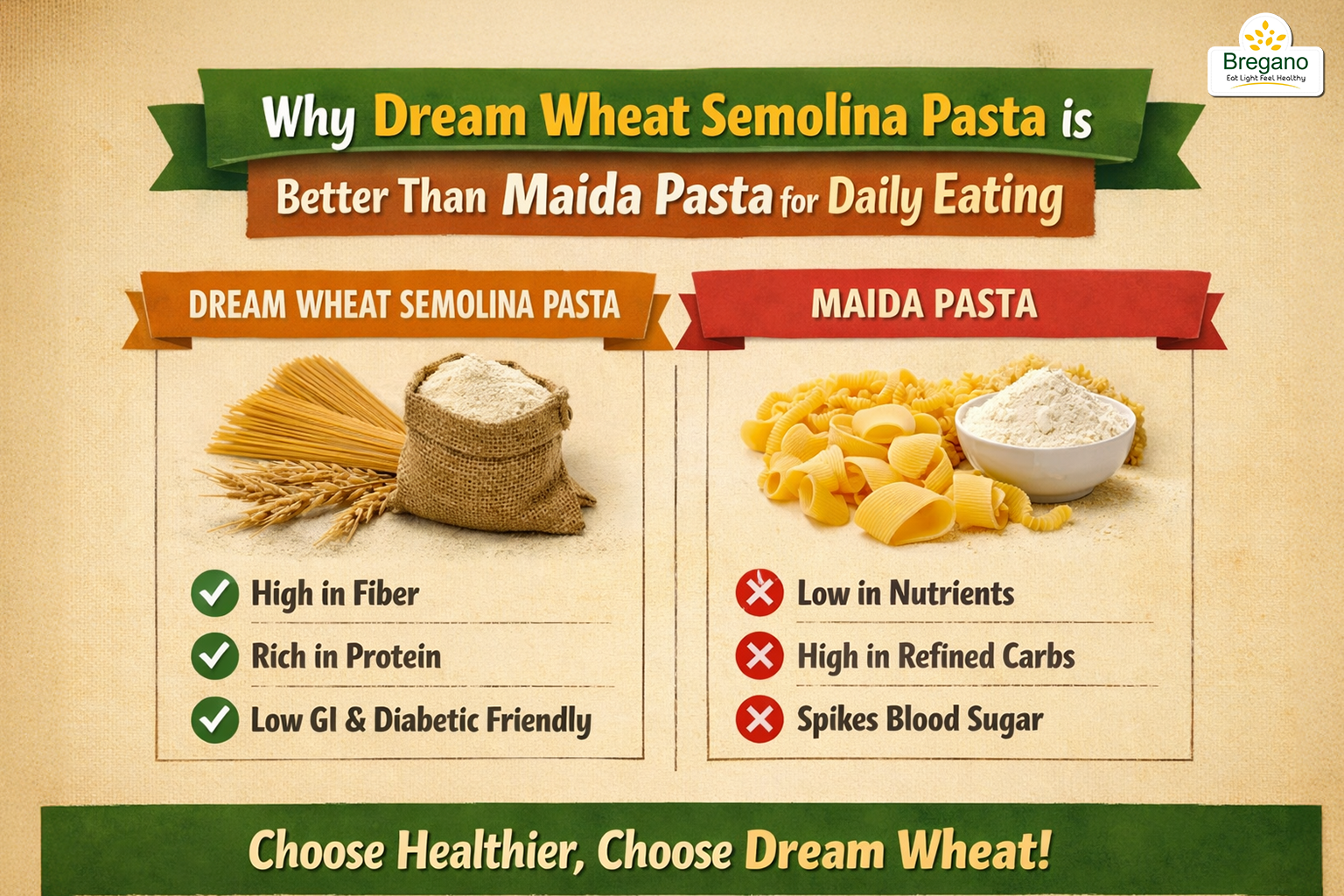
The health difference every Indian family should know before buying their next pasta packet
You pick up two pasta packets at the grocery store.
Packet A: ₹65 for 500g. Label says “Wheat Pasta.” Looks good.
Packet B: ₹110 for 500g. Label says “100% Durum Wheat Semolina Pasta.” More expensive.
You think: “It’s all pasta. Why pay ₹45 more?”
So you buy Packet A. Save money. Feel smart.
Then you cook it.
The pasta turns into sticky, mushy glue. Your kids push it around their plates. You wonder what went wrong.
Here’s what the cheaper packet didn’t tell you:
It’s made from maida (refined wheat flour) – not real pasta ingredients. That’s why it was cheap. That’s why it failed.
The expensive packet? Made from durum wheat semolina – the actual ingredient that makes pasta behave like pasta.
The ₹45 difference wasn’t about brand markup. It was about completely different ingredients.
This isn’t just about cooking performance. It’s about nutrition, health, blood sugar impact, protein content, and whether pasta is even safe for daily consumption.
In this guide, I’m going to show you the exact differences between maida pasta and durum wheat pasta – with science, nutrition facts, and practical advice for Indian families who want to make healthier food choices without breaking their budget.
Let’s start with the most important question.
Botanical name: Triticum durum
Common name: Durum wheat, hard wheat, macaroni wheat
Why it’s special: Durum wheat is the hardest of all wheat varieties. It has:
Where it grows: Mediterranean regions, Middle East, North America (requires specific climate – not widely grown in India, hence imported for quality pasta)
When durum wheat is milled, it produces semolina – a coarse, granular product.
Characteristics:
In India, we call it: Sooji or suji (though Indian sooji is usually from regular wheat, not durum wheat)
Pasta making requires specific properties:
Durum wheat semolina provides all three. Regular wheat flour (maida) provides none.
What it is: Highly refined flour made from the endosperm of regular wheat (after removing bran and germ)
Process: Regular wheat (soft wheat varieties) → Remove nutrient-rich bran and germ → Grind endosperm into fine powder → Bleach (sometimes chemically) → Result: White, soft, fine flour
Characteristics:
Simple reason: Cost
Price comparison:
For manufacturers: Use maida → Save ₹30–35 per kg → Higher profit margins. Marketing as “pasta” → Can charge ₹60–80 retail. Consumer doesn’t know the difference (until they cook it).
The problem: Maida pasta behaves nothing like real pasta – poor cooking quality (mushy, sticky), minimal nutrition. This is why cheap pasta exists – it’s maida noodles marketed as pasta.
According to nutritional comparisons of high-protein pasta brands in India:
Why this matters for families:
Practical impact: 100g durum wheat pasta provides ~25–30% of daily protein needs for kids. Maida pasta provides only ~10–15%. For vegetarian Indian families: Pasta can be a significant protein source when made from quality durum wheat semolina pasta.
Research on pasta GI studies shows:
What this means:
For Indian families: If you’re replacing rice with pasta, use durum wheat (similar or better GI). If using maida pasta, you’re not improving anything.
Benefits: Better digestion, regular bowel movements, gut health, feeling full longer, blood sugar regulation, heart health. For daily consumption: Higher fiber makes durum wheat pasta suitable for regular meals.
Durum wheat retains more nutrients:
Maida loses most of these during refining (even “enriched” maida doesn’t match natural whole grain nutrition).
For Indian cooking: Durum wheat pasta is essential. Indian recipes are tougher on pasta than Italian recipes.
For families: Kids and adults stay full longer with durum wheat pasta. Better for portion control and preventing overeating.
Is pasta good for daily eating or not? The answer depends entirely on what it’s made from:
For Indian families: If you want to include pasta regularly (once or twice weekly), it must be durum wheat semolina pasta.
| Aspect | Durum Wheat Semolina Pasta | Maida Pasta |
| Main Ingredient | Durum wheat semolina (whole grain milled coarsely) | Refined wheat flour (bran & germ removed) |
| Color | Natural golden yellow | White or artificially yellowed |
| Protein | 10–13g per 100g | 5–7g per 100g |
| Fiber | 3–5g per 100g | 1–2g per 100g |
| Glycemic Index | 45–55 (Low-Medium) | 60–70 (High) |
| Texture When Cooked | Firm, al dente, separate pieces | Soft, mushy, sticky clumps |
| Cooking Quality | Maintains structure, reheats well | Falls apart, gets worse when stored |
| Nutrition | Rich in B vitamins, iron, minerals | Most nutrients removed during refining |
| Satiety | High (keeps you full 3–4 hours) | Low (hungry again in 1–2 hours) |
| Blood Sugar Impact | Moderate, steady release | Rapid spike, then crash |
| For Diabetics | Acceptable in moderation | Not recommended |
| For Weight Management | Supportive (high protein + fiber) | Problematic (low satiety, high GI) |
| For Daily Eating | Yes (60–80g portions with vegetables) | No (occasional treat only) |
| Suitable for Indian Cooking | Yes (handles gravies, tadka, reheating) | No (breaks down in thick sauces) |
| Price | ₹90–140 per 500g | ₹50–80 per 500g |
| Value | Better (quality, nutrition, satisfaction) | Poor (cheap but disappointing results) |
The verdict is clear: Durum wheat pasta is objectively superior in every measurable way except initial price.
Pasta (made from durum wheat semolina) is a staple of Mediterranean diet, consistently ranked world’s healthiest eating pattern.
Associated with lower heart disease, better weight management, increased longevity.
Conclusion: Quality pasta is part of healthy eating.
Pasta made from durum wheat semolina has GI of 45–55 – significantly lower than white rice (70–80) or white bread (70–75).
Lower GI foods support better blood sugar control.
Conclusion: Durum wheat pasta is diabetes-friendly in moderation.
Durum wheat protein provides essential amino acids.
Combined with legumes/vegetables: complete protein for vegetarians.
Higher protein intake associated with better satiety and weight management.
Conclusion: High-protein pasta supports nutritional goals.
Multiple pasta health studies show pasta consumption (in appropriate portions) doesn’t cause weight gain.
May support weight management when part of balanced diet.
Higher fiber and protein content helps with portion control.
Conclusion: Quality pasta can be part of a weight management plan.
When prepared properly:
Result: Healthy, satisfying, nutritious meal
Durum wheat pasta works for:
Conditions: Must be 100% durum wheat semolina (not maida), moderate portions (60–80g dry per person), balanced preparation (vegetables + protein), not the only grain (rotate with rice, roti, millets).
If you’re asking this question, here’s the definitive answer:
Durum wheat semolina pasta is better in every way:
Maida pasta has only one advantage: Price: ₹30–50 cheaper per kg
But that “savings” costs you:
The smart choice: Spend ₹40–50 more per kg for durum wheat semolina pasta. The difference in quality, nutrition, and satisfaction is worth far more than ₹50.
Rather than naming specific brands (which can change), here’s your evaluation framework. Check out our detailed guide to healthy pasta brands in India to compare your options.
Daily protein requirements:
Indian vegetarian diet challenges:
Many families don’t get enough protein.
Dal/legumes often not consumed in sufficient quantity.
Rice and roti are low in protein.
How pasta can help:
100g durum wheat pasta provides 10–13g protein – that’s 15–25% of daily needs in one meal.
Easy to combine with vegetables, paneer, dal for complete amino acids.
Compare to: 100g cooked rice: 2.7g protein | 1 roti (30g): 2–3g protein | 100g maida pasta: 5–7g protein
For vegetarian families: High-protein pasta (durum wheat semolina) is a valuable protein source.
See top high-protein pasta brands in India for comparison.
Check nutrition label:
Higher protein = Better quality durum wheat semolina
Strategy: Use high-protein pasta (11–13g per 100g) and add protein-rich ingredients:
Example meal:
Total: ~22g protein in one meal.
This approaches daily protein needs significantly – especially important for kids and vegetarians.
When evaluating pasta brands, here’s how Bregano measures against the quality checklist.
You can shop Bregano durum wheat pasta directly online.
100% Durum Wheat Semolina: Bregano pasta (Penne, Fusilli, Macaroni) is made from 100% durum wheat semolina – not maida or mixed flour.
No Maida: Product descriptions specifically state “100% Semolina” and “No Maida.”
No Additives: Made without preservatives, fillers, additives, anti-caking agents, or MSG.
Bregano pasta is described as “rich in protein” due to the durum wheat semolina formulation.
See full Bregano nutrition details on the product page.
Also provides a good source of fiber and B vitamins.
Low Glycemic Index: Durum wheat semolina pasta has lower glycemic index compared to maida pasta.
Trans Fat Free: Zero trans fat.
May Support Health Goals: Product descriptions mention pasta may support weight loss, heart health, and digestion when part of balanced diet.
Italian PAVAN Technology: Manufactured using Italian PAVAN Thermo-Active System technology – advanced equipment ensuring consistent quality and proper drying.
See our manufacturing process for full details.
Fully Automated Facility: Produced in state-of-the-art, fully automated 7-acre facility in Rudrapur, Uttarakhand.
Multiple Certifications:
Food-grade, moisture-proof packaging with complete labeling: ingredients list, nutritional information, manufacturing date, best before date, batch number, FSSAI license.
Part of Dwarika Group: Dwarika Group has been in food manufacturing since 1992, starting with a flour mill in Rudrapur, Uttarakhand.
Bregano Launched 2019: Brand focused on bringing premium staples, pasta, and wholesome food products to Indian households.
Guided by Mr. Balram Agrawal: Vision of blending tradition, innovation, and trust.
Quality at Fair Pricing: Offers durum wheat semolina pasta at reasonable prices suitable for Indian family budgets.
Available in Multiple Pack Sizes: 400g, 450g, 900g options to suit different consumption needs.
Pasta Combo Packs Available: Better value for monthly grocery shopping.
Online: shop.bregano.in | Also available on BigBasket.
Geographic Reach: 7+ states across India. Find Bregano stores near you.
Product Range:
🛒 Bregano Penne Pasta – Perfect for thick Indian gravies
🛒 Bregano Fusilli Pasta – Great for lighter sauces and salads
🛒 Bregano Macaroni Pasta – Kid-friendly favorite
All made from 100% durum wheat semolina with Italian PAVAN technology.
Look at ingredient list on your current pasta packet:
Time to switch.
What to buy: Look for “100% durum wheat semolina” | Protein 10–13g per 100g | FSSAI + other certifications | Established brand | ₹90–140 per 400–500g range.
Start with 400–500g pack (test before buying bulk).
Compare top pasta brands 2026 to make an informed choice.
When cooking: Water stays clearer | Pasta doesn’t stick together | Cooks to firm texture | Smells better (natural wheat aroma)
When eating: Tastes better | Better texture (not mushy) | More satisfying | Feel full longer
Next day: Reheats well | Doesn’t turn into mush | Still edible (maida pasta becomes terrible)
Maida pasta: ₹65 per 500g | Durum wheat pasta: ₹110 per 500g | Difference: ₹45
For family of 4: Use 400g pasta per meal | Cost difference: ₹36 per meal | Per person: ₹9
Is ₹9 per person worth: 2x protein?
Better blood sugar control?
Proper nutrition?
Meal that actually works?
Family satisfaction?
Most families: Absolutely yes.
Once you’ve switched: Stock 2–3 packs in pantry | Include in monthly grocery list | Try different shapes (penne, fusilli, macaroni) | Experiment with recipes.
Never go back to maida pasta – the difference is too significant.
Shop Bregano pasta combos for the best monthly value.
Durum wheat semolina pasta:
Maida pasta:
Maida pasta has no scenario where it’s the better choice.
Today: Check your current pasta’s ingredient list | If it’s maida, plan to switch | Budget ₹100–140 for quality pasta
This week: Buy 400–500g durum wheat semolina pasta | Try it in your favourite recipe | Notice the difference
This month: Replace all maida pasta in pantry | Stock 2–3 packs of quality pasta | Make it a regular part of grocery shopping
Long term: Enjoy better-tasting pasta | Better nutrition for family | No more cooking disappointments
Switch to better pasta. Your family deserves it.
Choose Quality Durum Wheat Pasta – Choose Better Health
🛒 Bregano Penne Pasta – Best for masala and white sauce
🛒 Bregano Fusilli Pasta – Perfect for salads and light dishes
🛒 Bregano Macaroni Pasta – Kids’ favourite
Pasta Combo Packs – Stock your pantry, save money
Made with Italian PAVAN Technology
Certified: FSSAI | GMP | GHP | FSSC 22000 | HACCP | Halal
No Maida | No Preservatives | No Additives
Available online: shop.bregano.in | Also on BigBasket
Follow us: @breganoproducts
Stop buying maida pasta. Switch to durum wheat semolina. Give your family the nutrition they deserve.