
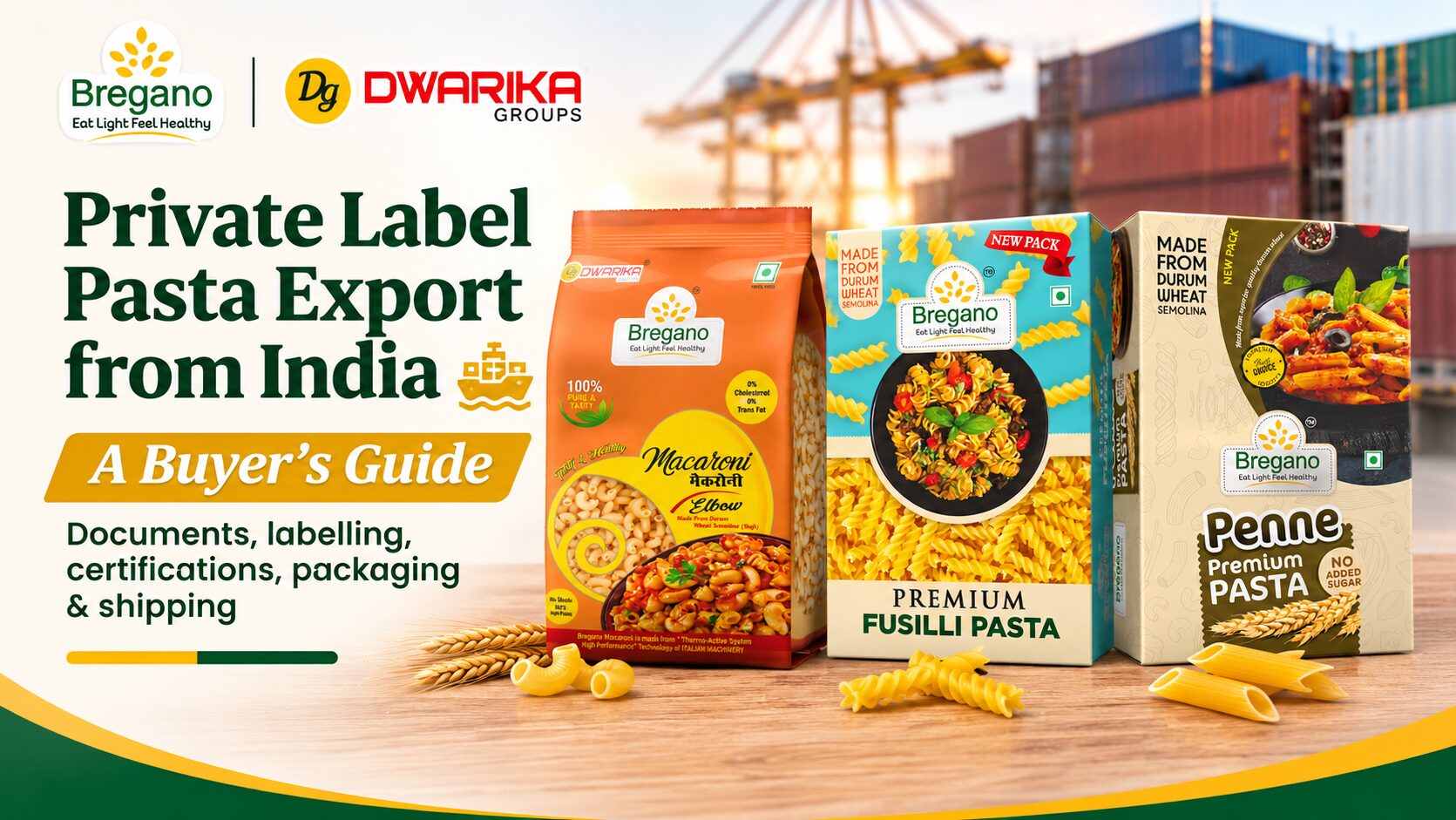
India is a large wheat producer with a growing food processing sector. That makes it a sourcing option for importers, distributors and brands that want private label pasta for export at scale. But exporting food involves more than placing an order. Documents, destination labelling, certifications and shipping conditions all need planning.
This guide explains what buyers and brand owners should prepare before sourcing pasta from an Indian manufacturer for export, from the first enquiry to the shipment reaching its market.
Each buyer type needs a slightly different mix of pack sizes, labelling and documents, so be clear about who your end customer is before you start.
Every country sets its own rules for imported food. Before any production, confirm:
The importer usually knows these rules well. Share them with your manufacturer at the start, so the product and packaging are planned correctly from day one.
Not every shape or pack size travels or sells equally well abroad. Think about:
Read Bregano’s guide to pasta manufacturing for the shapes Bregano produces.
Exact documents depend on the destination and the buyer. Commonly requested documents include:
| Document | Purpose |
|---|---|
| Commercial invoice | Value and details of goods |
| Packing list | Contents of each carton or pallet |
| Certificate of origin | Shows where goods were produced |
| Bill of lading or airway bill | Shipping contract and receipt |
| Certificate of analysis | Test results for the batch |
| Health or sanitary certificate | Required by some destinations |
The exporter also needs an Importer Exporter Code (IEC) from the Directorate General of Foreign Trade (DGFT). Confirm the full document list with your freight forwarder or customs broker before the first shipment.
Many importers and retailers abroad ask for proof of food safety systems before they approve a supplier. Common requests include:
Check which certifications your buyer needs and which certification bodies they accept, then ask the manufacturer for current certificate copies.
A pack designed for India may not be accepted abroad. Export packs often need:
Some brands use one pack with a local sticker. Others print market-specific packs. Discuss the MOQ for each option with your manufacturer, as market-specific printing usually needs its own minimum quantity.
Export deals need clear terms on who pays for and manages each part of the journey. Buyers and sellers usually agree on an Incoterm, such as FOB (Free on Board), where the seller delivers the goods onto the vessel at the port of shipment, or CIF (Cost, Insurance and Freight), where the seller also pays freight and insurance to the destination port.
Payment terms also need agreement in writing. Common options include advance payment, part advance with balance against documents, or a letter of credit. Discuss what suits both sides with your bank and freight forwarder.
Sea freight can take weeks, and containers face heat and humidity. Protect dry pasta with:
Ask for carton drop tests or transit trials if your route is long or involves several handling points.
Importers and retailers often ask for a minimum remaining shelf life on arrival. Plan production timing so stock reaches the market with enough shelf life left. Your best-before date must be supported by shelf-life testing of the product in its export packaging.
Include ingredient specification, cooking quality, moisture, packaging, labelling and testing frequency in your supply agreement. Approve a reference sample before the first shipment, and keep retained samples from each export batch.
A smaller first shipment helps you test the full chain: documents, customs clearance, transit conditions, shelf condition on arrival and customer response. Use what you learn to adjust packaging, labels or quantities before you scale up.
Bregano manufactures Penne Rigate, Fusilli and Macaroni from 100% durum wheat semolina and offers private label and contract manufacturing for food brands. Bregano’s contract manufacturing page lists FSSAI, FSSC, HACCP and Halal certifications, and pasta production on PAVAN lines imported from Italy. Share your target market, pasta shapes and pack format, and the team will discuss what is possible. Learn more about Bregano’s pasta manufacturing and the company.
To see the product, Bregano’s retail packs are available on Bregano Shop, Amazon and Flipkart: Penne Rigate, Fusilli and Macaroni.
Can I source private label pasta from India for export?
Yes. Discuss your destination’s requirements with the manufacturer before production.
What documents are needed to export pasta from India?
Commonly an invoice, packing list, certificate of origin and shipping documents. Some countries need more. Confirm with your customs broker.
Do export packs need different labels?
Often, yes. Labelling rules differ by country, including language, nutrition format and allergen declarations.
What is an IEC?
The Importer Exporter Code, issued by DGFT, needed to export from India.
Which certifications do pasta importers ask for?
It depends on the buyer and market. Common requests include FSSAI licence, HACCP, FSSC 22000 and Halal certification.
What is the difference between FOB and CIF?
Under FOB, the seller delivers the goods onto the vessel at the port of shipment. Under CIF, the seller also pays freight and insurance to the destination port.
Which pasta shapes are easier to export?
Short-cut shapes such as penne, fusilli and macaroni usually handle long transit better than long, thin shapes.
Should I start with a small shipment?
A trial shipment helps you test documents, transit and customer response before scaling up.
Planning to export private label pasta?