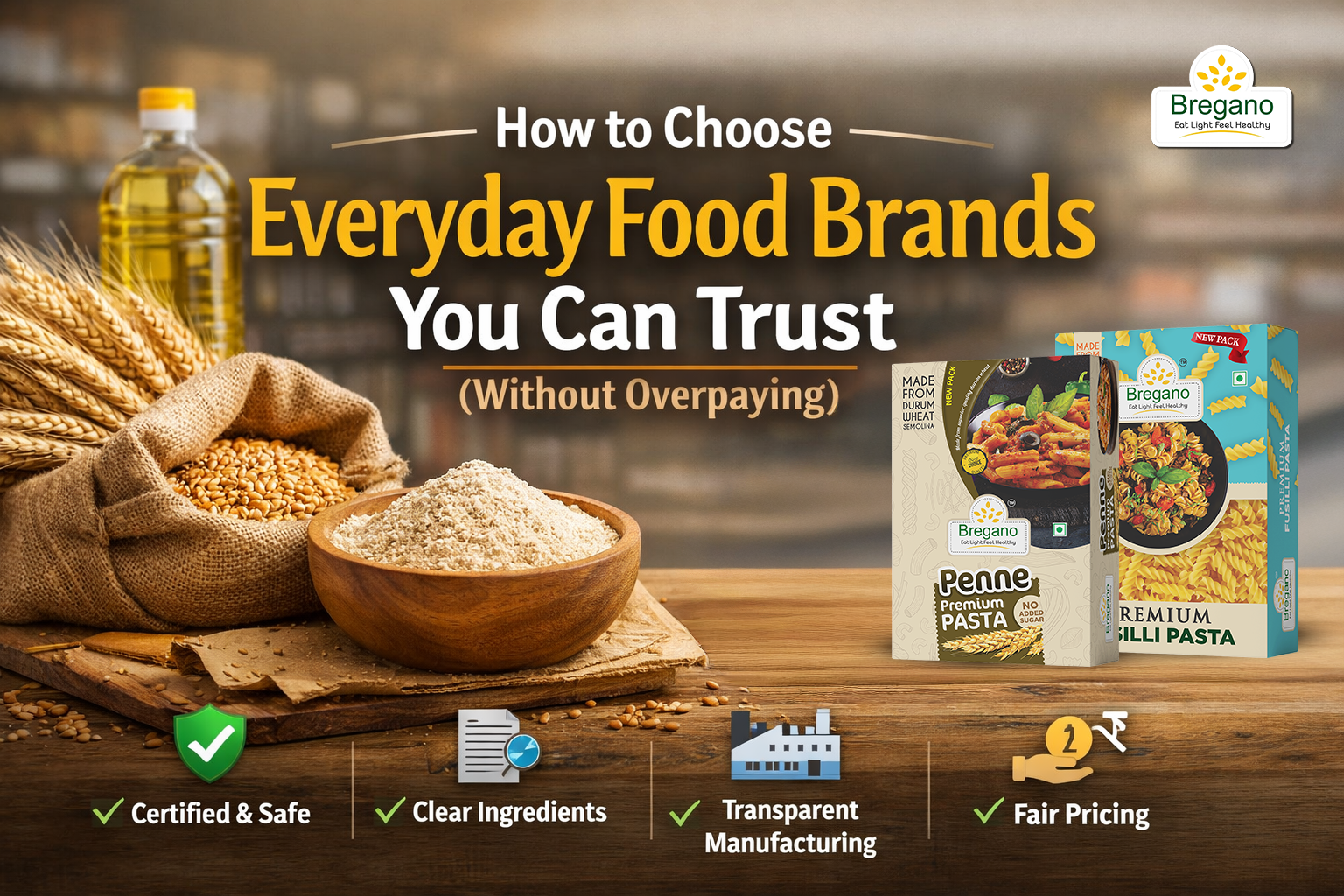
You’re standing in the grocery aisle, staring at three different atta brands.
Brand A costs ₹42/kg. Big billboard campaigns. Celebrity endorsement. Flashy packaging that catches your eye.
Brand B costs ₹48/kg. No celebrity face. Simple packaging. But there are actual certifications listed on the back.
Brand C from a local mill costs ₹38/kg. Unknown brand. No information beyond the basics. Just cheaper.
Which one do you grab?
Most people reach for Brand A. I mean, that celebrity wouldn’t lie about quality, right?
Here’s what nobody mentions in those ads: you’re paying ₹10–15 extra per kilogram for the celebrity’s endorsement fee, not better quality. Brand B might actually be superior quality. Those certifications cost real money to maintain and verify. Brand C? It could be excellent flour from a trustworthy local mill. Or it could be adulterated garbage. You genuinely have no way to know without more information.
The problem is that most Indian families choose food brands based on TV advertisements, price (assuming cheapest means best deal), what everyone else in their building buys, or packaging appeal. What they should be choosing based on: actual quality markers, safety certifications, ingredient transparency, and value (which is different from just price).
After years of researching food manufacturing and analyzing hundreds of brands across categories, I’m going to show you exactly how to choose trusted food brands for daily use — without overpaying for marketing or compromising on safety.
Let’s start with what “trust” actually means when it comes to food.
First, let’s clear something up: trust doesn’t equal famous.
The common mistake is thinking “this brand is on TV constantly, so it must be good.” The reality? Advertising budget and product quality are often inversely related. Brands spending crores on celebrity campaigns pass that cost directly to you. They might be cutting corners on actual product quality to afford those advertising budgets.
Consistent quality means the same taste, texture, and purity every single time you buy it. No batch-to-batch variation that forces you to adjust recipes. Reliable results in your cooking.
Safety standards mean proper certifications like FSSAI and GMP, no contamination issues, tested ingredients, and genuinely hygienic manufacturing conditions.
Ingredient honesty is straightforward — what’s on the label actually matches what’s inside the package. No hidden adulterants. Clear ingredient lists without misleading claims.
Traceable manufacturing means you know where the product is made, there are batch numbers for tracking, manufacturing and expiry dates are clearly printed, and you have actual manufacturer contact information if something goes wrong.
Reasonable pricing delivers quality without luxury markup. It’s fair pricing for actual value — not the cheapest option where corners get cut, and not the most expensive where you’re just paying for marketing.
Here’s your practical framework for assessing any food brand before you buy.
Start with the FSSAI license number. This is mandatory for all food manufacturers in India — it’s a 14-digit number that should be clearly visible on the package. You can verify it at fssai.gov.in if you want to be thorough.
Beyond the minimum, look for manufacturing standards certifications. GMP (Good Manufacturing Practices) indicates hygienic production. GHP (Good Hygiene Practices) means clean facilities. HACCP (Hazard Analysis Critical Control Points) shows they have safety systems in place. FSSC 22000 or ISO 22000 demonstrates food safety management that meets international standards.
Product-specific certifications matter too — organic certification for organic products, Halal or Kosher if that’s relevant to you, vegan certification where applicable.
Red flags to avoid: no FSSAI license visible anywhere, license number that’s illegible or clearly missing, or no manufacturing date or batch number on the package.
Why does this matter? Certifications aren’t just decorative stickers. They mean regular facility inspections happen, quality testing protocols are followed, processes are documented, and there’s accountability if issues arise. Brands with multiple certifications beyond just the minimum FSSAI tend to be more trustworthy.
Ingredients are listed in descending order by weight, so the first ingredient is the most abundant in the product.
For staples like atta, dals, and rice, you want to see a single ingredient. “Whole wheat” for atta. “Chana dal” for besan. Nothing else. If you’re seeing multiple ingredients where there should logically be one — like “wheat flour, maida, additives” for atta — that indicates adulteration or mixed quality.
For processed foods like pasta, vermicelli, and packaged snacks, look for simple, recognizable ingredients. Something like “durum wheat semolina, water, salt” with 3–5 ingredients you can actually pronounce is good. Avoid long lists of chemicals with artificial colors, excessive preservatives, and flavor enhancers mixed with ingredients you can’t identify.
Pay special attention to pasta (should say “durum wheat semolina 100%” not just “wheat flour”), besan (should say “100% chana dal” not “gram flour with additives”), and atta (should say “whole wheat” not mixed flours).
The basic rule: shorter ingredient lists are better for staples and basic foods.
The package should tell you the manufacturing date (ideally within 3–6 months for most items), expiry or best-before date that’s clear and far enough away, batch number showing quality control systems exist, complete manufacturer name and address (not vague), and customer care contact information for complaints.
Watch out for missing or smudged dates, no batch number, vague manufacturer info like “Made in India” without specifics, or no contact information at all.
This matters because if something goes wrong — contamination, quality issues, anything — can you trace it back? Can you actually contact the company? Brands with transparent manufacturing information are confident in their quality. Brands hiding information usually have something to hide.
Price alone is misleading. You need to focus on value instead.
Products that are too cheap (bottom 20% of the price range) are usually cutting corners somewhere — adulteration is common, poor quality ingredients, minimal safety measures.
Overpriced products (top 20%) often mean you’re paying for marketing and celebrity endorsements, fancy packaging, and “premium” positioning without an actual quality difference that justifies the cost.
The sweet spot is that middle 60% — fair pricing for actual quality, investment in production rather than just marketing, and the best value for daily use.
For atta, ₹35–45/kg covers quality options (anything under ₹32/kg is questionable, while ₹55/kg likely means you’re paying for branding). For dals, ₹80–130/kg depending on variety is fair. For pasta, ₹90–140 per 400–500g gets you good semolina pasta.
Think of value as: (Quality × Quantity) ÷ Price. Don’t just compare price tags. Compare what you’re actually getting.
Better brands actually tell you how they make their products.
Look for manufacturing process mentions like “stone-ground atta” indicating traditional methods, “Italian PAVAN technology” for pasta, or “slow-roasted” for vermicelli. This shows they’re proud of their process.
Quality controls mentioned like “multi-stage cleaning,” “tested for purity,” or “moisture-controlled storage” are good signs. Technology investments in modern facilities, automated production that reduces contamination, and climate-controlled drying all matter.
Why? Because manufacturing process directly determines quality. Traditional stone-ground atta is fundamentally different from industrial-milled atta in nutrition and taste. Pasta dried properly performs completely differently from pasta dried too quickly in texture and cooking quality.
Brands explaining their process are confident you’ll value the difference. Brands hiding their process usually don’t have anything special to share.
Not through TV ads. Through actual user experience.
Google the brand and check their website — is it professional and transparent? Look into company history. Read online reviews on Amazon, Flipkart, and Google Reviews. Look for patterns across reviews, not single isolated comments. Ask in your community — local WhatsApp groups, friends and family who cook regularly.
Red flags: no online presence, multiple complaints about quality issues, defensive responses to legitimate concerns, or suspiciously perfect 5-star reviews.
Green flags: professional websites with real transparency, constructive responses to complaints, a realistic mix of ratings, and evidence of long-term repeat customers.
Never buy 10kg of anything based on packaging alone.
For your first purchase, buy the smallest available pack. Test the quality, taste, texture, purity. See how it performs in your actual cooking. Then verify consistency by buying again after 2 weeks. Second purchase: get a medium pack to confirm consistency across batches. Then commit: buy larger packs or your monthly supply. Now you know it’s reliable.
This minimizes risk, tests actual quality rather than marketing promises, and ensures you’re not stuck with 10kg of substandard product.
Look for single ingredients with no additives, clear source mentions, proper moisture-proof packaging, batch numbers and dates, and mid-price range products. Avoid suspiciously cheap products, poor packaging, mixed or vague ingredients, and anything without proper certifications.
Look for “100% durum wheat semolina” on the ingredient list, high protein content (10–13g per 100g), manufacturing technology mentioned, FSSAI plus GMP minimum certifications, and no artificial colors. Avoid anything listing just “wheat flour” (usually maida), low protein under 8g per 100g, and vague ingredient claims.
Look for specific oil type clearly mentioned, clear expiry date, dark bottles or tetra packs that protect from light, whether it’s refined or cold-pressed clearly stated, and brands established specifically in oils. Avoid mixed or blended oils without clarity, clear plastic bottles, and anything too cheap where adulteration is common.
Look for pure spice with no fillers, natural color (not artificially bright), strong aroma indicating freshness, and proper packaging. Avoid artificial coloring, weak aroma suggesting old or adulterated spices, and loose spices from completely unknown sources.
There’s a myth that trusted brands are automatically expensive. That’s false. Many trusted brands are genuinely affordable — you just need to know what to look for.
Regional brands over national often have less marketing spend, lower distribution costs, and frequently offer better quality for the price — but you should still verify certifications. Direct-to-consumer brands cut out retailer margins and pass savings to you through online shopping. Mid-tier established brands focus on quality rather than image and offer fair pricing with proven track records.
| Option | Atta (10kg) | Dals (2kg) | Pasta (1kg) | Besan (1kg) | Total |
|---|---|---|---|---|---|
| Cheapest brands | ₹320 | ₹150 | ₹130 | ₹130 | ₹730 |
| Expensive “premium” | ₹550 | ₹280 | ₹350 | ₹190 | ₹1,370 |
| Smart trusted brands | ₹420 | ₹220 | ₹220 | ₹160 | ₹1,020 |
The math: ₹290 more per month than the cheapest option, but ₹350 less than “premium” brands. Zero health risks. Consistent quality you can count on. Is ₹290 per month worth your family’s health? Most families spend more than that on a single movie outing.
For daily staples: atta (10kg per month, stone-ground or chakki, whole wheat, GMP certified, budget ₹400–480). Rice (5kg, aged if buying basmati, budget ₹250–400). Dals (2–3kg mixed, unpolished, single ingredient, budget ₹200–300). Cooking oil (2L, specific oil type, proper packaging, budget ₹250–350).
For regular use: pasta (1–1.5kg monthly if used weekly, 100% durum wheat semolina, budget ₹200–280). Vermicelli (500g–1kg, hard wheat semolina, budget ₹80–120).
A monthly budget of ₹1,500–2,200 covers quality staples for a family of four with certified, trusted brands. The smart choice: ₹1,700–2,000 range with certified brands that deliver actual value.
Let me show you how to apply this evaluation framework to an actual brand.
For pasta: “100% durum wheat semolina” with no maida. Vermicelli uses hard wheat semolina. Clear ingredient transparency with no hidden additives or preservatives. Verdict: honest, simple ingredients.
Production happens at a 7-acre certified facility in Rudrapur, Uttarakhand. Manufacturing dates appear on all products. Batch numbers enable traceability. Company details are transparent and accessible. Verdict: complete transparency.
Pasta runs ₹100–140 range for quality semolina — not the cheapest (which would require compromising quality), not overpriced with celebrity endorsements. Verdict: good value proposition.
The facility uses the Italian PAVAN Thermo-Active System for pasta production. Fully automated. Process transparency is openly mentioned. Verdict: technology investment is visible and verifiable.
Bregano is part of the Dwarika Group, established in 1992. The Bregano brand launched in 2019 as a newer brand under an established company. Products are available through major retailers. Verdict: growing trusted brand with established backing.
400–500g pasta packs are available as test sizes. Not forcing bulk purchases initially. Verdict: low-risk trial is possible.
Overall assessment: Bregano fits the “good value” category with multiple quality markers, fair pricing, transparency, and suitability for daily use. Explore Bregano Monthly Essentials →
Structure your monthly shopping across weeks. Week 1: stock staples — atta (10kg), rice (5kg), dals (2–3kg), oil (2L). Week 2: add processed foods — pasta, vermicelli, besan, poha or dalia. Week 3: restock perishables — fresh produce, dairy, eggs or meat. Week 4: top up based on usage — spices, condiments, snacks.
The smart strategy: identify 2–3 trusted brands for staples, buy monthly from the same brands, take advantage of combo packs when available, stock up during sales, and keep a 2-week buffer so you’re never desperate.
Try switching to trusted brands gradually. Month 1: switch one category. Buy a trusted brand instead of the cheapest option and track the actual difference in quality, family feedback, and cooking results. Month 2: switch another category based on Month 1 success. Month 3: complete the transition.
What most families discover: it costs ₹200–400 more per month. But they get better health outcomes, fewer cooking failures, and genuine peace of mind. Most decide it’s absolutely worth it.
Cheapest brands usually cut corners, and your family’s health pays the price. The most expensive brands make you pay for marketing. Smart trusted brands offer fair pricing for actual quality — that’s your best value.
Your action plan: use the 7-point checklist for any brand evaluation. Check certifications first (FSSAI minimum, GMP or HACCP is better). Read ingredients carefully (simple, transparent lists). Assess value, not just price. Start small, then commit. Build your monthly basket with 2–3 trusted brands.
The investment is ₹200–400 more per month. What you get: peace of mind from certified, tested, safe products; better health without adulteration; consistent cooking results; less waste; and family satisfaction.
Is that worth it? You decide. But remember: you’re feeding this food to your family every single day.
Quality food isn’t expensive. Poor health is.
Start with trusted brands that deliver real value:
Available at: Patanjali | Vishal Mega Mart | Britannia Stores | 7+ States
Online: shop.bregano.in
📱 Follow us: @breganoproducts
Build your monthly food basket with brands you can trust. Quality essentials. Fair prices. Complete transparency.