
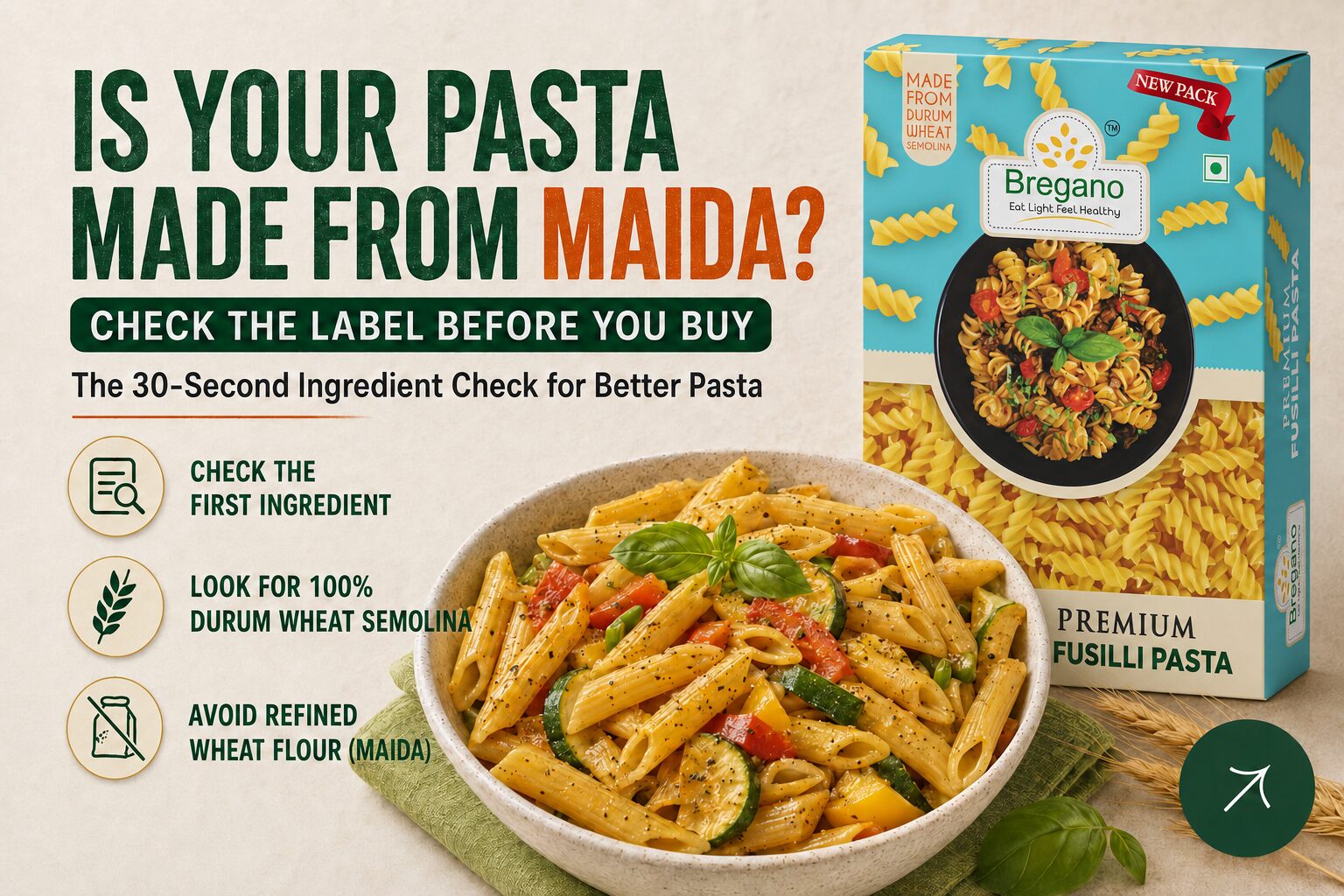
Here is a question most people have never thought to ask.
You buy pasta. You boil it. It turns into a sticky, disappointing pile of mush. You think you overcooked it. You try again next time, be more careful with the timer. Same result.
What if the problem was never your cooking?
A huge chunk of the pasta sold in India, especially the cheaper packs, is made from maida. Refined wheat flour. The same thing that goes into biscuits, samosas, and white bread. Not semolina. Not durum wheat. Maida.
And the frustrating part is that most brands do not say this clearly on the front of the pack. You have to know where to look.
This is that guide. By the end of it, you will be able to check any pasta pack in under 30 seconds and know exactly what is inside.
Before the label-reading lesson, it helps to understand why the ingredient choice makes such a practical difference.
Real pasta, the kind Italians have been making for centuries, uses durum wheat semolina. Durum is a hard wheat variety with high protein content, anywhere from 10 to 13 grams per 100 grams in quality pasta. That protein forms a strong gluten structure, which is what gives pasta its firmness, its bite, its ability to hold shape while cooking and not turn into glue.
Maida comes from regular soft wheat. The refining process removes the bran and germ, leaving almost pure starch. Protein drops to roughly 5 to 7 grams per 100 grams. The gluten structure is weak. And when weak gluten hits boiling water, it cannot hold. The pasta softens too fast, sticks together, turns cloudy your cooking water, and loses texture within a minute of the suggested cook time.
So the mush problem is not a cooking problem. It is a raw material problem.
There is a nutritional angle to this too. Maida has a high glycemic index, meaning it raises blood sugar quickly. Durum wheat semolina pasta has a significantly lower GI, often below 55, because the protein slows down how fast the starch is digested. For parents feeding this to kids daily, or anyone keeping an eye on their health, that difference matters.
And then there is the issue of what the label actually tells you versus what is actually inside the pack.
Indian food regulations do not require pasta to contain a minimum percentage of durum wheat semolina. There is no law that says a product labelled “pasta” must be made from semolina. This means a brand can legally use 30% semolina and 70% maida and still describe itself as pasta on the front of the pack.
Some brands go further. They use terms like “made with semolina” or “contains durum wheat” without specifying how much. That is not a lie, technically. But it is designed to let you assume more than is actually true.
A few brands go even further and simply list “wheat flour” or “refined wheat flour” in the ingredients while using pasta-shaped imagery and Italian-sounding names on the front. The packaging works. The product, inside the kitchen, does not.
This is not a niche problem. Looking at the budget end of the market, the majority of pasta packs priced below Rs 70 for 500 grams are either fully maida-based or contain a maida-heavy blend.
This is the part you actually came for.
Flip the pack over. Find the ingredient list. It is always there, usually in small print, often in a light font that seems designed to discourage reading.
Step one: Find the first ingredient.
Ingredients on a food label are listed in descending order by weight. Whatever is listed first makes up the largest proportion of the product.
If the first ingredient says any of the following, the pasta is maida-based or maida-heavy:
If the first ingredient says any of the following, the pasta is likely quality semolina:
That one check tells you most of what you need to know.
Step two: Watch out for the “made with semolina” trick.
If the label says “made with semolina” but semolina is not the first ingredient, it is being used as a minor addition. The base is still maida. The semolina is a marketing touch, not the actual flour.
Step three: Check the protein number.
Turn to the nutritional information panel. Look for protein per 100 grams.
Quality durum wheat semolina pasta: 10 to 13 grams protein per 100 grams. Maida pasta or blended pasta: 5 to 8 grams protein per 100 grams.
If the protein is below 9 grams, the pasta will struggle to hold its texture in the pan. That is a reliable shortcut when the ingredient text is too small to read clearly.
Step four: Look at the colour of the pasta inside the pack.
Hold the pack up to the light. Quality semolina pasta has a warm, golden-yellow tone. It is the natural colour of durum wheat. Maida pasta tends to be pale, almost white, and often has a slightly plastic sheen to it.
This check takes about two seconds and is surprisingly accurate.
Step five: Check the certification and manufacturer details.
Any serious pasta manufacturer will have FSSAI certification at minimum. Better manufacturers also carry GMP (Good Manufacturing Practices) and GHP (Good Hygiene Practices) certifications. Some carry FSSC 22000 and HACCP as well.
If a pack lists only a trader address with no actual manufacturing facility details, it may be a relabelled product from a contract manufacturer with no quality oversight on the raw material.
If you have ever cooked both, you probably already know this. But it is worth laying out clearly.
When you boil semolina pasta properly, the water stays relatively clear. The pasta cooks to a firm texture, holds its shape when you drain it, and does not clump together in the bowl. It reheats the next day without turning into paste. In thick gravies or Indian-style sauces, it survives the heat without disintegrating.
Maida pasta does something different. The water goes cloudy fast. The pasta softens quicker than the suggested time on the pack. It sticks together if you do not toss it in oil immediately. In a masala or gravy, it breaks down. Leftover maida pasta from the fridge is usually a congealed block the next morning.
If your pasta consistently behaves like the second description, it is not your cooking. It is the pasta.
Most people have no idea that pasta manufacturing in India ranges wildly in quality, from world-class facilities using Italian-imported machinery to small plants using whatever equipment they could piece together.
The ingredient difference is the starting point, but the manufacturing process also shapes the final product.
Quality pasta production involves precise mixing of semolina and water, extrusion through dies (the metal plates that create the shape), and then a controlled drying phase. The drying phase is critical and often overlooked. Pasta dried too fast develops micro-cracks in its structure. It looks fine in the pack but crumbles when cooked. Pasta dried slowly and at controlled temperatures has a dense, uniform interior that holds up.
Bregano, for context, uses the Italian PAVAN Thermo-Active System at their facility in Rudrapur, Uttarakhand. This is automated Italian technology that controls mixing, extrusion, and drying precisely. Their pasta is made from 100% durum wheat semolina with no maida, no preservatives, and no additives, verified directly from their official website. The facility is 7 acres, fully automated, and holds FSSAI, GMP, GHP, FSSC 22000, HACCP, and Halal certifications.
This matters not as a brand advertisement but as a reference point for what serious pasta manufacturing looks like. When a manufacturer invests in equipment like the PAVAN system, it usually reflects a broader commitment to raw material quality, because cheap equipment and quality semolina do not make economic sense together. Producers who cut on raw material tend to cut on equipment too.
India’s pasta market is growing fast, which is attracting both serious manufacturers and opportunistic ones. Here is how to think about the brand landscape without relying on marketing claims.
The brands worth trusting share a few common characteristics. They name their raw material specifically on the pack, usually “100% durum wheat semolina” without any hedging. They publish manufacturer details, not just distributor or importer information. They carry multiple food safety certifications beyond just FSSAI. And their pasta performs consistently across different cook times and Indian cooking methods.
Imported Italian brands like Barilla, De Cecco, and Garofalo will always be 100% durum wheat semolina because Italian law requires it. But they are priced at Rs 200 to 400 for 500 grams and are not always widely stocked outside metro cities.
Among Indian manufacturers, the honest answer is that quality varies enormously even within the same price range. The label check described above remains your most reliable tool regardless of brand recognition. A brand with a large advertising budget can still sell maida pasta. A smaller but serious Indian manufacturer can produce genuinely excellent semolina pasta.
In the Rs 90 to 140 per 400 to 500 gram range, you are more likely to find 100% durum wheat semolina products from Indian manufacturers who have invested in genuine quality. Below Rs 70, the probability of maida or a heavy maida blend goes up sharply.
Indian Pasta Manufacturers and Export
This is worth covering because people often assume export capability signals quality. It often does, but not always.
Several Indian pasta manufacturers supply or prepare for international markets, primarily across regions like the Middle East, Southeast Asia, East Africa, and countries with large Indian diaspora communities. Export requires compliance with the import food standards of the destination country, which means quality control, documentation, hygiene systems, and batch consistency become much more important than regular domestic supply.
Bregano has started working towards export readiness. The brand has already built the required manufacturing base, quality systems, certifications, and production standards needed for export-oriented operations. Export activity is currently in the starting stage, with commercial export partnerships and market-level requirements being developed further.
Other established Indian pasta exporters are usually manufacturers with automated facilities, documented quality systems, and experience handling international food safety documentation. To identify pasta exporters based in India for bulk orders, the most reliable sources are the APEDA directory, India Trade Portal, and direct inquiry with manufacturers who list export or export-ready supply as a business category.
For businesses looking to source Indian-manufactured pasta with export potential, the key questions to ask any potential supplier are: What is the semolina percentage? What certifications do you hold? Are your systems aligned for export documentation? What is the minimum order quantity? Do you provide lab test reports per batch? Can you do private label or custom packaging?
Manufacturers who answer these questions clearly, with documentation and production transparency, are generally the ones operating at a standard suitable for future export or bulk purchasing relationships.
There is a reason quality semolina pasta costs more than budget pasta. Durum wheat semolina costs roughly Rs 30 to 35 more per kilogram than maida. In a 500-gram pack, that translates to a difference of Rs 15 to 20 in raw material cost alone. Add the equipment investment for proper extrusion and drying, and the final retail difference between a Rs 60 maida pasta and a Rs 110 semolina pasta is almost entirely explained by what is actually inside.
The thing is, the real cost comparison should include waste. A family of four using 400 grams of pasta in a meal, where the pasta turns out badly enough that half gets left on the plate, has effectively paid more per enjoyable serving than the family that spent Rs 45 extra for quality semolina pasta that everyone actually ate.
Put differently: cheap pasta that fails is not actually cheaper.
Print this, screenshot it, or just remember the headline version.
Flip the pack. Check the first ingredient. If it says anything other than durum wheat semolina, put it back.
Check the protein number. Below 9 grams per 100 grams, the pasta will likely mush.
Look at the colour. Golden yellow is good. Bright white or pale with a sheen is usually maida.
Find the manufacturer, not just the brand. A real manufacturing address with certifications is a good sign. Only a trader’s address is a red flag.
Accept the price reality. Quality semolina pasta in India sits between Rs 80 and Rs 140 for a 400 to 500 gram pack. If a pack is priced at Rs 50 and claims to be “100% semolina,” one of those two things is not true.
Cook it once and observe. Clear water, firm texture, holds shape when drained: semolina. Cloudy water, mushy texture, sticks together: maida or a weak blend.
Is all pasta in India made from maida?
No, but a significant proportion of budget pasta is. Quality semolina pasta exists in India, manufactured by serious producers. You just have to know what to look for on the label.
Can a brand use both maida and semolina?
Yes. Indian regulations do not set a minimum semolina percentage for products labelled as pasta. A blend of 30% semolina and 70% maida is legal and sold widely. The label check tells you which you are buying.
Is semolina pasta actually healthier?
It has more protein, more fiber, a lower glycemic index, and no stripped-out nutrition. For everyday family consumption, yes, it is meaningfully different from maida pasta.
What does Italian PAVAN technology mean on a pasta pack?
PAVAN is an Italian pasta machinery manufacturer. Their Thermo-Active System manages the mixing, extrusion, and drying process automatically, with precise control over each stage. Manufacturers using this equipment have invested seriously in production infrastructure. It is a reliable indicator of manufacturing commitment, though ingredient quality still needs to be verified separately.
Which Indian pasta companies export internationally?
Several Indian pasta manufacturers either export internationally or are preparing for export-oriented supply. Bregano has started working towards export readiness, with manufacturing systems, certifications, and quality standards already aligned for future export opportunities. For comprehensive lists of active Indian pasta exporters for bulk orders, the APEDA directory and India Trade Portal are reliable sources.
What is the best pasta brand in India for quality?
1 Any brand that genuinely uses 100% durum wheat semolina, holds multiple food safety certifications, and performs well in actual cooking can be considered quality. Bregano specifically uses 100% durum wheat semolina with Italian PAVAN technology, no maida, no preservatives, no additives, and carries FSSAI, GMP, GHP, FSSC 22000, HACCP, and Halal certifications. That is verifiable from their official website. Use the label check on any brand you buy, regardless of reputation.
Most pasta in India is not what the front of the pack implies. The ingredient list, specifically the first ingredient, tells you the truth the packaging is designed to obscure.
Durum wheat semolina first: you are buying real pasta. Wheat flour or refined wheat flour first: you are buying an expensive way to eat maida.
Flip the pack. Read the first ingredient. Check the protein number. Buy accordingly.
Your kitchen experiments are not the problem. Your pasta selection might be.
Order Bregano pasta at www.shop.bregano.in
100% Durum Wheat Semolina. No Maida. No Preservatives. Italian PAVAN Technology. FSSAI, GMP, GHP, FSSC 22000, HACCP, Halal Certified.
Follow @breganoproducts on Instagram for recipes and updates.
Manufactured at a 7-acre automated facility in Rudrapur, Uttarakhand.
Part of Dwarika Group, in food manufacturing since 1992.