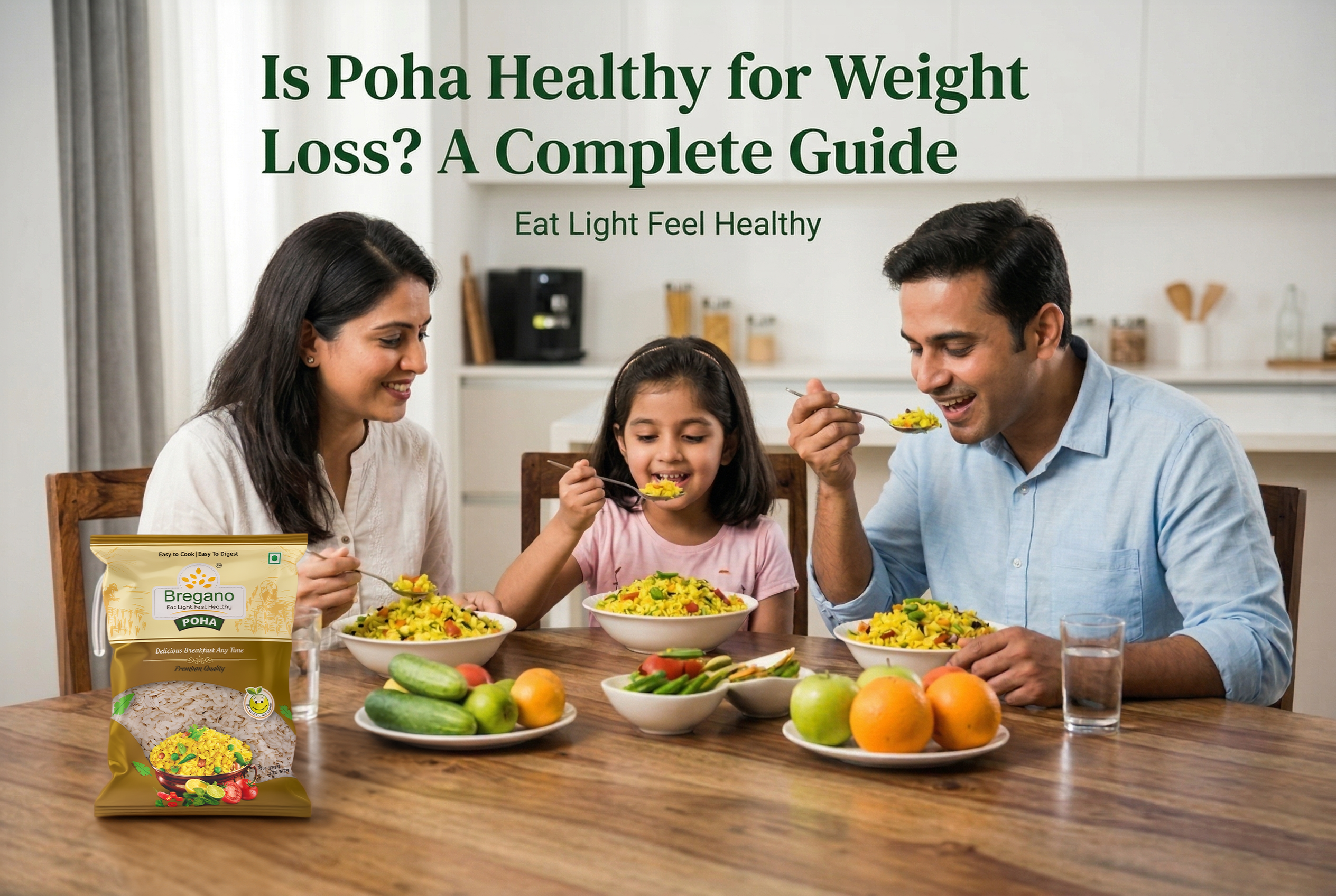
The truth about India’s favorite breakfast and whether it helps or hurts your weight loss goals
You wake up at 6:30 AM. Workout done. Shower done. Now you’re hungry.
You want breakfast that:
You open your pantry. Rice. Bread. Poha.
Your mind starts calculating:
Poha is rice… rice has carbs… carbs make you fat… right?
But my grandmother ate poha her whole life and was never overweight…
Maybe it’s different?
So you Google: “Is poha healthy for weight loss?”
And you get conflicting answers:
“Poha is low-calorie and perfect for weight loss!
“Poha is high-carb and will sabotage your diet!
“Poha is fine if prepared correctly…
Which one is true?
Here’s what nobody tells you: The question itself is incomplete.
Poha for weight loss isn’t a yes/no answer. It’s a how, when, and with what answer.
In this complete guide, I’m going to show you exactly:
By the end, you’ll know exactly whether poha belongs in your weight loss diet and if yes, how to prepare it the right way.
Let’s start with the most important question.
Bregano Poha is described as a major source of protein, which is an important building block for the body.
Why protein helps weight loss:
Bregano Poha is a quick snack that can be prepared within minutes perfect for busy mornings when you need a fast, healthy breakfast.
Why this helps weight loss:
Part of Dwarika Group (since 1992), Bregano operates a state-of-the-art, fully automated 7-acre facility with globally recognized standards:
Why this matters:
Plain poha has almost zero fat. The fat comes entirely from cooking oil and additions like peanuts.
Weight loss advantage:
Plain poha has 2.5-3.5g protein per 100g not high, but not zero.
Weight loss advantage:
For people with gluten sensitivity or celiac disease, poha provides a safe breakfast option.
Weight loss advantage:
Before we discuss weight loss, we need actual numbers.
Calories: 130-160 kcal varies by thickness of poha
Carbohydrates: 24-28g
Protein: 2.5-3.5g
Fat: 0.2-0.5g
Fiber: 1.5-2.5g
Iron: 1.5-2mg
B Vitamins: Good source (especially B1, B3)
Glycemic Index: Medium (50-60, varies by type and preparation)
Nobody eats plain uncooked poha.
You cook it. You add oil. Vegetables. Peanuts. Sugar. Salt.
That’s where calories change dramatically.
Now compare this to other breakfast options:
2 Parathas with butter: 600-700 kcal
Poori-Bhaji 4 pooris: 550-650 kcal
Bread Toast 4 slices with butter and jam: 450-500 kcal
Upma 1 plate : 250-300 kcal
Idli-Sambar 3 idlis: 200-250 kcal
Omelette 2 eggs with 2 bread slices: 300-350 kcal
Verdict: Poha can be one of the lower-calorie breakfast options if prepared correctly.
Weight loss isn’t only about calories. It’s about nutrition, satiety, energy, and how food affects your metabolism.
Why it matters for weight loss:
Pro tip: Add lemon juice to your poha Vitamin C increases iron absorption by up to 300%.
Poha is parboiled and flattened; this makes it one of the easiest foods to digest.
Weight loss advantage:
Short answer: Yes, poha can be excellent for a weight loss diet with conditions.
Prepared with minimal oil (1-2 tsp, not 2-3 tbsp)
Loaded with vegetables (carrots, peas, beans, capsicum)
Portion controlled (200-250g cooked, not a huge plateful)
Eaten for breakfast or lunch (not dinner)
Combined with protein (peanuts, roasted chana, or side of dal)
No sugar added (or just 1/4 tsp for taste)
Not eaten with high-calorie sides (no fried snacks, avoid too much sev)
When prepared this way: 200-250 kcal, filling, nutritious, satisfying
Cooked in excessive oil (3-4 tbsp for taste)
Large portions (400-500g cooked = 500+ kcal)
With too many high-calorie toppings (lots of sev, cashews, fried extras)
With added sugar (1-2 tsp sugar = 40 kcal, seems small but adds up)
Eaten late at night (carbs before bed can affect fat burning)
As an additional snack (not replacing a meal, but adding calories)
With high-calorie beverages (sweet chai, packaged juice)
When prepared this way: 400-500+ kcal, not filling enough, causes blood sugar spike
Weight-Loss Poha: 220 kcal
Weight-Gain Poha: 450 kcal
That’s a 230 kcal difference, the difference between losing and gaining weight over time.
Absolutely yes.
But let’s understand the framework:
Calories In < Calories Out = Weight Loss
Daily calorie needs for weight loss:
Poha fits perfectly when:
Breakfast (220-250 kcal poha) + Lunch (400-450 kcal) + Dinner (400-450 kcal) + Snacks (100-150 kcal) = 1200-1400 kcal total
This creates a calorie deficit while:
Reason 1: Replacement Effect
If you’re currently eating:
380 kcal x 30 days = 11,400 kcal saved per month
Since 1 kg fat = ~7,700 kcal, you could lose 1.5 kg per month just from this breakfast change.
Reason 2: Satiety
Well-prepared poha (with vegetables, moderate protein) keeps you full for 3-4 hours.
This prevents:
Reason 3: Compliance
Weight loss diets fail when they’re too restrictive or boring.
Poha is:
You can stick with it long-term = Sustainable weight loss
Let’s look at the scientific factors:
Poha GI: 50-60 (Medium)
Why this matters:
Comparison:
Verdict: Poha is better than rice/bread, similar to oats.
Poha fiber: 1.5-2.5g per 100g Low-Moderate
For comparison:
Poha is not a high-fiber food by itself.
But: When you add vegetables peas, carrots, beans, total fiber increases to 4-6g per plate which is decent.
Higher fiber = Better satiety = Less total food intake = Weight loss
Poha protein: 2.5-3.5g per 100g (Low)
This is the weak point.
During weight loss:
Solution: Add protein to poha
Result: 8-12g protein per meal much better for weight loss
TEF = Calories burned during digestion
Protein: 20-30% of calories burned during digestion
Carbs: 5-10% of calories burned
Fats: 0-3% of calories burned
Poha is mostly carbs → Lower TEF
But: When you add vegetables and protein, TEF increases meaning you burn more calories just by digesting the food.
Research shows:
Poha for breakfast = Smart timing Poha for dinner = Not ideal for weight loss
Why:
Ideal scenario: Poha after morning workout
Why:
Best as: Light lunch when you have an active afternoon planned
Why:
Amount: Small portion (100g cooked)
Why:
Better choice: Protein + vegetables for dinner
Why:
For best results:
Ingredients:
Total: ~220 kcal | Protein: 6-7g | Carbs: 42g | Fat: 6g
Method:
Serve hot. Eat slowly. Drink water.
Extra additions to Recipe 1:
OR skip paneer and just add:
Total: ~280 kcal | Protein: 12-15g | Carbs: 40g | Fat: 8-10g
This version:
Modifications:
Total: ~200 kcal | Protein: 7g | Carbs: 35g | Fat: 6g | Fiber: 5-6g
This version:
Plain water or lime water (0 kcal)
Black coffee or green tea (0-5 kcal)
Buttermilk (chaas) homemade, no sugar (30-40 kcal)
Sweet chai (80-100 kcal)
Packaged juice (120-150 kcal)
Sweet lassi (150-200 kcal)
Complete comparison:
| Breakfast Option | Calories | Protein | Carbs | Fat | Fiber | Weight Loss Rating |
| Healthy Poha | 220 | 6-7g | 42g | 6g | 3-4g | ⭐⭐⭐⭐⭐ |
| Idli-Sambar (3 idlis) | 200 | 8g | 38g | 2g | 4g | ⭐⭐⭐⭐⭐ |
| Upma | 250 | 5g | 45g | 7g | 3g | ⭐⭐⭐⭐ |
| Oats (with milk, no sugar) | 230 | 10g | 38g | 5g | 6g | ⭐⭐⭐⭐⭐ |
| Moong Dal Chilla (2) | 180 | 12g | 25g | 4g | 5g | ⭐⭐⭐⭐⭐ |
| Regular Poha (high oil) | 400 | 5g | 55g | 18g | 2g | ⭐⭐ |
| 2 Parathas with butter | 650 | 10g | 70g | 35g | 4g | ⭐ |
| Poori-Bhaji | 600 | 8g | 65g | 32g | 4g | ⭐ |
| Bread-Butter-Jam (4 slices) | 480 | 10g | 72g | 18g | 2g | ⭐⭐ |
Top 3 for Weight Loss:
Poha ranks #1 because:
What people do: Pour oil generously (“for taste”)
Result: 3 tbsp oil = 360 kcal (more than the poha itself!)
Fix: Measure 1 tsp. Use non-stick pan. Add water if it sticks.
What people do: Fill a large plate, eat until stuffed
Result: 400-500g cooked poha = 500+ kcal
Fix: Use a smaller plate. Measure 1 cup dry poha (makes ~200g cooked). Eat slowly.
What people do: “Just 1 tsp sugar for taste”
Result: 40 kcal, blood sugar spike, increased hunger
Fix: Use 1/4 tsp or skip entirely. The vegetables add natural sweetness.
What people do: Generous sev, cashews, fried extras
Result: +150-200 kcal
Fix: Skip sev. Use measured peanuts (1 tbsp). No fried additions.
What people do: Sweet chai, lassi, packaged juice
Result: +100-200 kcal
Fix: Plain water, black coffee, or unsweetened buttermilk.
What people do: Just onions, maybe a few peas
Result: Low fiber, less filling, hungry sooner, overeat later
Fix: Add 1-1.5 cups mixed vegetables. Makes it much more satisfying.
What people do: Poha as late dinner or midnight snack
Result: Poor glucose handling, disrupted sleep, weight gain
Fix: Only breakfast or lunch. Never after 6 PM.
When choosing poha for your weight loss diet, quality matters. Here’s what makes Bregano Poha a good choice:
Bregano Poha is made from best-sourced paddy, ensuring great taste and nutrition in every batch.
Bregano Poha is high in fiber, which improves digestive health crucial for weight loss.
Why fiber helps weight loss:
Available in 800g packs perfect for stocking your kitchen for the month.
YES with these conditions:
Prepared with 1-2 tsp oil only (not 3-4 tbsp)
Loaded with vegetables (at least 1 cup per serving)
Portion controlled (1 cup dry poha = 200g cooked)
Eaten for breakfast (6-9 AM ideal)
Combined with protein (peanuts, chana, or yogurt side)
Minimal or no sugar (1/4 tsp max)
Part of a calorie-controlled diet (not extra calories on top of regular meals)
When all these are followed: Poha = 200-250 kcal, nutritious, filling breakfast that supports fat loss
Cooked in excessive oil
Large portions (2-3 cups dry)
Too many high-calorie toppings (sev, cashews, fried items)
Sugar added
Eaten late at night
Minimal vegetables
With high-calorie drinks
When prepared wrong: Poha = 400-500+ kcal, not filling, blood sugar spike, weight gain
Poha is not magically weight-loss-friendly or weight-gain-causing. It’s neutral.
What makes the difference is:
Use the recipes and guidelines in this article, and poha can absolutely be part of a successful weight loss diet.
Start Your Weight Loss Journey with Quality Ingredients
High in Fiber Keeps you full, supports digestion
Good Source of Protein Helps preserve muscle during weight loss
Quick to Prepare No excuses for unhealthy breakfast
Made from Best-Sourced Paddy Quality and taste guaranteed
Hygienically Processed Safe for daily consumption
Bregano Poha Quality You Can Trust
Part of Dwarika Group’s legacy of food manufacturing since 1992
Manufactured in state-of-the-art facility with FSSAI, GMP, GHP certifications
Available in convenient pack sizes for your monthly needs
Also Explore:
Breakfast Combo Packs Stock healthy staples for the month
Complete Staples Range From breakfast to dinner essentials
Certified: FSSAI | GMP | GHP
Online: shop.bregano.in
Follow us: @breganoproducts
Make weight loss easier.
Choose quality ingredients.
Start with a healthy breakfast.