
Pasta is now sold in India through kirana stores, quick-commerce apps and online marketplaces, and it appears on many cloud kitchen menus. For a new food brand, that makes pasta a category worth considering. Many brands enter it without building a factory, by working with a private label pasta manufacturer.
This guide walks you through the full process, from your first enquiry to the first pallet leaving the plant.
A private label pasta brand is sold under your name but produced by a specialist manufacturer. You own the brand, the pricing and the customer. The manufacturer handles raw material sourcing, extrusion, drying and packing.
It is also called white label or contract pasta manufacturing. For a new brand, it removes a major barrier: the cost and time of setting up a plant.
Start with who will buy your pasta. The answer shapes every later decision.
Pick one primary channel for launch. You can expand later.
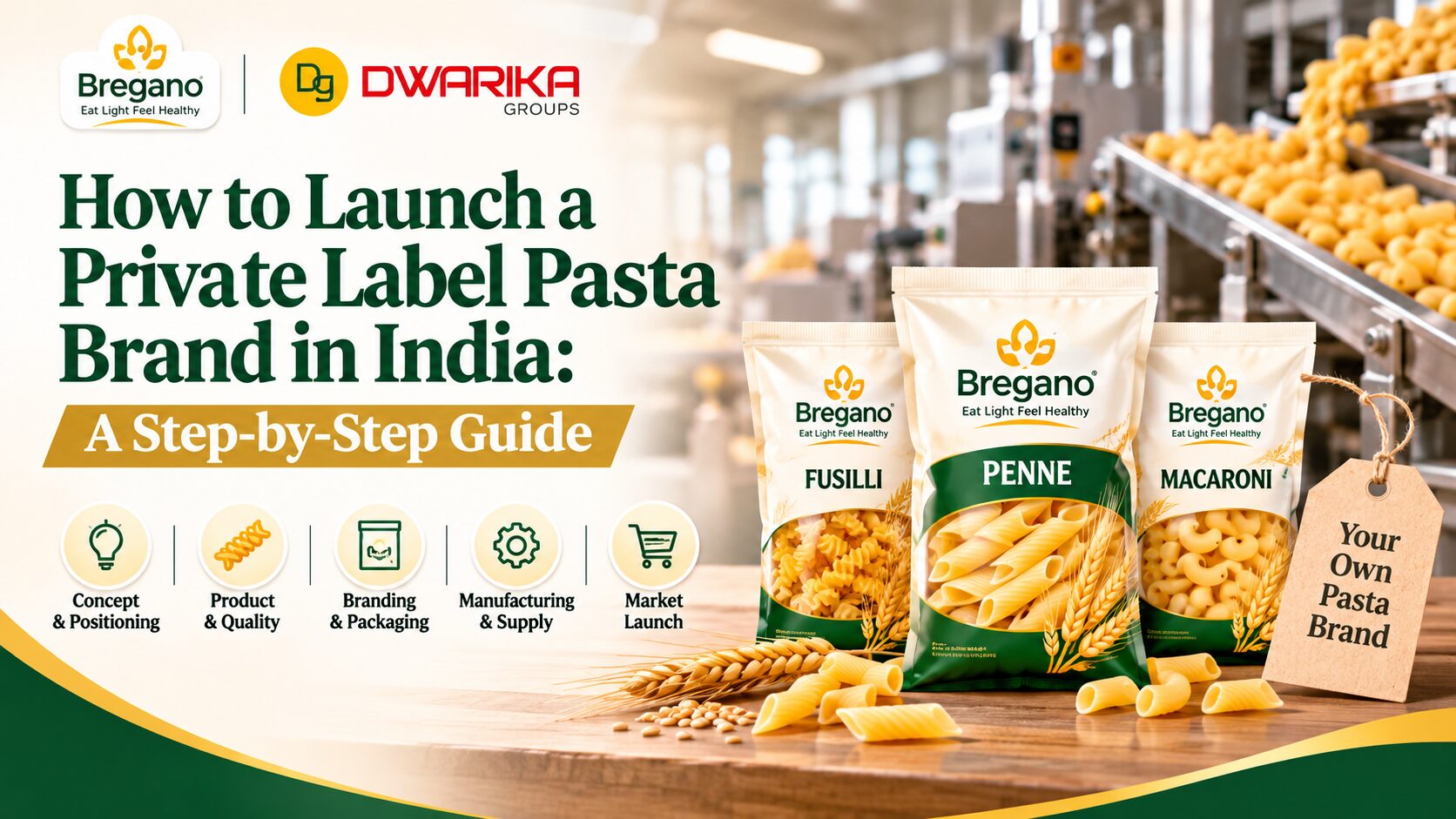
Many brands keep their launch range to three to five shapes. Common starting points are penne, fusilli and macaroni. Bregano’s short-cut pasta range, Penne Rigate, Fusilli and Macaroni, is made from 100% durum wheat semolina. See our pasta manufacturing page for the full range.
Bregano’s own retail packs are sold on Bregano Shop, Amazon and Flipkart: Penne Rigate (900 g), Fusilli (900 g) and Macaroni (900 g).
A smaller range keeps your minimum order quantities manageable and your shelf message clear.
Minimum order quantity (MOQ) depends on the shape, pack size and packaging type. Custom-printed packaging usually needs its own minimum, separate from the pasta itself.
Ask your manufacturer for:
Get these in writing before you finalise artwork.
Never skip sampling. Cook every sample the way your end customer will. Check cooking time, texture, shape retention and how it holds a sauce. For HoReCa buyers, also check how it behaves after holding and reheating.
Once approved, the sample becomes your reference standard for every future batch.
Your pack must meet FSSAI labelling rules and Legal Metrology requirements. It must carry details like ingredients, net quantity, nutrition information, batch number, best-before date, and the FSSAI licence numbers that apply. Our FSSAI labelling checklist for private label pasta covers the full list.
Three points brands often miss on a private label pack:
Agree with your manufacturer who prints the packaging and who holds the artwork files.
As a brand owner, you need your own FSSAI licence or registration, depending on your business size and activity. Your manufacturer needs its own manufacturing licence. Both licence numbers appear on the pack. Confirm the exact category with the FSSAI portal or a compliance consultant.
After approval, production is scheduled. Your manufacturer should share batch documents for each lot. Plan dispatch with your distributor or warehouse in advance, so stock does not sit idle.
An experienced pasta manufacturer in India can bring tested processes, existing shape dies and quality checks already in place. That can shorten your launch time and lower your risk on the first batch.
Bregano, backed by Dwarika Groups, manufactures pasta, vermicelli and staples, and offers private label production for food brands.
Bregano’s contract manufacturing page lists FSSAI, FSSC, HACCP and Halal certifications, and pasta production on PAVAN lines imported from Italy.
Can I start a pasta brand without a factory?
Yes. Private label manufacturing lets you sell under your brand while a manufacturer produces it.
How many pasta shapes should I launch with?
Many brands start with a small range, then add more shapes based on sales.
Do I need my own FSSAI licence for a private label brand?
Yes, the brand owner needs FSSAI registration or a licence based on the business type. Check the FSSAI portal for your category.
What is the difference between private label and contract manufacturing?
They are often used interchangeably. Both mean a manufacturer produces food that is sold under another company’s brand.
Planning your own pasta brand?