
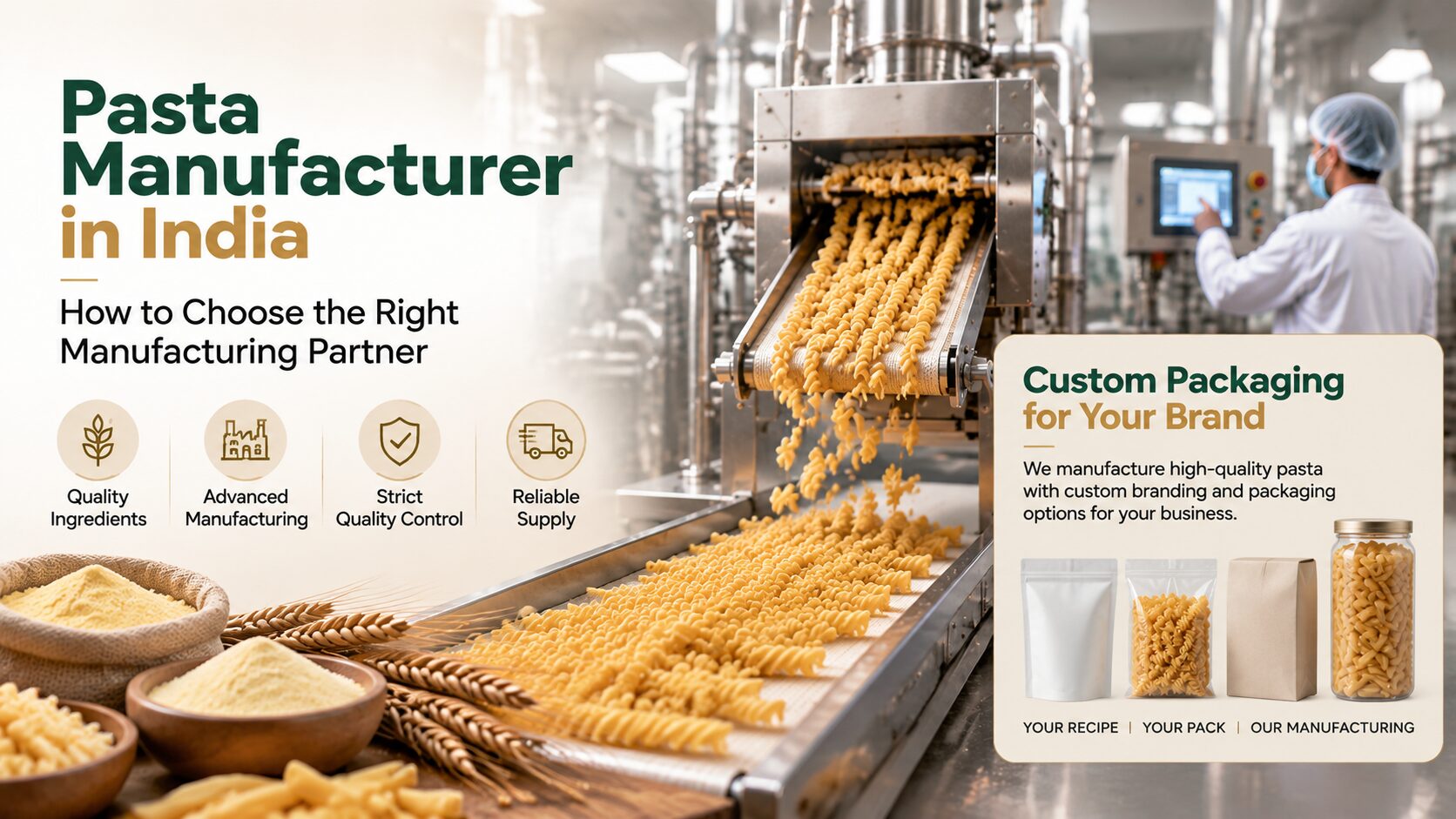
Choosing a pasta manufacturer in India is not a purchase decision. It is a partnership decision. Learn more about our Bregano food manufacturing capabilities and how we support B2B food partnerships.
If you are building a retail brand, taking on a distributorship, supplying supermarkets or exporting, the manufacturer behind your product controls three things you cannot control yourself: consistency of quality, reliability of supply, and your final landed cost. Get the partner right and your brand grows quietly in the background. Get it wrong and you spend the next two years handling customer complaints, delayed dispatches and margin leakage.
The problem is that most buyers start their search on a B2B directory, collect ten phone numbers, and compare on price alone. Price is the easiest thing to compare and the least useful. Two suppliers can quote the same rate per kilogram and deliver completely different products, because the raw material, the drying process and the quality control behind those two quotes are not the same.
This guide walks through what actually separates a reliable pasta manufacturer in India from a trading company with a website. It is written for people who buy in tonnes, not kilograms.
Before you evaluate anyone, establish what kind of business you are talking to. Many listings that appear under “pasta manufacturers in India” are not manufacturers at all.
A trader can be useful if you need small, mixed quantities quickly. But if you are placing repeat orders in tonnes, working with a pasta manufacturer and supplier in India who owns the plant removes an entire layer of cost and an entire layer of excuses.
Quick way to check: ask for the manufacturing address on the FSSAI licence and compare it with the address on the invoice. Ask what the daily production capacity is. Ask if you can visit. A genuine pasta manufacturing company in India answers all three without hesitation.
This is the single biggest quality variable and the one most buyers skip.
Good dry pasta is made from durum wheat semolina, which Indian buyers know as suji. Cheaper pasta is made from maida, or from a semolina base heavily cut with refined flour. The difference does not show on the shelf. It shows in the customer’s kitchen.
Pasta made with proper durum wheat semolina holds its shape after boiling, stays firm rather than turning mushy, and does not release cloudy starch into the water. Maida heavy pasta sticks together, breaks in the pack, and comes back as a complaint.
Ask directly: what percentage of the recipe is durum wheat semolina, and where is that semolina sourced from. If the answer is vague, that vagueness will end up in your product. A manufacturer that mills its own semolina can answer this in one sentence.
IMAGE 2 File: durum-wheat-semolina-suji-pasta-raw-material.jpg Alt text: Durum wheat semolina, the suji raw material used to make 100 percent semolina pasta with no maida Caption: Durum wheat semolina. Everything about the finished pasta starts here.
Capacity is not just about whether they can fill your first order. It is about whether they can fill your order in month eighteen when your distributor network has tripled.
A large scale pasta manufacturer in India should be able to tell you daily output in metric tons, how many shifts they run, and what their peak season load looks like. Festival months and export order cycles put real pressure on food plants. Ask what happened the last time they were at full capacity and a customer needed an urgent dispatch.
For a bulk pasta manufacturer relationship, also ask about buffer stock policy. A manufacturer who holds finished goods inventory of fast moving SKUs can service you in days rather than weeks.
The non negotiable baseline for any food manufacturer in India:
Beyond the baseline, look for evidence that the plant runs on documented process rather than individual judgement. Good Manufacturing Practice and Good Hygiene Practice certification covers this at plant level. If you plan to supply modern trade or supermarket chains, food safety certification becomes a procurement requirement rather than a nice to have, so confirm what the manufacturer holds and what they are audited on.
Ask for copies. A serious manufacturer has them ready as a standard document pack.
Anyone can produce one good batch. The question is whether batch forty looks and cooks like batch one.
If you can, get samples from two different production dates and cook them side by side. Colour, cooking time and firmness should be indistinguishable.
If you are building your own brand, this section decides everything. A manufacturer set up for private label pasta manufacturing should be able to handle:
private label pasta manufacturing
Ask who arranges the packaging material, who owns the design files, and what the lead time is for a new label. Ask what happens to leftover printed packaging if you change your design. These are the details that create disputes later.
MOQ is usually treated as an obstacle. It is better treated as information.
A very low MOQ often means the supplier is trading, repacking or running a small unit, which is fine if that matches your volume. A higher MOQ means the plant is set up for continuous industrial runs and prices accordingly. Neither is automatically better. What matters is whether the number matches your actual offtake plan.
Buying more than you can move inside a shelf life cycle is a costlier mistake than paying slightly more per kilogram. Equally, splitting tiny orders across a large plant will always cost you more per unit than consolidating.
Dry pasta is light and bulky, which means freight is a real component of your landed cost, not a rounding error.
A manufacturer located near your distribution territory can save you more in freight than a distant supplier saves you on unit price. For buyers serving North India, a plant in the Uttarakhand industrial belt sits close to the Delhi NCR, Uttar Pradesh, Punjab and Haryana corridors.
The least technical check, and the one that predicts the relationship best.
How quickly did they respond to your first enquiry? Did they send a proper quotation with written specifications, or a price on WhatsApp? Do you have a single point of contact for your account? What are the payment terms, and are they on paper?
A B2B pasta manufacturer who is disciplined about paperwork before you place an order will be disciplined about dispatch after you place one.
The right manufacturing partner depends on what you are trying to build.
Launching a retail brand: private label capability, packaging flexibility and design support matter most. You need a partner who can start you at a manageable volume and scale with you, not one who treats your first order as an inconvenience.
Taking a distributorship: consistency and supply reliability matter most. Your retailers will not tolerate stockouts, and your margin depends on predictable landed cost. Ask about territory support and dispatch schedules.
Supplying supermarkets: compliance is the gate. You must clear vendor audits, provide correct labelling, meet barcode and shelf life requirements, and show documented food safety practice. Confirm all of this before you pitch the chain, not after.
Exporting: documentation capability, export packaging standards and HS code familiarity become as important as the product. Dry pasta falls under HS heading 1902, commonly declared as 19021900.
HORECA and institutional supply: bulk pack formats, cooking yield consistency and volume pricing drive the decision.
None of these is automatically disqualifying on its own. Two or more together usually are.
Everything above is a checklist. Here is how Bregano answers it.
IMAGE 3 File: bregano-manufacturing-facility-rudrapur-uttarakhand.jpg Alt text: The Bregano manufacturing facility spread across seven acres in Rudrapur, Udham Singh Nagar, Uttarakhand Caption: The Bregano plant, Rudrapur, Udham Singh Nagar, Uttarakhand.
Who we are. The Dwarika Group began in 1992 as a small atta chakki in Rudrapur, Uttarakhand, milling wheat for local customers. Under the leadership of Mr. Balram Agarwal the group moved into large scale flour milling, and in 2019 launched Bregano as its own food brand. We did not start as a pasta company that bought a mill. We started as millers who moved into pasta, which is why the raw material conversation is the one we are most comfortable having. You can read the full story on our About page.
Raw material. Our pasta is made from 100% durum wheat semolina. No maida, no blend, no filler. We say this in one line because we can. Grain handling and semolina milling sit inside the same group, so the input to our pasta lines is controlled by us rather than bought on the open market batch by batch.
Plant and process. A fully automated facility spread across seven acres in Rudrapur, Udham Singh Nagar, Uttarakhand, running Italian pasta technology through extrusion, controlled drying and automated packing. The location puts us within a short haul of the Delhi NCR, Uttar Pradesh, Punjab, Haryana and Uttarakhand distribution belts.
Certification. FSSAI licensed, with GMP and GHP certified manufacturing and hygiene practice. Documentation pack available to serious enquiries before sampling.
Range. Pasta in penne, fusilli, macaroni and other shapes, plus vermicelli and roasted vermicelli, sooji, dalia, atta, besan, poha, soya products and condiments. A single plant covering the pasta and staples basket means fewer vendors on your purchase order. Full list on our Products page.
Contract manufacturing track record. Alongside our own brand, we manufacture under private label for established Indian retail and FMCG names. Existing client references can be shared under NDA once an enquiry is qualified.
How we work with you. Because we manufacture in house, you deal directly with the production unit. Specifications, quality queries and dispatch schedules go to one place. There is no trading layer in between. B2B engagements start at 10 metric tons and move up through 25 MT, 50 MT and above, across wholesale, distribution, private labelling and export requirements.
And the checks you should run on us. Ask us for the FSSAI licence and match the address. Ask for a plant video or book a visit. Ask for samples from two different production dates. We would rather you asked.
How do I verify if a pasta manufacturer in India is genuine?
Ask for the FSSAI manufacturing licence and check that the address on it matches both the plant address and the invoice address. Request a plant visit or a video walkthrough. Ask for daily production capacity in metric tons and for samples drawn from two different production dates so you can compare colour, cooking time and firmness.
What is the minimum order quantity for a bulk pasta manufacturer in India?
MOQ varies with the manufacturer, the pack format and whether you need standard packing or custom private label packing. Small units may accept one or two tons, while plants set up for industrial runs usually quote higher. At Bregano, B2B enquiries start from 10 metric tons and move up through 25 MT, 50 MT and above.
What is the difference between a pasta manufacturer and a pasta supplier in India?
A manufacturer owns the production unit and controls the raw material and the process. A supplier may simply be reselling another company’s output. Many businesses describe themselves as a pasta manufacturer and supplier in India, meaning they manufacture and also handle distribution. Check the FSSAI manufacturing licence to confirm which applies.
Can a pasta manufacturer in India produce under my own brand name?
Yes. This is called private labelling. The manufacturer produces to your specification and packs the product in your branding, carrying your brand name, your FSSAI number and your nutritional panel. Confirm artwork responsibility, pack sizes, lead times and what happens to leftover printed packaging before you start. Details are available on our Private Labelling page.
Which raw material should a good pasta manufacturer use?
Durum wheat semolina, known in India as suji. Semolina gives dry pasta its firm bite and stops it turning soft or sticky after boiling. Pasta made largely from maida is cheaper to produce but performs poorly in the customer’s kitchen and generates returns.
What certifications should I check before selecting a pasta manufacturing company in India?
At minimum a valid FSSAI manufacturing licence, GST registration matching the billing entity, and Legal Metrology compliant packaging declarations. Good manufacturing and hygiene practice certification such as GMP and GHP shows the plant runs on documented process. For supermarket supply or export, buyers often ask for food safety certification and an IEC code.
Can I get pasta manufactured for distribution in my territory?
Yes. Manufacturers regularly work with distributors on territory based arrangements. Agree on expected monthly offtake, pricing slabs, dispatch schedules and territory protection before finalising, and confirm the buffer stock policy for your fast moving SKUs.
Which HS code applies to dry pasta exports from India?
Dry uncooked pasta without meat or stuffing falls under HS heading 1902, commonly declared as 19021900. Confirm the exact sub heading with your customs broker for your specific product and destination market. Exporters can also review guidance from Indian Trade Portal before shipping.
The right pasta manufacturer in India for you is the one whose scale matches your ambition, whose raw material you are comfortable putting your brand name on, and whose paperwork is in order before you ask for it.
Check the semolina. Check the capacity. Check the certifications. Check batch to batch consistency. It is far cheaper to run these checks now than to change manufacturers after your brand is already on the shelf.
IMAGE 4 File: bregano-pasta-range-penne-fusilli-macaroni-vermicelli.jpg Alt text: Bregano product range showing penne, fusilli, macaroni and vermicelli packs made from 100 percent semolina Caption: The Bregano range, produced for our own brand and for partner brands under private label.
Share your product, estimated quantity and purpose through our enquiry form and our team will come back with specifications and commercial terms. Enquiries start from 10 metric tons.