
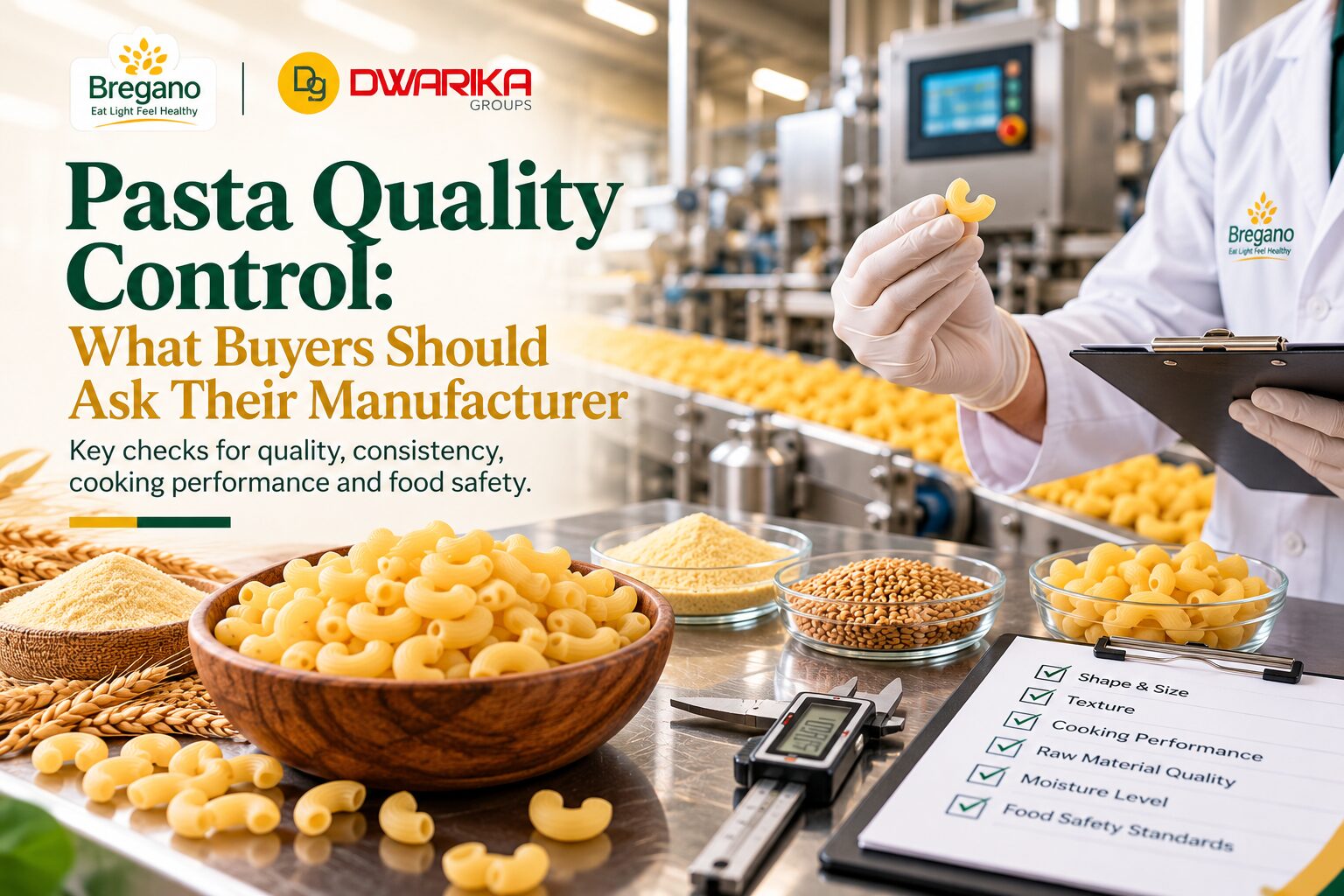
When you source pasta for your brand, shelves or kitchen, you are trusting someone else’s plant with your reputation. One bad batch, whether broken pieces, uneven cooking or a labelling error, can mean returns, poor reviews and lost customers.
Good pasta quality control prevents that. This guide explains why quality control matters, where checks happen in a pasta manufacturing plant, the quality parameters that matter, the questions to ask, the documents to request, how to read a lab report, what to look for on a plant visit, how to set up a quality agreement and the red flags to watch for.
If you are new to how pasta is produced, start with our guide on how pasta is made. It explains each stage that quality control checks.
Quality problems rarely stay small. A single inconsistent batch can affect your business in several ways:
That’s why it pays to understand how your manufacturer controls quality before you place an order.
Every buyer cares about safety and consistency, but each one feels quality problems in a different place.
| Buyer | Where quality problems hurt most | What to focus on |
|---|---|---|
| Private label brands | Reviews, returns and label compliance under your own name | Specifications, approved samples, label sign-off and change control |
| Distributors and wholesalers | Retailer complaints and stock that won’t move | Batch consistency, packaging strength and traceability |
| Retailers and quick commerce | Damaged packs and listing issues | Seal quality, label accuracy and best-before dates |
| Restaurants, cafés and caterers | Inconsistent cooking during service | Cooking time, holding performance and shape retention |
| Institutional kitchens | Large-batch failures and supply gaps | Bulk consistency, delivery reliability and complaint handling |
If you buy in volume, our guide to buying pasta in bulk covers the commercial side of sourcing in more detail.
Quality control is not a single test at the end. In a well-run plant, checks happen at every stage.
| Stage | What is typically checked |
|---|---|
| Raw material receipt | Semolina moisture, colour, particle size, and freedom from foreign matter and pests |
| Mixing and extrusion | Water ratio, dough consistency, shape accuracy and surface finish |
| Drying | Temperature, humidity and final moisture of the pasta |
| Inspection | Colour, shape, broken or defective pieces, foreign matter |
| Packing | Net weight, seal quality and correct label details |
| Finished goods | Batch records, retained samples and cooking tests |
Two of these stages shape quality more than any other. Extrusion decides shape accuracy and surface finish, which our guide to the pasta extrusion process explains. Drying decides moisture, cracking and shelf life, covered in our guide to the pasta drying process.
Ask your manufacturer to walk you through what they check at each of these stages and how often.
When you agree a specification with a manufacturer, these are the parameters most worth defining. The exact limits depend on the product and should be agreed in writing, checked against the applicable FSSAI standards for your product category.
| Parameter | What it tells you | Why it matters to buyers |
|---|---|---|
| Moisture | How well the pasta was dried | Too much moisture shortens shelf life and invites spoilage |
| Colour | Raw material quality and process control | Uneven or dull colour signals inconsistent production |
| Broken pieces | Drying and handling quality | Broken pasta looks poor and cooks unevenly |
| Shape and size uniformity | Die condition and cutting accuracy | Uneven pieces cook at different speeds |
| Cooking time | How the pasta performs in the pot | Must match what is printed on the pack |
| Cooking loss | How much starch leaves the pasta during cooking | High loss means cloudy water and sticky pasta |
| Foreign matter | Cleaning, sieving and hygiene | Any foreign matter is a safety and reputation risk |
| Net weight | Packing accuracy | Short weight creates compliance risk under Legal Metrology rules |
You don’t need to be a food technologist to use this table. Ask your manufacturer which of these they measure, how often, and what limits they work to.
When something goes wrong, the defect often points to the stage where it started.
| Defect | Likely stage | Usual cause |
|---|---|---|
| Cracks and splitting | Drying | Surface dried much faster than the core |
| Excess broken pieces | Drying, packing or transport | Over-dried pasta, rough handling or weak packaging |
| White spots | Mixing or drying | Air in the dough or uneven drying |
| Rough or uneven surface | Extrusion | Worn dies, unstable pressure or dough consistency |
| Sticky or mushy cooking | Raw material or drying | Weak raw material, poor drying or high cooking loss |
| Pale or patchy colour | Raw material or drying | Inconsistent semolina or drying conditions |
| Foreign matter | Raw material or hygiene | Poor cleaning, sieving or pest control |
| Seal failures | Packing | Packing machine settings or film quality |
Sharing a defect photo and batch number with your manufacturer, and asking which stage they think caused it, is one of the quickest ways to see how seriously they take quality.
For more on choosing a supplier, read our guide on how to choose the right pasta manufacturing partner. If you are deciding whether to outsource at all, our guide to third-party food manufacturing compares outsourcing with building your own plant.
Before you sign, ask for copies of:
Check that the name and address on each certificate match the plant that will make your product.
A test report is only useful if you know what to check on it. When a manufacturer shares one, look for:
If a report is unclear, ask the manufacturer to explain it, or have a food compliance consultant review it before you rely on it.
If the manufacturer allows a visit, use it well. Look for:
If you are comparing several manufacturers, score each one from 1 to 5 on the same criteria. It keeps the decision objective and makes it easier to explain to partners or investors.
| Criterion | What a high score looks like |
|---|---|
| Licences and certificates | Valid, current and in the name of the actual plant |
| Raw material control | Clear sourcing and documented incoming checks |
| Process control | Controlled extrusion and drying, with records |
| Inspection and testing | Regular moisture, visual and cooking checks |
| Traceability | Every pack traceable to batch and raw material lot |
| Hygiene | Clean plant, trained staff, documented pest control |
| Transparency | Open answers, documents shared, plant visits allowed |
| Complaint handling | A clear, written process with defined timelines |
A supplier that scores well on transparency usually scores well on everything else, because it has nothing to hide.
A written quality agreement turns expectations into commitments. It should cover:
If you are working under a contract manufacturing or private label arrangement, these terms usually sit inside your main agreement. Our guides on contract pasta manufacturing and private label pasta manufacturing explain both models. If you are building a new brand from scratch, see our step-by-step guide to launching a private label FMCG food brand, and for products made to your own recipe, our guide to custom food product development.
Quality control doesn’t end at the factory gate. Run quick checks on every delivery:
Even good manufacturers have occasional problems. What matters is how quickly and fairly they are resolved. When you find an issue:
A manufacturer that responds with a clear investigation, rather than a quick denial, is one worth keeping.
One red flag doesn’t always mean a bad supplier, but several together are a reason to look elsewhere.
Bregano pasta is made by Dwarika Food Products in Rudrapur, Uttarakhand. Based on Bregano’s published information on its contract manufacturing page:
Brands and distributors are welcome to discuss quality requirements directly with the Bregano team. Call +91-9012143222, email sales@dwarikagroups.com, or enquire through the contract manufacturing page or the Become a Distributor page.
To try Bregano pasta first, order Penne, Fusilli or Macaroni from the Bregano online shop. For a closer look at one shape, see our guide for macaroni buyers.
Pasta quality is built at every stage, from semolina checks to sealed packs, and it is protected by clear agreements and regular checks on your side.
Ask the right questions, request the right documents, read test reports carefully, visit the plant if you can, and put quality expectations in writing. A manufacturer that welcomes these conversations is usually one you can rely on for the long term.
What is pasta quality control?
It is the set of checks a manufacturer runs from raw material to finished pack to make sure every batch meets agreed standards for safety, appearance and cooking performance.
What should I test when I receive pasta samples?
Check ingredients on the label, look for broken or discoloured pieces, cook samples as per the pack, and check how well the pasta holds its shape.
Which certifications should a pasta manufacturer have?
At minimum, a valid FSSAI licence. Many plants also hold food safety certifications such as HACCP, ISO 22000 or FSSC 22000. Ask for copies with validity dates.
How can I verify a manufacturer’s FSSAI licence?
Enter the licence number on the FoSCoS portal. It shows whether the licence is valid and the name and address it is registered to.
What quality parameters should a pasta specification include?
Common parameters include moisture, colour, broken pieces, shape uniformity, cooking time, cooking loss, foreign matter and net weight. Agree the limits for each in writing.
What causes white spots or cracks in pasta?
White spots are often linked to air in the dough or uneven drying. Cracks usually come from the surface drying much faster than the core.
Why is batch traceability important?
It lets the manufacturer trace any pack back to its production run and raw materials, which is essential for handling complaints or recalls.
What should a quality agreement include?
Product specifications, an approved reference sample, testing frequency, labelling responsibility, complaint handling, traceability and a rule that changes must be notified in advance.
Who is responsible for label accuracy in private label pasta?
The brand owner. The manufacturer can verify technical print parameters, but final legal sign-off on label declarations under FSSAI and Legal Metrology rules rests with the marketer whose brand is on the pack.
How do I know if a lab report is reliable?
Check that it comes from an accredited laboratory, matches the product and batch, is recent, shows results against limits, and carries a report number and authorised signature.
What should I check when a pasta delivery arrives?
Packaging condition, label details, appearance of a sample pack, a quick cooking test, and the batch number for your records.
Is a plant visit necessary before ordering?
It isn’t always possible, but a visit is one of the best ways to see hygiene, equipment and quality records first-hand.
How does Bregano check its pasta?
Bregano states that automated moisture, colour and shape inspection rejects defective pieces before packaging, on automated PAVAN lines.