Bregano is a food brand of the Dwarika Group, manufacturing pasta and staples from Rudrapur, Uttarakhand since 1992.
You do not need a factory to own a food brand.
That is the single idea behind private labelling, and it is why a significant share of the packaged pasta on Indian shelves today was not made by the company printed on the pack. It was made by a private label pasta manufacturer in India and packed under someone else’s brand name.
For a food brand, a D2C seller, a supermarket chain or a distributor who wants to stop selling other people’s products, this changes the maths completely. Instead of investing crores in a plant, machinery, FSSAI manufacturing compliance and a production team, you invest in your brand, your packaging and your distribution. The manufacturing happens behind the scenes.
This guide covers how private label pasta manufacturing in India actually works: the models, the process, the products you can put your name on, packaging, MOQ, costing and compliance.
If you are still at the stage of shortlisting and vetting plants, start with our guide on how to choose a pasta manufacturer in India, which covers semolina content, capacity, certifications and batch consistency in detail. This guide picks up from there and focuses on the private label journey itself.
These three terms get used interchangeably in India, and the confusion causes real commercial problems. Here is the practical distinction.
| Private label | White label | Contract / OEM | |
|---|---|---|---|
| Product | Made or customised for you | Existing generic product, your label on it | Made fully to your specification |
| Recipe control | Some, within the plant’s capability | None | Full |
| Exclusivity | Usually yours | Same product sold to others too | Yours |
| Setup time | Moderate | Fastest | Longest |
| MOQ | Medium to high | Lower | Highest |
| Best for | Brands wanting a differentiated product | Brands wanting speed to market | Brands with a specific formulation |
A white label pasta manufacturer relationship is the quickest way to get stock on the shelf, because the product already exists and only the packaging changes. An OEM arrangement gives you more control over shape, blend and specification, but takes longer and needs higher volume.
Most food brands in India start somewhere in the middle. They take the manufacturer’s proven recipe, choose their own pack sizes and design, and refine the specification once sales data comes in. That is the practical version of private labelling and it works.
The important part is agreeing which model you are in, in writing, before production starts. Ask one specific question: is this product exclusive to my brand, or is the same product being sold to other labels? The answer changes what you can legitimately claim in your marketing.
You skip the capital cost. A pasta plant means extruders, dryers, packing lines, warehouse space, an FSSAI manufacturing licence and a technical team. A private label food manufacturer partnership gets you a finished, compliant, packed product without any of it.
You go to market faster. Setting up your own unit is a multi year project once you account for land, machinery import, commissioning and licensing. Private labelling gets a launch ready SKU in weeks, once artwork and specifications are locked.
You keep margin where it belongs. When you sell someone else’s brand, you earn a distribution margin. When you sell your own, you earn the brand margin. On a repeat purchase category like pasta, that gap compounds every month.
You control the shelf. Your name, your design, your pricing, your positioning. In a category where most consumers cannot name three pasta brands, packaging does a large part of the selling.
You can test without betting the company. Launch two shapes, see what moves, expand what works. Trying that with your own factory means idle machinery on the SKUs that fail.
Here is what the process looks like from first enquiry to first dispatch.
Step 1: Requirement discussion. You share the products you want, estimated quantity, pack sizes and target market. The manufacturer confirms what is feasible and at what MOQ.
Step 2: Sampling. You receive samples of the base product. Cook them. Check firmness after boiling, whether the shape holds, water clarity and taste. If you are comparing manufacturers, cook the samples side by side on the same day.
Step 3: Specification lock. Recipe or blend, shape, pack size, net weight, shelf life and quality parameters get written down. This document is what you hold the manufacturer to later, so do not treat it casually.
Step 4: Artwork and packaging. You supply brand design. The manufacturer confirms it is print ready and legally compliant, including FSSAI declarations, net quantity, nutritional panel, ingredient list, veg mark, batch and date coding space, and barcode. Packaging material is then printed and delivered to the plant.
Step 5: Pilot batch. A first production run at limited volume. You approve the physical output, not just a mock up. Check print quality, seal integrity, fill weight and product appearance inside the pack.
Step 6: Commercial terms. Pricing slabs, payment terms, lead time, dispatch schedule and who bears freight get finalised.
Step 7: Full production and dispatch. Regular production runs against your purchase orders, with batch coding for traceability.
The whole cycle, from first conversation to first commercial dispatch, typically runs a few weeks. Packaging printing is usually the longest step, not the manufacturing. Plan your launch date backwards from the printing lead time, not from the production lead time.
A private label partnership is rarely limited to one product. Building a small range gives your brand better shelf presence and better distributor conversations than a single SKU.
Pasta shapes
Beyond pasta
If you are building a brand rather than a single product, a partner who can supply across these categories means one relationship, one set of commercial terms, one dispatch schedule, and better pricing as your combined volume grows.
Product quality keeps customers. Packaging gets you the first purchase. In pasta, where the product itself is largely invisible inside the pack, this is not a small point.
Pack sizes. Consumer packs typically run 250g, 500g and 1kg. Institutional and HORECA buyers need bulk formats. Decide sizes based on your channel, not on what looks nice.
Material. Barrier properties matter for dry pasta. Poor film means moisture ingress, and moisture means shortened shelf life and breakage in transit. Ask what material is being quoted and what its barrier rating is.
Mandatory declarations. Your pack must legally carry your brand’s FSSAI licence number, net quantity as required by the Legal Metrology (Packaged Commodities) Rules, ingredients, nutritional information, veg mark, manufacturer or packer details, MRP, batch number, and manufacturing and expiry dates. Getting this wrong means a recall, not a reprint.
Design responsibility. Clarify who creates the artwork, who owns the design files, who pays for printing plates, and what the minimum print quantity is. Printing MOQ is often higher than production MOQ, which surprises first time brands.
Barcode and shelf readiness. If you plan modern trade or e-commerce, register GS1 barcodes in your brand’s name from the start. Retrofitting barcodes after your first print run means reprinting.
Understanding MOQ. Minimum order quantity is information, not an obstacle. A lower MOQ suits a brand testing a market or running a small unit. A higher MOQ means the plant is set up for continuous industrial runs and prices accordingly. Neither is automatically better. What matters is whether the number matches what you can realistically sell inside the product’s shelf life.
Higher volume does bring your per unit cost down, which is what makes your retail price competitive against established brands. But overbuying to reach a lower per kilogram rate is the most common early mistake, and dead stock costs far more than the few rupees you saved.
Cost components to budget for:
A note on freight. Dry pasta is light and bulky, so freight is a real line item and not a rounding error. A plant closer to your primary market can save you more than a distant supplier saves you on unit price.
This is the part first time brand owners most often get wrong.
The manufacturer holds: the FSSAI manufacturing licence for the plant, plant level hygiene and manufacturing practice certification, and responsibility for producing to the locked specification.
You hold: an FSSAI licence or registration in your brand’s name, applied for through the FoSCoS portal, which must appear on the pack. Legal responsibility for the claims your packaging and marketing make. GS1 barcode registration in your brand’s name. Trademark protection for your brand name, which is separate from FSSAI and worth filing before you print.
Both of you should hold: a written specification sheet, agreed pricing slabs, and a documented process for what happens if a batch fails your quality check.
Who we are. The Dwarika Group began in 1992 as a small atta chakki in Rudrapur, Uttarakhand. Under the leadership of Mr. Balram Agarwal the group moved into large scale flour milling, and in 2019 launched Bregano as its own food brand. We started as millers and moved into pasta, not the other way round, which is why the raw material conversation is the one we are most comfortable having.
Raw material. Our pasta is made from 100% durum wheat semolina. No maida, no blend, no filler. Grain handling and semolina milling sit inside the same group, so the input to our pasta lines is controlled by us rather than bought on the open market batch by batch. For a brand owner, that means the one claim your customers will test in their own kitchen is a claim you can stand behind.
Plant and process. A fully automated facility spread across seven acres in Rudrapur, Udham Singh Nagar, Uttarakhand, running Italian pasta technology through extrusion, controlled drying and automated packing. The location sits within short haul distance of the Delhi NCR, Uttar Pradesh, Punjab, Haryana and Uttarakhand distribution belts.
Certification. FSSAI licensed, with GMP and GHP certified manufacturing and hygiene practice. Documentation pack shared with qualified enquiries before sampling.
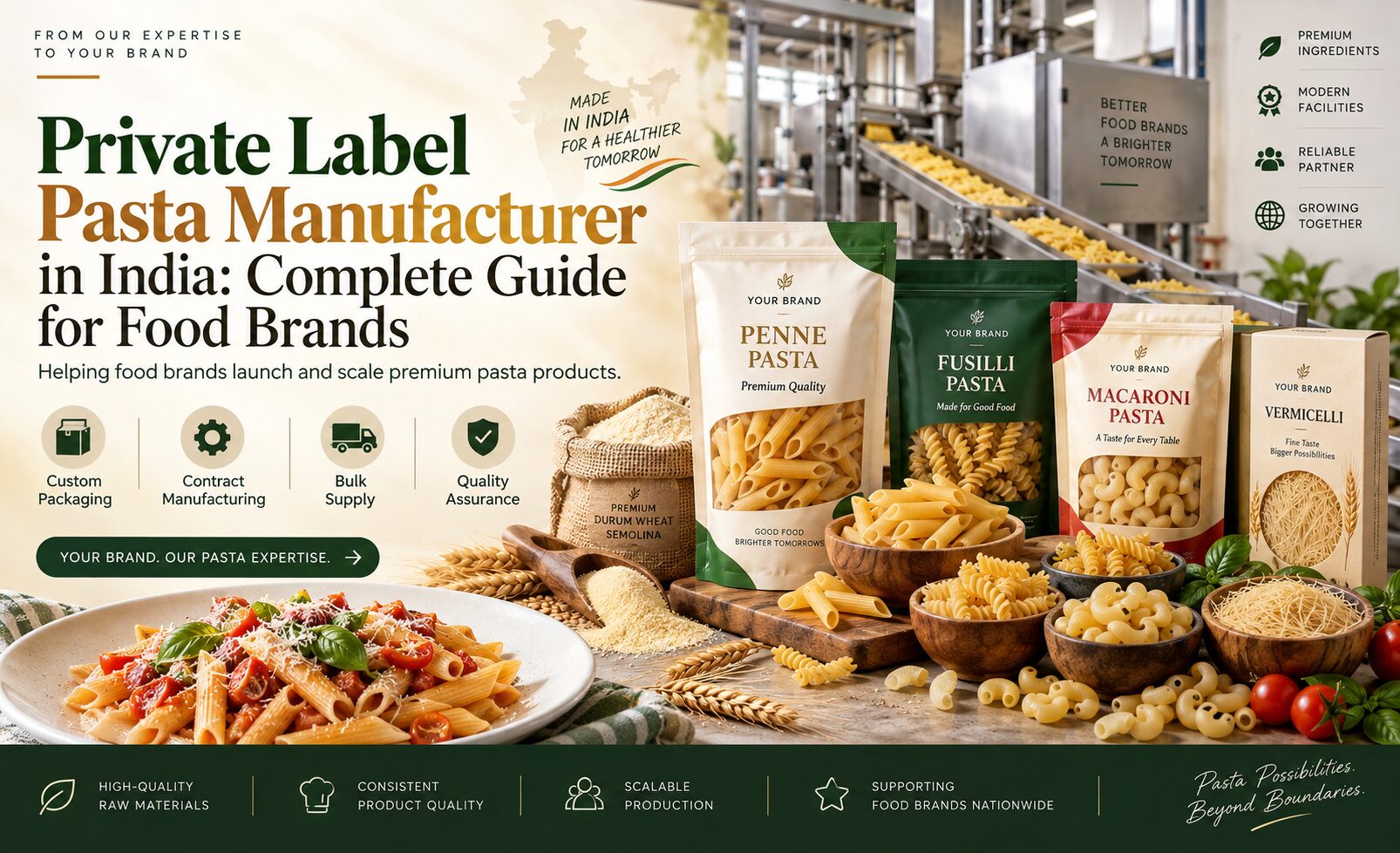
What you can private label. Pasta in penne, fusilli, macaroni and other shapes, plus vermicelli and roasted vermicelli, sooji, dalia, atta, besan, poha, soya products and condiments. One plant covering the pasta and staples basket means fewer vendors on your purchase order.
Private label track record. Alongside our own brand, we manufacture under private label for established Indian retail and FMCG names. Client references can be shared under NDA once an enquiry is qualified.
How we work. Because production is in house, you deal directly with the plant. Specification, quality and dispatch conversations happen in one place, without a trading layer in between. Private label engagements start from 10 metric tons, with slabs through 25 MT, 50 MT and above.
The checks you should run on us. Ask for the FSSAI licence and match the plant address. Ask for a plant video or book a visit. Ask for samples from two different production dates and cook them side by side. We would rather you asked.
How do I start a private label pasta brand in India?
Decide your product range and target channel, get an FSSAI licence in your brand’s name, shortlist and sample two or three manufacturers, lock your specification and pack sizes, get artwork designed and legally checked, approve a pilot batch, then place your first commercial order. Most brands go from first enquiry to first dispatch in a few weeks.
What is the minimum order quantity for private label pasta in India?
MOQ varies with the manufacturer, the pack format and whether you need standard or custom printed packing. Small units may accept one or two tons, while plants running continuous industrial lines usually quote higher. Match the number to what you can sell within shelf life rather than chasing the lowest per kilogram rate. At Bregano, private label enquiries start from 10 metric tons.
What is the difference between private label and white label pasta?
White label means an existing generic product gets your label on it, and the same product may be sold to other brands. Private label means the product is made or customised for your brand, usually with some exclusivity. Confirm in writing which arrangement applies before production, because it affects what you can claim in your marketing.
Do I need my own FSSAI licence for a private label pasta brand?
Yes. The manufacturer holds a manufacturing licence for the plant, but as the brand owner you need your own FSSAI registration or licence, and your number must appear on the pack. You are also responsible for the claims your packaging makes.
Can I get my own packaging design printed?
Yes. You supply the artwork and the manufacturer confirms it is print ready and legally compliant. Note that packaging printing usually carries its own minimum quantity, which can be higher than the production MOQ, and printing is normally the longest step in a first order.
Which pasta shapes can be private labelled?
Penne, fusilli, macaroni, shells and other standard shapes. Many brands also add vermicelli, dalia, besan, sooji and poha to build a fuller staples range under one manufacturing partner.
How long does private label pasta manufacturing take?
Sampling and specification take a few days. Packaging printing is usually the longest step. Once packaging is at the plant, production and dispatch move quickly. Plan for a few weeks end to end on a first order and shorter cycles on repeats.
Is private label pasta profitable in India?
It can be, because pasta is a repeat purchase category with steady household demand. Profitability depends on your landed cost, packaging cost, channel margins and how efficiently you move stock within shelf life. Build your costing before you commit to a volume.
How do I check that a private label pasta manufacturer is genuine?
Ask for the FSSAI manufacturing licence and match the plant address, ask for daily capacity in metric tons, and request samples from two different production dates. Our guide on choosing a pasta manufacturer in India covers the full vetting checklist.
Private labelling removes the hardest barrier in packaged food, which is the factory. What it does not remove is the need to choose your manufacturing partner carefully.
Check the semolina. Confirm they manufacture rather than trade. Get the specification written down. Run a pilot batch before full volume. Do these four things and most of what goes wrong in private label projects simply does not happen.
Share your product, estimated quantity and purpose through our enquiry form. Our team will come back with specifications, pack options and commercial terms. Enquiries start from 10 metric tons.