
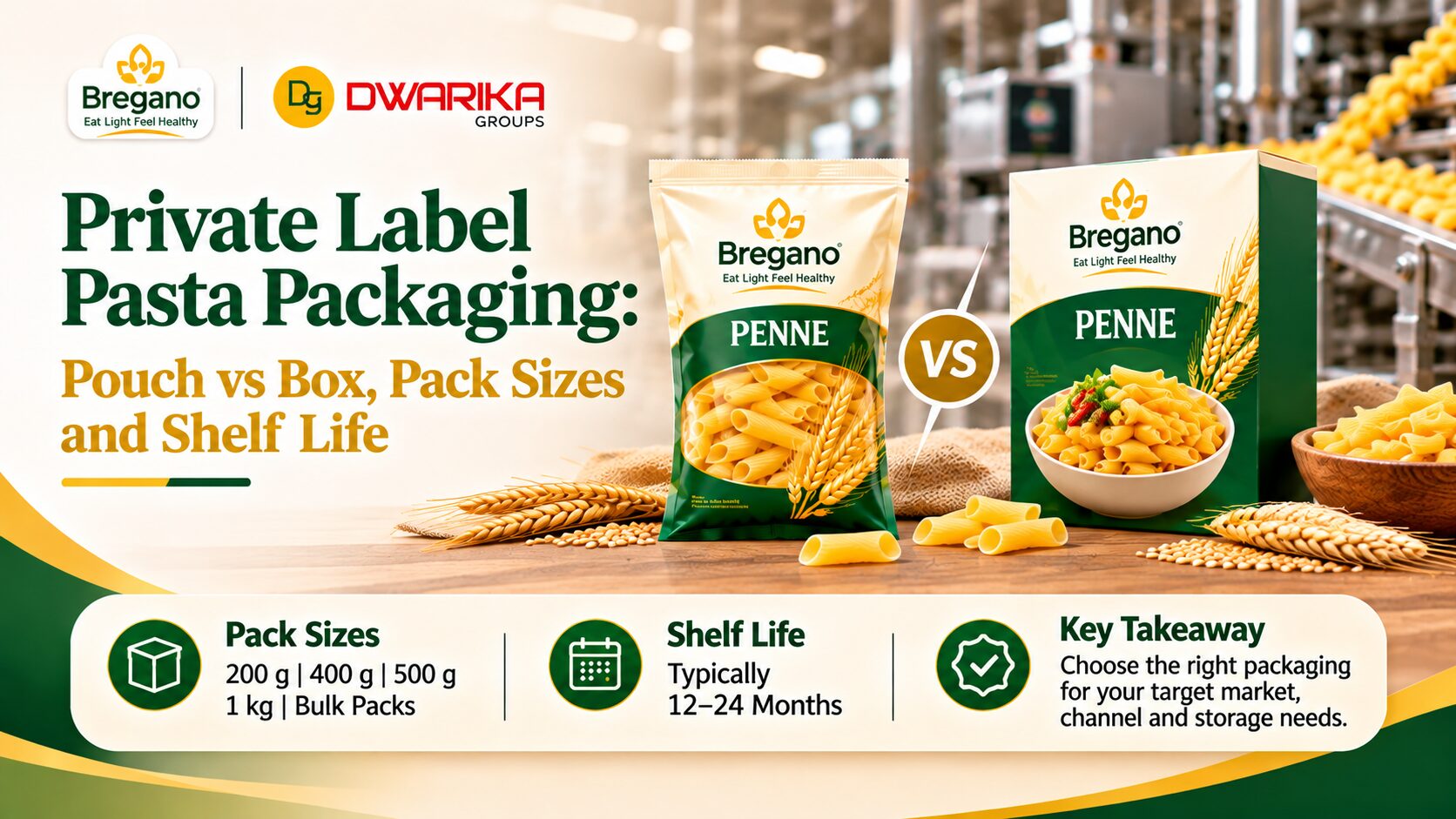
Your pasta might be excellent, but shoppers see the pack first. For a private label pasta brand, packaging decides shelf visibility, product protection and cost per unit. It also affects how long raw pasta stays in good condition.
Here is how to choose packaging that works for your channel and budget.
Dry pasta is a low-moisture product, so it stores well. But it still needs protection from:
Good packaging handles all four.
| Factor | Printed pouch (laminate) | Carton box |
|---|---|---|
| Cost per unit | Usually lower | Usually higher |
| Shelf look | Flexible, can have a window | Stands upright, premium feel |
| Breakage protection | Moderate | Better for long or fragile shapes |
| Moisture barrier | Depends on laminate layers | Usually needs an inner liner |
| Storage space | Compact | Bulkier |
| Suited to | Kirana, quick-commerce, value packs | Modern trade, gifting, premium range |
Printed pouches are commonly used for short-cut pasta in India. Boxes are often chosen for long pasta and premium ranges.
Pack size should match how your buyer shops.
Ask your manufacturer which pack sizes they already run. Using existing formats often lowers MOQ and speeds up your first order.
A clear window lets buyers see the pasta’s colour and shape. That builds trust, especially for a new brand. The trade-off: the product is exposed to light, and the window area reduces space for branding. If you use a window, keep it small and place it where it does not weaken the pack.
Shelf life is not a number to copy from another brand. It depends on:
Your best-before date must be backed by shelf-life testing on your product in your chosen packaging. Change the pack material and you should re-test.
Before artwork is final, check three legal details:
This varies. Some brands supply their own printed packaging. Others ask the manufacturer to source it. Agree on this early, along with who owns the artwork and printing cylinders.
Bregano’s private label service supports brands with custom packaging for their pasta range.
For reference, Bregano sells its own pasta in 900 g retail packs, such as Penne Rigate, Fusilli and Macaroni on Flipkart. The full range is on Bregano Shop and Amazon.
Which packaging is most common for pasta in India?
Printed laminated pouches are widely used for short pasta shapes.
How long does dry pasta last?
It depends on moisture, packaging and storage. Your shelf life must be confirmed by testing your own product.
Can I use a window on my pasta pouch?
Yes. It helps buyers see the product, but reduces branding space and exposes pasta to light.
Do bulk HoReCa packs need full retail labelling?
Labelling requirements differ for retail and non-retail packs. Check the FSSAI regulations for your pack type.
Want custom packaging for your pasta brand?