
You follow the recipe. You measure the water. You keep an eye on the clock. And it still turns into paste.
This happens to enough people that it has become one of the more quietly frustrating cooking experiences in the Indian kitchen. Vermicelli upma that looked perfect in the pan turns to mush the moment it sits for five minutes. Or it comes out sticky and clumped straight from cooking, no matter what you try.
Here is the honest answer: in most cases, this is not a cooking failure. It is either an ingredient problem or one of three specific technique mistakes. Fix those, and the problem disappears permanently.
This guide goes through both. The ingredient side first, because that is where most people do not look. Then the technique side, with every specific mistake and its exact fix.
Before technique gets any credit or blame, the raw material matters enormously.
Most vermicelli sold in India, particularly at the cheaper end of the market, is made from maida: refined wheat flour. Maida is fine, white, and soft. It makes an acceptable noodle for some applications. But it is genuinely the wrong flour for upma-style cooking.
Here is what happens at the molecular level when maida-based vermicelli hits boiling water. Maida has low protein content, typically around 7 to 9 grams per 100 grams of the raw flour. Protein is what forms gluten, and gluten is the structural network that holds the strand together under heat and moisture stress. Low protein means a weak gluten network. Weak gluten cannot hold the strand shape as water penetrates it. The starch swells, the structure gives way, and you get paste instead of firm strands.
Quality vermicelli made from durum wheat semolina behaves completely differently. Durum wheat is a hard wheat variety with significantly higher protein content. The stronger gluten network it forms can withstand heat and moisture. The strands cook through without losing structural integrity. The result is firm, separate, non-sticky vermicelli even after it has been sitting for a few minutes.
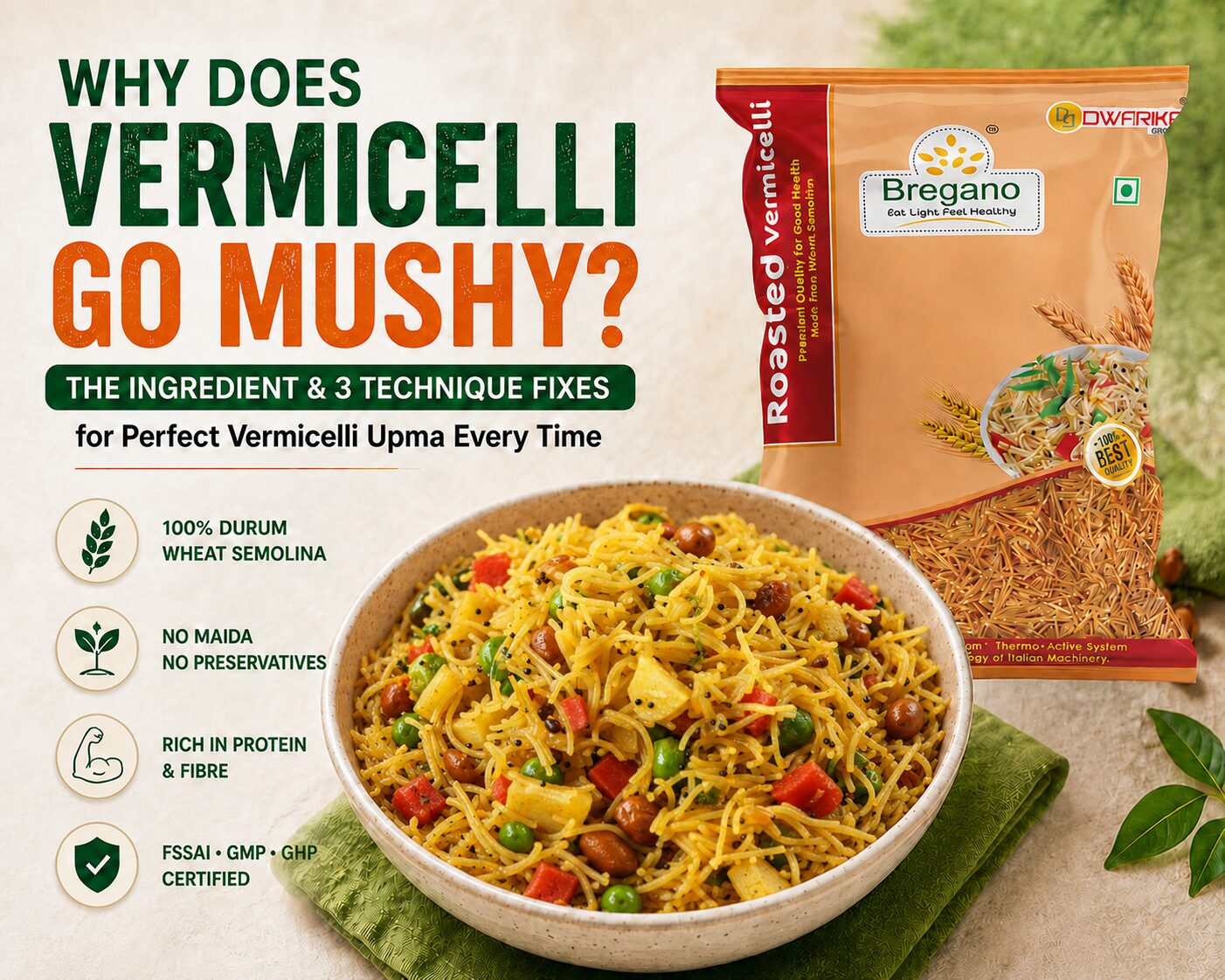
RoaBregano sted Vermicelli is made from 100% durum wheat semolina, not maida or refined flour. That single ingredient distinction is the reason quality-minded cooks who switch brands stop having the mushy vermicelli problem. Not because they learned a new technique. Because the ingredient underneath the technique finally cooperated.
Additionally, Bregano’s vermicelli is pre-roasted to a golden perfection before it reaches your kitchen. This pre-roasting matters. Dry heat applied to the vermicelli before packaging deepens flavour (a mild nuttiness develops) and further stabilises the surface of the strands. Roasted strands absorb cooking liquid more slowly and evenly than raw strands, which is part of why roasting, whether done before purchase or at home in a pan, is essential for texture control.
Even good-quality semolina vermicelli can be ruined by technique. These are the three most common errors.
This is the most common mistake and the one with the most dramatic impact.
Raw, unroasted vermicelli is surface-wet in a way that roasted vermicelli is not. When it enters a pan with oil and tempering, it immediately begins absorbing moisture from the steam in the pan. By the time you add water, the strands have already softened unevenly. Some parts are partially cooked, some are barely affected. The result is inconsistent texture and clumping.
Roasting drives off surface moisture and creates a slightly sealed, golden surface on each strand. That surface slows down water absorption, giving you more control. The strands take in water uniformly and gradually, cooking evenly rather than collapsing at the first touch of liquid.
The fix: always roast the vermicelli if it is not pre-roasted, to avoid stickiness. If using Bregano Roasted Vermicelli, this step is already done before the pack is sealed. If using any other brand where you are unsure, dry roast in a pan on medium heat, stirring continuously, until the strands are a uniform light golden colour with a faint nutty smell. This takes two to four minutes. Do not skip it.
One more point on roasting from Bregano’s recipe guide: ensure the vermicelli is evenly roasted to a golden brown to enhance its flavour and prevent it from becoming mushy. Uneven roasting, where some strands are golden and others are still pale, creates uneven cooking later. The pale strands absorb water faster than the golden ones and go mushy first.
This is the easiest mistake to make because it feels intuitive to add more water when you are worried the dish is drying out.
The correct ratio is: 2 cups of water for every 1 cup of vermicelli when adding vegetables. This is stated directly in Bregano’s cooking guide and it is the ratio that produces cooked-through, firm, separate strands.
What happens with too much water: the strands cook through before the water is absorbed. They sit in liquid after they are done and continue softening. Ten minutes of extra simmering in excess water turns firm strands into mush. The dish also becomes waterlogged rather than fluffy.
What happens with too little water: the strands cook unevenly. The outside softens and the centre stays slightly raw. Or the bottom burns while the top is undercooked.
The 2:1 ratio (water to dry vermicelli, with vegetables) accounts for the steam that vegetables release during cooking. If cooking vermicelli with no vegetables at all, use slightly less, closer to 1.75 cups per cup of dry vermicelli.
The fix is simply to measure. Do not eyeball water when cooking vermicelli. The difference between correct texture and paste is sometimes just 50 to 100 millilitres of extra water.
Use exact water ratio to keep it fluffy, not mushy. This is one of the most practical cooking tips on Bregano’s official page, and it deserves more emphasis than it typically gets in recipe guides.
After the water goes in, two things happen that people instinctively do wrong.
The first is cranking up the heat to speed cooking. High heat after adding water causes the bottom layer to cook and stick while the top layer has not yet absorbed enough liquid. The cook panics and stirs aggressively. This breaks the strands, releases more starch from the broken ends, and accelerates mushiness.
The second is over-stirring. Every time you stir vermicelli while it is cooking in liquid, you agitate the strands and cause strand-to-strand friction. Starch that has been released from the strands during cooking acts as glue. More agitation means more glue. The dish becomes sticky and dense rather than fluffy and separate.
The fix for heat: add water, stir once gently to distribute evenly, then reduce the heat to low. Cover the pan. Let it cook undisturbed. The steam inside the covered pan does the work. Cook the vermicelli on a low flame and avoid stirring too often to maintain its delicate structure. This approach, confirmed by Bregano’s recipe instructions, is the correct technique.
The fix for stirring: after adding vermicelli and water, one gentle stir to distribute, then leave it alone. Check once at the 8-minute mark by lifting a corner with a spoon to see if water is absorbed. If not, cover again and check at 10 minutes. Do not stir in between.
You need a reference point, because the difference between correct texture and slightly mushy is sometimes hard to articulate.
Perfect vermicelli upma: the strands are separate and identifiable. When you scoop it with a spoon, it mounds rather than slides. The strands have a slight firmness when you press them between your fingers but no raw or hard center. The surface looks slightly dry rather than wet or glistening. When you let a scoop fall back into the pan, it does not splat.
Mushy vermicelli: the strands have merged into each other and are hard to separate. The texture is uniform and paste-like. It presses flat under a spoon rather than holding a shape. The surface is wet-looking. When it cools even slightly, it sets into a dense block.
If your vermicelli is consistently landing in the second description, the ingredient is the first thing to check. Then the technique.
Here is a practical diagnostic.
Make a batch of vermicelli upma. Eat your portion immediately. Cover the rest and put it in the fridge. Take it out the next morning.
Quality semolina vermicelli that was cooked correctly will be refrigerator-cold and slightly firmer, but still recognisably separate strands. Reheat with a splash of water in the morning and it recovers well. Can I prepare this the night before? Yes. Store in the fridge and reheat with a splash of water in the morning. This is confirmed on Bregano’s website as a tested and recommended approach.
Maida-based vermicelli that was cooked even correctly will have set into a single congealed mass in the fridge. Reheating does not restore it. It just makes the paste warm.
This overnight test is the clearest signal of ingredient quality. It removes technique from the equation entirely. If it sets solid in the fridge, the raw material was not good enough.
This is the recipe with every technique point applied correctly.
One cup Bregano Roasted Vermicelli Two cups water Two tablespoons oil or ghee Half a teaspoon mustard seeds Half a teaspoon cumin seeds Two tablespoons raw peanuts One sprig curry leaves Two green chillies, slit One medium onion, finely chopped One medium tomato, chopped Half a cup mixed vegetables: carrot, peas, beans, finely chopped Half a teaspoon turmeric powder Salt to taste Half a lemon Fresh coriander for garnish
Step 1: Since Bregano Roasted Vermicelli is already pre-roasted, no dry-roasting step is needed. Set the pack aside.
Step 2: Heat oil in a wide, heavy-bottomed pan on medium heat. Add mustard seeds and wait for them to pop fully. Add cumin seeds, peanuts, curry leaves, and green chillies. Sauté until peanuts are golden, about two minutes.
Step 3: Add onions. Sauté on medium heat until translucent and beginning to colour at the edges, about four minutes. Add tomato, stir, cook two minutes.
Step 4: Add the finely chopped vegetables and a small splash of water, about two tablespoons. Cover and cook for six to seven minutes until vegetables are just tender.
Step 5: Add turmeric and salt. Stir to coat the vegetables.
Step 6: Add the Bregano Roasted Vermicelli. Stir gently once to mix with the vegetables and tempering.
Step 7: Pour in exactly two cups of water. Stir once, gently. Reduce heat to low. Cover the pan.
Step 8: Cook on low for ten minutes without lifting the lid. At ten minutes, lift the lid and check: the water should be fully absorbed and the surface should look dry. If there is still visible water, cover for two more minutes.
Step 9: Remove from heat. Squeeze lemon juice over the top. Garnish with coriander. Serve immediately.
Add extras like bell peppers, corn, or tofu for variety and nutrition. Stir in paneer cubes for added protein. Substitute vegetable stock for water for a richer flavour. These are all validated additions from Bregano’s recipe guidance.
This is worth saying directly rather than dancing around it.
Maida vermicelli is cheaper for a reason. The raw material costs less. The manufacturing is simpler. The shelf appeal is sometimes better because the strands are very white and uniform-looking. But in the pan, it will keep failing the texture test regardless of how carefully you follow technique.
When you look for vermicelli in a shop or online, the check is the same one that applies to pasta: flip the pack and read the first ingredient. If it says durum wheat semolina or hard wheat semolina, the structural protein is there to support good texture. If it says wheat flour, refined wheat flour, or maida, the structure is not.
For quality range reference: quality range is approximately Rs 40 to 80 per 400 grams. Below Rs 30 per 400 grams is likely poor quality maida. This benchmark from Bregano’s website is a useful anchor for price-to-quality expectations.
Everything below is taken directly from bregano.in.
Made from 100% durum wheat semolina (sooji), not maida or refined flour. Roasted to perfection, providing a delightful, nutty flavour. Contains no preservatives, additives, or trans fats. Tasty and nutritious: rich in protein and fibre. Versatile: can be used in both sweet and savoury dishes, such as desserts, breakfast, or as a side dish. SMART SNACK: best partner for mid-night hunger pangs, evening snack, instant brunch and exotic delicacies. SWEET CELEBRATION: perfect partner for happy and auspicious moments with kheer, pongal, and sweets.
Pack sizes: 400 grams and 860 grams.
Certifications: FSSAI, GMP, GHP.
Part of Dwarika Group, food manufacturing since 1992. Bregano launched in 2019. 7-acre fully automated facility in Rudrapur, Uttarakhand.
Where to buy: shop.bregano.in, Amazon, Flipkart, JioMart. Follow @breganoproducts on Instagram for recipes and tips.
Why does my vermicelli always turn mushy?
There are two root causes. Either the vermicelli is made from maida (refined wheat flour), which has low protein and a weak gluten structure that cannot hold under heat and moisture. Or one of three technique mistakes is present: skipping roasting, using too much water, or cooking on high heat with excessive stirring. Check the ingredient list first. If it says wheat flour rather than durum wheat semolina, switching brands is the most effective fix.
What is the correct water ratio for vermicelli upma?
Use 2 cups of water for every 1 cup of vermicelli when adding vegetables. This is the verified ratio from Bregano’s cooking guide. The vegetables release some steam during cooking, which is factored into this ratio. If cooking without vegetables, reduce slightly to approximately 1.75 cups per cup of dry vermicelli.
Should I roast vermicelli before cooking?
Yes, always, unless the vermicelli is already pre-roasted. Always roast the vermicelli if not pre-roasted to avoid stickiness. Roasting stabilises the surface of the strands, slows moisture absorption, and develops a mild nutty flavour. Bregano Roasted Vermicelli is pre-roasted before packaging, so this step is already done.
What heat should I use when cooking vermicelli?
After adding water, reduce heat to low. Cover the pan and let it cook undisturbed for ten minutes. High heat after adding water causes uneven cooking and bottom-sticking. Cook the vermicelli on a low flame and avoid stirring too often to maintain its delicate structure.
Can I make vermicelli upma the night before?
Yes. Store in the fridge and reheat with a splash of water in the morning. Quality semolina vermicelli that was cooked correctly retains its strand separation when refrigerated and reheats well with a small addition of water. Maida-based vermicelli typically sets solid in the fridge and does not reheat well.
What is the difference between roasted and plain vermicelli?
Roasted vermicelli has been dry-heated before sale, developing a light golden colour and mild nutty flavour. The surface of each strand is more stable, which slows water absorption during cooking and produces better texture. Plain vermicelli has not been pre-roasted and is more prone to stickiness and uneven cooking if the home roasting step is skipped. The underlying ingredient (whether durum wheat or maida) is a separate question from whether it is roasted.
Which is the best vermicelli brand for upma that does not go mushy?
Look for vermicelli where the first ingredient is durum wheat semolina or hard wheat semolina (sooji), and which is pre-roasted. Bregano Roasted Vermicelli is made from 100% durum wheat semolina (sooji), roasted to perfection, with no preservatives or additives, FSSAI, GMP, and GHP certified. Available in 400 gram and 860 gram packs at shop.bregano.in.
Order Bregano Roasted Vermicelli at www.shop.bregano.in Available in 400g and 860g packs. FSSAI, GMP, GHP certified. 100% durum wheat semolina. No maida. No preservatives. Follow @breganoproducts on Instagram for recipes. Part of Dwarika Group, in food manufacturing since 1992.
Paste all four schema blocks inside the head tag before the closing head tag. Validate at: https://search.google.com/test/rich-results
FAQPage: highest SERP impact, enables accordion questions directly in Google results
HowTo: second highest, enables step-by-step rich results which dominate recipe-type searches
Article: enables article metadata display
BreadcrumbList: improves URL display and click-through rate
This blog targets a featured snippet position for the query “why does vermicelli go mushy” because it provides a direct, structured answer in the first 300 words. The HowTo schema additionally targets the recipe-step rich results that appear for “perfect vermicelli upma recipe” searches.