
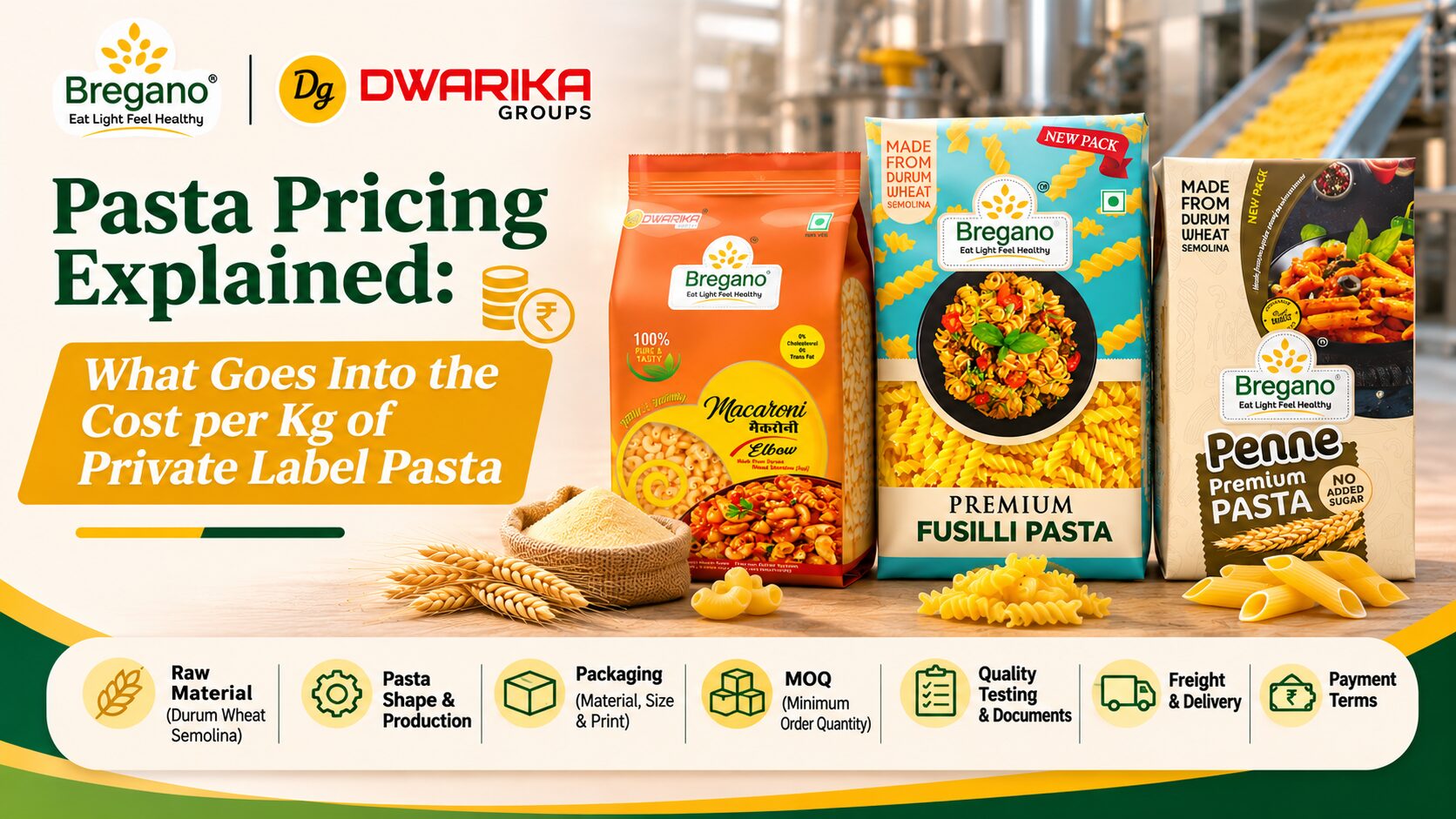
When you ask manufacturers for a quote, the private label pasta cost per kg can vary widely. Two quotes for “penne, 500 g” may look similar on paper and still describe very different products. Understanding what goes into the price helps you compare quotes fairly and avoid surprises after launch.
This guide breaks down the main cost drivers in private label pasta, and the questions to ask before you sign.
Most quotes are built from a few common parts:
| Cost Element | What It Covers |
|---|---|
| Raw Material | Semolina or flour used to make the pasta |
| Processing | Mixing, extrusion, drying and cooling |
| Packaging Material | Printed pouches, boxes, cartons and liners |
| Packing Labour | Filling, sealing and cartoning |
| Quality Testing | In-house checks and lab reports |
| Freight | Delivery from the plant to your warehouse |
| Taxes | GST as applicable |
Ask for a quote that shows these parts separately. A single bundled number makes it hard to see where the difference between two suppliers comes from.
The raw material decides both cost and quality. Pasta can be made from durum wheat semolina, common wheat semolina, refined flour (maida) or blends. Durum wheat semolina is widely used for quality pasta because of how it holds shape during cooking.
If one quote is much cheaper than another, check the ingredient declaration first. A lower price can mean a different raw material. Read Bregano’s guide on whether pasta is made from maida for how to check.
Wheat prices also move with crop conditions and market supply. Ask your manufacturer how often prices are revised and how raw material changes are communicated.
Each pasta shape needs its own extrusion die. Shapes the manufacturer already runs are usually simpler and quicker to produce. A new or rare shape may need a new die, trials and longer changeovers, which adds cost.
Short-cut shapes such as penne, fusilli and macaroni are common in India. Starting with familiar shapes keeps your first order simpler.
Packaging can be a large share of cost, especially for small packs.
A brand that launches with a 200 g pack will usually pay more per kg than one selling 900 g packs. Read our guide to pasta manufacturing for the formats Bregano works with.
Minimum order quantity (MOQ) affects price. Larger, regular orders usually allow better pricing because production runs are longer and changeovers fewer. Ask your manufacturer for prices at two or three volume levels, so you can plan how cost changes as you grow.
Remember that the pasta MOQ and the packaging MOQ may be different. You may meet the pasta minimum but still need to print more pouches than you can use in the first order.
Batch testing, lab reports and documentation cost money, but they protect your brand. A quote with no testing may look cheaper but leaves you exposed if a quality problem appears in the market.
Ask what is included: in-house checks on every batch, external lab reports and how often, and certificate copies.
Freight depends on distance, order size and how the goods are packed and palletised. Clarify whether the price is ex-factory or delivered. For multi-city distribution, compare the cost of one central warehouse against several delivery points.
Advance payments, credit periods and payment milestones also affect your real cost, because they change your cash flow. Agree on these clearly before the first order.
Before you compare prices, make sure both quotes describe the same product:
Then cook samples from both suppliers side by side. Cooking time, texture and shape retention will often tell you more than the price difference.
Avoid saving money by changing raw material or skipping testing. Those savings can cost far more in returns and lost trust.
Bregano manufactures Penne Rigate, Fusilli and Macaroni from 100% durum wheat semolina and offers private label and contract manufacturing for food brands. Share your target shapes, pack sizes and volumes, and the team can discuss pricing and MOQs.
You can see Bregano’s own 900 g retail packs on Bregano Shop, Amazon and Flipkart: Penne Rigate, Fusilli and Macaroni.
What decides private label pasta cost?
Mainly raw material, shape, packaging, order volume, testing, freight and payment terms.
Why are some pasta quotes much cheaper?
Often because of a different raw material, simpler packaging or less testing. Compare ingredient declarations and specs before comparing prices.
Does pack size affect cost per kg?
Yes. Smaller packs use more packaging per kg, so the cost per kg is usually higher.
Can I reduce cost by ordering more?
Usually, yes. Larger and regular orders allow longer production runs. Ask for prices at different volumes.
Is freight included in pasta quotes?
It depends on the supplier. Confirm whether the price is ex-factory or delivered.
Need a private label pasta quote?