
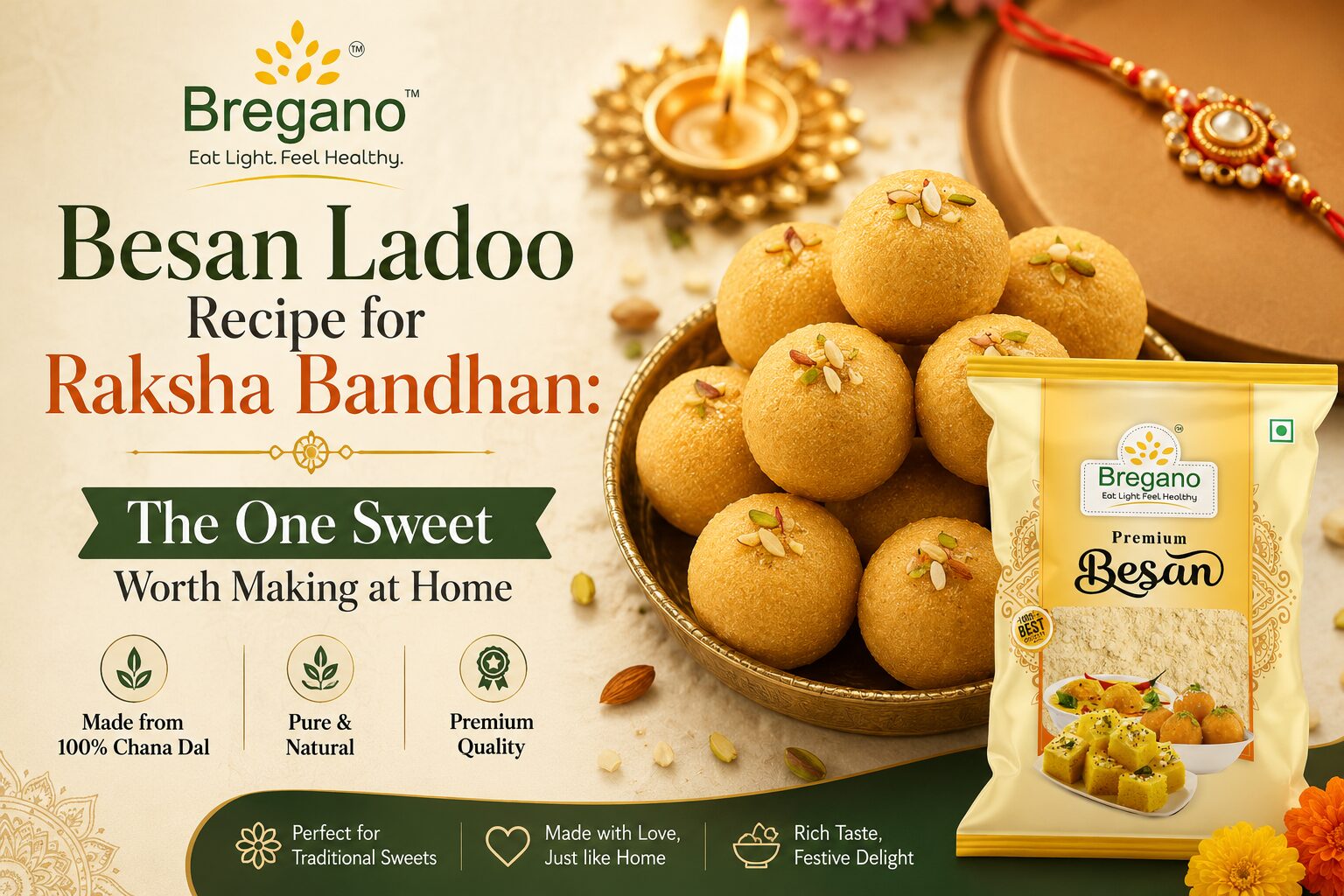
There is a short list of sweets that feel like they were made for Raksha Bandhan specifically.
Seviyan kheer is on it. So is barfi. But at the top, for most North Indian households, sits besan ladoo. Round, golden, faintly nutty, with that particular combination of ghee and roasted gram flour and cardamom that no shop-bought mithai has ever quite replicated. You can taste the kitchen it came from. That is why it matters.
Making besan ladoo at home also solves a problem that bought mithai cannot. You know exactly what is in it. The quality of the gram flour. How much ghee. Whether the sugar is refined or powdered at home. For a sweet you are giving to your sibling along with a rakhi, that knowledge feels right.
This recipe covers the whole picture. The base recipe, verified from Bregano’s official Besan Ladoo recipe. The roasting technique in depth, because that is where most people go wrong. Four variations worth trying. How to shape and store them. How to gift them properly for Raksha Bandhan. And the honest conversation about why the besan you start with determines more than any technique.
Not every festival sweet is practical for home production. Some require equipment, precision, or skill that takes years to develop. Besan ladoo requires none of these. It needs three primary ingredients: gram flour, ghee, and sugar. A heavy-bottomed pan, a spatula, and patience. No tempering, no candy thermometers, no overnight prep. And the result is a sweet that keeps for two to three weeks at room temperature, which means you can make it days before the festival and it will be at its best when Raksha Bandhan actually arrives.
Besan Ladoo is a popular Indian sweet made from gram flour (besan), ghee (clarified butter), and sugar, often flavoured with cardamom and garnished with nuts.
That description from Bregano’s website is accurate in its simplicity. The dish is not complicated in its ingredients. What it demands is correct technique, specifically in the roasting phase, and correct proportion between the three primary components.
Besan is also essential in sweets like besan ladoo during festivals and special occasions. It is one of the oldest Indian sweets, made in household kitchens across North India for generations, long before mithai shops existed. The homemade version has a different character from the mass-produced one: slightly less uniform in shape, a little more personal in flavour, and considerably more meaningful as a gift.
Most failed besan ladoo batches can be traced back to one thing: the roasting.
Besan must be roasted in ghee on low-to-medium heat until it turns genuinely golden brown and releases a strong, deeply nutty aroma. Not pale golden. Not cream-coloured. Golden brown. This is a significant visual change from the raw besan colour, and it takes longer than most people expect: anywhere from 15 to 25 minutes depending on your pan and stove.
Why does this matter so much?
Raw besan has a sharp, slightly bitter, chalky flavour. This flavour does not disappear when you add sugar and cardamom. It persists through the finished ladoo and makes it taste flat and unpleasant. The Maillard reaction that happens during roasting, when amino acids and reducing sugars in the gram flour react under heat, is what creates the warm, nutty, complex flavour that defines a good besan ladoo.
Under-roasted besan produces ladoos that taste of raw flour. They are also slightly grainy in texture because the starch granules have not fully gelatinised. These ladoos will not bind properly and will crumble when shaped.
Over-roasted besan burns. Burnt besan smells sharp and slightly acrid. This flavour does carry through and cannot be masked.
The target: besan roasted until it is uniformly golden brown, smells deeply nutty and fragrant, and has visibly changed from its raw colour throughout, not just at the bottom of the pan.
How to tell you are there:
The colour has shifted from pale yellow or beige to a warm golden brown throughout the mass. When you tilt the pan, the besan at the bottom and sides matches the besan in the centre in colour.
The kitchen smells of roasted chickpea flour. Nutty, warm, slightly sweet. If it smells slightly sharp or like it is about to burn, it has gone far enough.
The texture has changed slightly. Raw besan feels grainy and sandy. Properly roasted besan feels slightly smoother and begins to come together in the pan.
The heat for this entire process: medium to low. Not high. High heat burns the bottom while the top stays raw. Low and slow is the correct approach.
Prep time: 5 minutes Cook time: 25 to 30 minutes Shaping time: 15 minutes Makes: approximately 15 to 18 medium ladoos
2 cups Bregano Besan (gram flour) 1 cup ghee (clarified butter) 1 and a half cups powdered sugar Half teaspoon cardamom powder Chopped nuts for garnish: cashews, almonds, pistachios (optional) 2 tablespoons raisins (optional)
Step 1: Roast the besan in ghee
Heat ghee in a pan over medium heat.
Add the besan and roast it until it turns golden brown and releases a nutty aroma.
Use a heavy-bottomed pan if you have one. This distributes heat more evenly and reduces the chance of hot spots that burn the bottom while the top stays raw. Stir continuously. Not occasionally. Continuously. The besan at the bottom of the pan roasts faster than the rest, and if it is left undisturbed, it burns while the top layer remains raw.
Keep the flame at medium or slightly below medium throughout. This takes patience: 18 to 25 minutes is typical. The temptation to raise the heat to speed the process is real. Resist it.
The ghee quantity matters here. One cup of ghee for two cups of besan is the verified ratio. Insufficient ghee produces a dry, crumbly ladoo that will not hold its shape. Excess ghee produces an oily ladoo that leaves your hands shiny after eating. The 1:2 ratio (ghee to besan by volume) is the correct starting point.
Step 2: Cool slightly
Take it off the fire and let it cool a little.
This step is critical and often skipped in a hurry. If you add powdered sugar to the besan while it is still at full cooking temperature, the sugar partially melts and the ladoos become sticky rather than firm. Let the roasted besan cool for five to eight minutes: warm enough to shape, cool enough that the sugar stays powdery and the mixture holds.
You will know the temperature is right when the besan mixture feels warm to touch but not uncomfortably hot.
Step 3: Add sugar and cardamom
Mix in the powdered sugar and cardamom powder.
Use powdered sugar, not granular sugar. Granular sugar does not incorporate fully into the warm besan and creates a gritty texture in the finished ladoo. If you are powdering your own sugar at home, do it before you start roasting the besan so it is ready to add at the right moment.
The cardamom should be freshly ground if possible. Pre-ground cardamom loses its intensity quickly. For a Raksha Bandhan batch where you want the ladoos to smell as good as they taste, the difference is worth the two minutes of extra effort.
Mix thoroughly until the sugar and cardamom are evenly distributed through the warm besan.
Step 4: Shape into ladoos
Shape the mixture into small balls (ladoos) and garnish with chopped nuts if desired.
Work quickly while the mixture is still warm. As it cools further, it becomes harder to shape because the ghee sets. If your mixture cools too much before you finish shaping, briefly warm it in the pan for 30 to 60 seconds on low heat, just enough to make it pliable again.
To shape: take a small amount of mixture, press it firmly between both palms, and roll in a circular motion. The pressure compresses the mixture and binds it. If it is not binding, the besan may have been insufficiently roasted, or the mixture needs a very small additional amount of warm ghee (half a teaspoon at a time) to help it come together.
Size: a medium ladoo is roughly the size of a golf ball. For gifting in small boxes, slightly smaller ladoos look more elegant.
Garnish: press a cashew, almond sliver, or pistachio into the top of each ladoo while still warm. The nut sets into the ladoo as it cools and stays in place.
Step 5: Cool completely before storing
Let them cool completely before storing them.
This is not optional. Ladoos stored while still warm trap steam inside the container, which causes them to soften, lose their shape, and sometimes develop a slightly off flavour. Cool on a plate at room temperature for 30 to 45 minutes before packing or stacking.
Gram flour quality directly affects both the texture and flavour of besan ladoo in ways that technique alone cannot compensate for.
Coarsely milled besan produces a slightly grainy ladoo with an inconsistent texture. The flavour is muddier because the larger particles do not roast uniformly. Fine-textured besan produces a smooth, uniform ladoo with a clean, sharp nutty flavour from even, consistent roasting.
Bregano Besan is made from high-quality chickpeas and offers a fine texture and nutty flavour. It is described as bringing a smooth consistency and authentic taste to sweet dishes, and is rich in protein and fiber.
The nutty flavour of Bregano Besan is important for ladoos specifically. A besan with a naturally strong chickpea character produces a more flavourful roasted base. When you add ghee to good-quality besan, the roasting brings out a flavour that is greater than either ingredient alone.
Using quality of ingredients enhances the flavor. This principle, consistent across Bregano’s recipe guidance, applies most directly to besan ladoo because the ingredient list is so short. Three primary ingredients. Nothing to hide behind. The quality of each one shows in the finished sweet.
Pack sizes: 400 grams and 500 grams.
The base recipe above is the traditional one. These variations are for households that make besan ladoo every year and want to bring something different to the celebration.
Add two tablespoons of raisins and one tablespoon of roughly chopped cashews to the besan-sugar mixture before shaping. When you bite into the ladoo, you hit the raisin’s chewiness and the cashew’s crunch against the soft, sandy interior of the ladoo. The textural contrast is significant. Raisins also add a subtle sweetness that complements rather than duplicates the sugar.
Press a single whole cashew on the outside as garnish so the person receiving the ladoo knows what to expect inside.
Add one teaspoon of rose water and a pinch of dried rose petal powder to the besan-sugar mixture along with the cardamom. Skip raisins. Press a small dried rose petal into the top of each ladoo as garnish. The result is more delicate and fragrant than the base recipe: softer on the palate, more floral. This is the Raksha Bandhan version for the sibling who prefers something lighter and more elegant over the classic dense ladoo.
Add four tablespoons of desiccated coconut to the besan in the final five minutes of roasting. The coconut toasts alongside the besan, adding its own nutty sweetness. Roll the finished, shaped ladoos in a thin coat of additional desiccated coconut before they cool. The white coconut coating against the golden ladoo interior is visually attractive in a gift box.
Reduce powdered sugar from one and a half cups to three-quarters of a cup. Replace the remaining sweetness with two tablespoons of honey added at the mixing stage (off heat), which adds a milder, floral sweetness. Add an extra pinch of cardamom to compensate for the reduced sugar flavour. The ladoos will be less sweet, slightly more bitter from the besan’s natural character, and considerably lower in total sugar content. Shape them slightly smaller so they feel like a portion-controlled treat rather than a compromise.
Storage: Besan ladoo keeps well at room temperature for two to three weeks when stored in an airtight container. Do not refrigerate: cold temperatures affect the ghee and change the texture of the ladoo from soft and yielding to dense and slightly waxy.
Make the ladoos three to five days before Raksha Bandhan. The flavour actually improves over the first two to three days as the ghee, besan, and cardamom integrate and mellow. Day-of ladoos are good. Day-three ladoos are better.
Gifting: For a sibling gift, a simple approach works best.
A small cardboard box or wooden box lined with butter paper. Arrange the ladoos in a single layer so they do not press against each other. If stacking, place a sheet of butter paper between layers. Close and tie with a simple ribbon in the colours of the rakhi you chose. Add a small handwritten card.
This presentation costs almost nothing and communicates something that an ordered mithai box cannot: these were made in someone’s kitchen, specifically for this occasion, specifically for you. That is the point of the gesture.
Quantity guide for gifting:
A small gift box holds six to eight medium ladoos, appropriate for one to two people. A family box holds 15 to 18 ladoos, appropriate for a family of four. A large batch of 30 ladoos requires approximately four cups of besan and two cups of ghee, scaled from the base recipe.
Ladoos not binding: The besan was under-roasted, or the mixture cooled too much before shaping. Solution: return to low heat for one to two minutes to rewarm, or add a very small amount of warm ghee (half a teaspoon at a time) to help binding.
Gritty texture: Sugar was not powdered finely enough, or granular sugar was used. Solution: always use powdered sugar and check its texture before adding.
Raw flour taste in finished ladoo: Roasting was insufficient. The besan did not reach golden brown throughout. There is no fix after the fact: the only solution is roasting longer the next time. This is the most important mistake to avoid, which is why the roasting section is the longest in this guide.
Ladoos crumbling after cooling: Too little ghee, or the besan was over-roasted and dried out. Solution: while still warm, knead in a small additional amount of ghee and reshape.
Ladoos too oily: Too much ghee. Solution: reduce ghee by two to three tablespoons in the next batch.
Everything below is taken directly from bregano.in.
Made from high-quality chickpeas. Rich in protein and gluten-free. Fine texture and nutty flavour. Brings a smooth consistency and authentic taste. Rich in protein and fiber, an excellent choice for health-conscious sweet preparations. Besan is packed with protein, and research on the nutritional composition and health benefits of chickpeas supports chickpeas as a useful source of protein and dietary fibre. Chickpeas are associated with a lower glycaemic response; a systematic review on chickpeas and blood sugar discusses their potential role in glycaemic control. Besan is naturally gluten-free; for Indian labelling and safety context, see the FSSAI guidance on gluten-free foods.
Besan Ladoo recipe from Bregano (exact verified ingredients): 2 cups besan (gram flour) 1 cup ghee (clarified butter) 1 and a half cups powdered sugar Half teaspoon cardamom powder Chopped nuts for garnish
Verified method steps: heat ghee, add besan, roast until golden brown and nutty aroma. Cool slightly. Add powdered sugar and cardamom. Shape into balls. Garnish with nuts. Cool completely before storing.
Pack sizes: 400 grams and 500 grams.
Part of Bregano’s Everyday Cooking Combo alongside Maida and Sooji. Each ingredient is hygienically processed, finely milled, and packed to preserve freshness.
Certifications: FSSAI, GMP, GHP.
Part of Dwarika Group, food manufacturing since 1992. Bregano launched 2019. 7-acre fully automated facility in Rudrapur, Uttarakhand. Guided by the vision of Mr. Balram Agrawal.
Where to buy: Bregano’s official online store, Amazon, Flipkart, Instamart, and JioMart. Follow @breganoproducts on Instagram for recipes and updates.
If you want to try more recipes with besan, explore:
How long does it take to make besan ladoo?
The full process from raw besan to finished ladoos takes approximately 45 to 50 minutes: 20 to 25 minutes of roasting, 5 to 8 minutes of cooling, and 15 minutes of shaping. It is not a quick recipe, but almost all of the active time is the roasting, which requires continuous stirring rather than complicated technique.
How do I know when the besan is properly roasted?
The besan should turn uniformly golden brown throughout (not just at the bottom), release a strong, deeply nutty aroma, and feel slightly smoother than raw besan when stirred. On medium-low heat, this typically takes 18 to 25 minutes. Do not rush this stage: under-roasted besan produces ladoos that taste of raw flour.
Why are my besan ladoos not binding?
Two common causes. Either the besan was not roasted enough (insufficient roasting means the starch did not gelatinise enough to bind), or the mixture cooled too much before shaping. Try rewarm on low heat for one to two minutes. If still not binding, add a small additional amount of warm ghee, half a teaspoon at a time, and knead until the mixture comes together.
Can I reduce the ghee in besan ladoo?
You can reduce by up to three to four tablespoons without significantly affecting binding and texture. Below that, the ladoos will struggle to hold their shape and will feel dry. The ghee is structural in besan ladoo, not just flavour. Reducing it changes the finished sweet meaningfully.
How long do besan ladoos last?
Two to three weeks at room temperature in an airtight container. Do not refrigerate: cold affects the ghee and changes the texture. Make them three to five days before Raksha Bandhan for best flavour.
Can I use jaggery instead of sugar in besan ladoo?
Yes. Use powdered jaggery in the same quantity. Add it off the heat after the besan has cooled slightly, as jaggery can make the mixture sticky if added too hot. The flavour is deeper and less clean than with sugar: a mild molasses note that many people prefer. The ladoos may be slightly softer and darker in colour.
What is the best besan for ladoo in India?
Fine-textured besan made from quality chickpeas produces the best ladoos: smooth, even texture, clean nutty flavour after roasting. Bregano Besan is made from high-quality chickpeas with a fine texture and nutty flavour, described as bringing a smooth consistency and authentic taste to sweet dishes. Available in 400 gram and 500 gram packs.
Order Bregano Besan online Available in 400g and 500g packs. FSSAI, GMP, GHP certified. Made from high-quality chickpeas. Fine texture. Rich in protein and gluten-free. Part of Dwarika Group, food manufacturing since 1992. Follow @breganoproducts on Instagram for more festival recipes.