
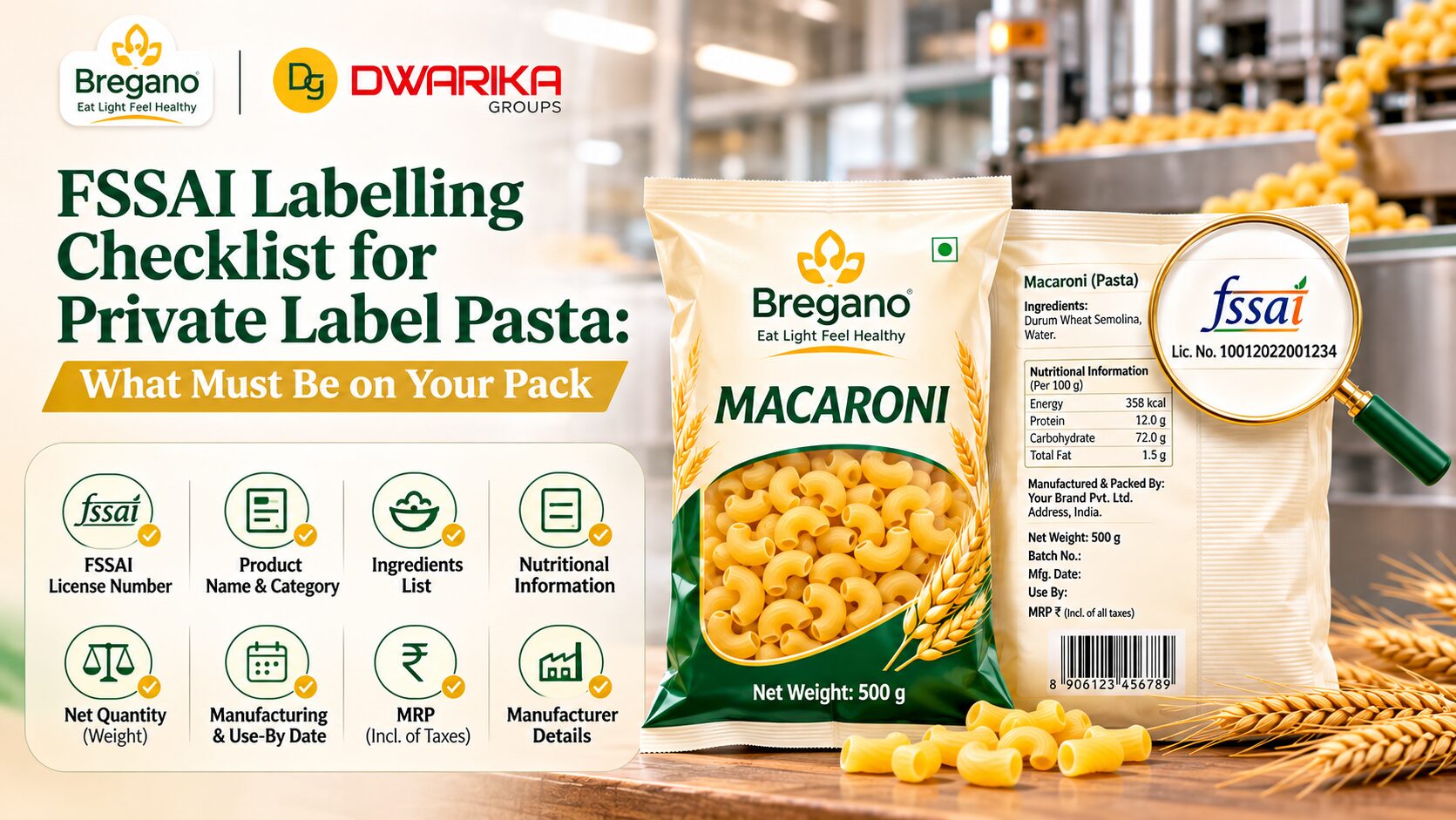
A private label pasta pack does two jobs. It sells your product, and it tells the buyer exactly what is inside. In India, the second job is governed by law. Missing a mandatory detail can lead to rejected listings, stock recalls or penalties.
This checklist covers what your pasta pack needs before it goes to print.
Two sets of rules apply to packaged pasta in India:
Rules are updated from time to time. Always confirm the latest version on the
FSSAI website
before final print.
| Label Element | What to Check |
|---|---|
| Name of the food | A clear name, for example “Penne Pasta” |
| List of ingredients | In descending order of weight, for example “Durum wheat semolina” |
| Nutrition information | Per 100 g values, from lab testing of your product |
| Veg logo | Green square with green dot |
| Allergen declaration | A clear, separate “Contains: Wheat (Gluten)” statement |
| FSSAI logo and licence number | Both the manufacturer’s and the brand owner’s licence numbers |
| Name and address | “Manufactured by:” and “Marketed by:” with full names and addresses |
| Net quantity | In grams or kilograms, at the minimum numeral height |
| MRP | Inclusive of all taxes |
| Batch or lot number | For traceability |
| Date of manufacture or packing | As required |
| Best before or use by date | Based on shelf-life testing |
| Consumer care details | Phone number and email |
| Instructions for use | Cooking directions |
A private label pack involves two businesses: the company that makes the pasta and the company that sells it under its brand. FSSAI’s labelling regulations require both to be identified on the pack, each with its FSSAI licence number.
A clear way to present this:
Showing only the brand owner’s number is a common mistake on private label packs.
Pasta made from durum wheat semolina contains wheat, a cereal containing gluten. FSSAI requires this allergen to be declared.
Print it as a separate, easy-to-spot line, such as “Contains: Wheat (Gluten)”, close to the ingredient list. Bold text helps it stand out.
The Legal Metrology (Packaged Commodities) Rules, 2011 set minimum heights for the net quantity numerals, based on the area of the pack’s principal display panel:
| Principal Display Panel Area | Minimum Numeral Height |
|---|---|
| Up to 100 sq cm | 1 mm |
| 100 to 500 sq cm | 2 mm |
| 500 to 2,500 sq cm | 4 mm |
| Above 2,500 sq cm | 6 mm |
Minimums are higher when the declaration is moulded or embossed on the pack rather than printed. MRP and other declarations must also be clear and legible.
Packs that do not meet these requirements can attract penalties, so check sizes on the final artwork, not just the design file.
Rules are amended from time to time, so confirm the current figures with the
Department of Consumer Affairs
before print.
Shoppers often search “pasta is made of maida?” before buying. Your ingredient list is where they find the answer.
If your pasta is made from durum wheat semolina, declare it exactly that way. If it uses a blend, list each ingredient in order of weight. Never call a product “durum wheat pasta” if the ingredient list says otherwise.
For context: maida is refined wheat flour, finely milled from common wheat. Durum wheat semolina is a coarser grind from durum wheat. They are different ingredients and must be labelled separately.
Read our guide on
whether pasta is made from maida
for more.
Do not copy nutrition values from another brand or the internet. Values change with raw material and process. Get your finished product tested at an accredited lab and use those numbers.
Any claim on the front of pack must follow FSSAI’s advertising and claims rules.
Avoid:
A simple, accurate ingredient statement is a clear and safe message to lead with.
An experienced manufacturer can share the specifications you need for the label and help flag missing details at the artwork stage.
At Bregano, our
private label
team works with brands through packaging and production.
Bregano’s short-cut pasta is made from 100% durum wheat semolina. You can see how Bregano’s own retail packs are presented on
Bregano Shop,
Amazon
and Flipkart:
Penne Rigate,
Fusilli
and
Macaroni.
The final responsibility for label compliance sits with the brand owner, so always get the artwork reviewed by a food regulatory expert.
Yes. Under FSSAI’s labelling regulations, cereals containing gluten, such as wheat, must be declared as allergens.
No. Use values from lab testing of your own product.
Both. The pack should show the manufacturer’s details and FSSAI licence number under “Manufactured by”, and the brand owner’s details and FSSAI licence number under “Marketed by”.
Maida is refined wheat flour, also known as all-purpose flour.