
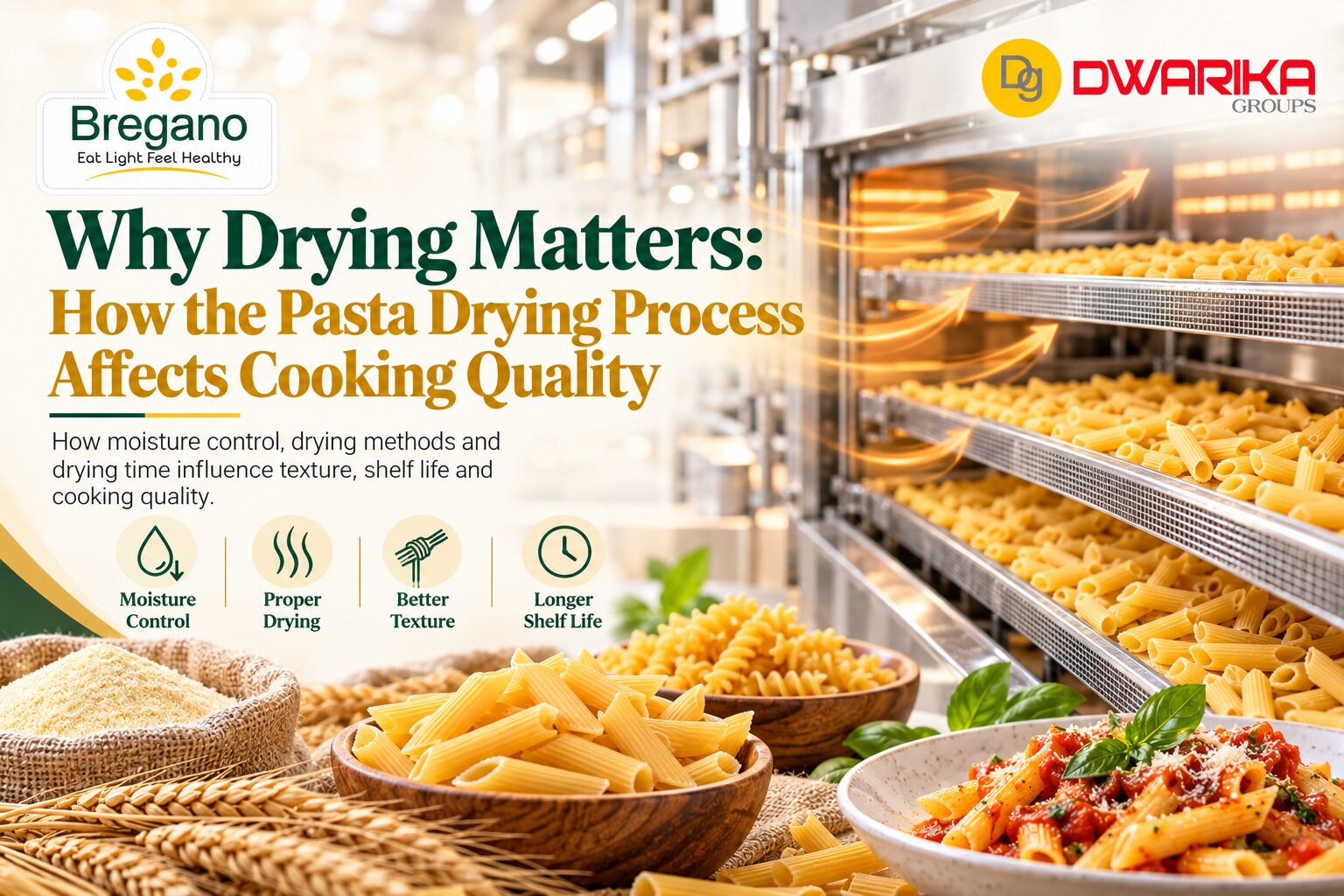
When people talk about good pasta, they usually mention the wheat or the shape. Few mention drying, yet it is one of the stages that most decides how pasta cooks.
Poorly dried pasta can crack, break, turn mushy or spoil early. Well-dried pasta keeps its shape, cooks evenly and stays good on the shelf. Here is why the pasta drying process matters, how it works, and what it means for anyone who buys, sells or cooks pasta.
For the full journey from semolina to sealed pack, read our guide on how pasta is made.
Freshly extruded pasta contains a lot of water. In that state it is soft, easy to deform and spoils quickly. Drying removes most of that moisture so that:
The goal isn’t just to remove water. It is to remove it at the right pace, evenly, from the outside and the inside of every piece.
Drying is not as simple as blowing hot air at wet dough. Inside every piece, two things happen at the same time:
Problems start when these two speeds don’t match. If the surface dries much faster than water can move out from the core, the outside hardens and shrinks while the inside is still wet. That creates internal stress, which later shows up as cracks, breakage or uneven cooking.
Good drying keeps the surface and the core in balance, so the whole piece dries together.
Commercial drying is managed through three main settings. Each one affects the others. For further reading, see scientific research on pasta processing and quality.
| Control | What it does | If it goes wrong |
|---|---|---|
| Temperature | Speeds up evaporation and helps moisture move through the pasta | Too high can stress or discolour pasta; too low makes drying slow and less hygienic |
| Humidity | Controls how quickly the surface loses water | Too dry and the surface hardens too fast; too humid and drying stalls |
| Airflow | Carries moisture away and keeps conditions even across the line | Uneven airflow means some pieces dry faster than others |
Getting the balance right is why modern drying units are divided into zones, each with its own settings.
On a commercial pasta production line, drying usually happens in stages rather than all at once. It begins straight after extrusion, which is explained in our guide to the pasta extrusion process.
The settings for each stage are adjusted to the pasta shape. Thin vermicelli and thick short shapes don’t dry the same way.
Each shape has its own thickness, surface area and fragility, so each needs its own drying approach.
| Shape | Drying challenge | What the manufacturer manages |
|---|---|---|
| Penne | Thicker tube walls hold more moisture in the core | Slower, even drying so walls don’t crack |
| Fusilli | Spirals have thin edges and thicker centres | Balanced airflow so the spiral keeps its form |
| Macaroni | Small, curved tubes dry relatively quickly | Avoiding over-drying and brittleness |
| Vermicelli | Very thin strands are fragile | Gentle handling and controlled conditions to prevent breakage |
This is one reason a manufacturer that makes many shapes needs drying equipment that can be set precisely for each one.
| Problem | Likely cause | What you notice |
|---|---|---|
| Cracks and breakage | Surface dries much faster than the core | Broken pieces in the pack, pasta that splits while cooking |
| Uneven texture | Moisture not evened out between core and surface | Some parts soft, others hard after cooking |
| Stickiness | Insufficient or uneven drying | Pasta that clumps or turns gummy in the pot |
| Short shelf life | Too much moisture left in the pasta | Pasta that spoils or develops off-smells early |
| Uneven colour | Inconsistent drying conditions | Patchy or dull appearance |
| White spots | Uneven drying or moisture stress | Small pale marks on the surface of the pasta |
This is why manufacturers invest in drying systems that let them control conditions precisely.
Traditionally, pasta was dried slowly in open air, which depended heavily on the weather. Results varied from day to day and season to season.
Modern pasta lines dry pasta inside enclosed drying units. Temperature, humidity and airflow are set for each zone and each shape. This brings three advantages:
For a buyer, the result is pasta that looks and cooks the same from one pack to the next.
The effects of drying carry all the way to the kitchen: For further reading, see scientific research on pasta processing and quality.
If you are a brand, distributor or bulk buyer, drying is worth discussing before you place an order:
For a full list of questions, read our guide to pasta quality control.
Bregano pasta is made by Dwarika Food Products in Rudrapur, Uttarakhand, on PAVAN pasta lines imported from Italy. According to Bregano’s contract manufacturing page:
Try the results in your own kitchen with Bregano’s Penne, Fusilli or Macaroni from the Bregano online shop. For private label or bulk enquiries, call +91-9012143222 or email sales@dwarikagroups.com.
Drying protects pasta, but storage protects the drying. Dry pasta can pick up moisture again if it is stored badly. For food businesses, see the official FSSAI FoSCoS portal for licensing and compliance information.
Drying rarely gets attention on a pasta pack, but it shapes almost everything you notice about the product: how it looks, how long it lasts and how it behaves in the pot. Controlled drying, with the right balance of temperature, humidity and airflow for each shape, is what turns freshly extruded dough into pasta that cooks the same way every time.
Whether you are choosing a pasta for your kitchen or a manufacturer for your brand, it is worth asking how the pasta was dried.
What is the pasta drying process?
It is the controlled removal of moisture from freshly extruded pasta, usually through pre-drying, main drying, stabilising and cooling stages.
Why is drying so important for pasta quality?
Drying affects shelf life, shape, texture and how evenly the pasta cooks. Poor drying can cause cracks, stickiness or early spoilage.
How long does it take to dry pasta?
It depends on the shape and the drying system. Bregano states that its PAVAN TAS system completes drying in 2 to 4 hours.
Why does some pasta break or crack?
One common cause is drying the surface much faster than the core, which creates internal stress.
Do different pasta shapes need different drying?
Yes. Thicker shapes like penne need slower, more even drying, while thin vermicelli needs gentle handling to avoid breakage. Manufacturers adjust settings for each shape.
What are the white spots on some pasta?
Small white or pale spots are often linked to uneven drying or moisture stress during production. Well-controlled drying reduces them.
Does drying affect cooking time?
Yes. Evenly dried pasta cooks in the time printed on the pack. Unevenly dried pasta may cook unevenly, with a soft outside and a hard centre.
How should I store dry pasta?
In a cool, dry place, in a sealed pack or container, and within the best-before date on the pack.