
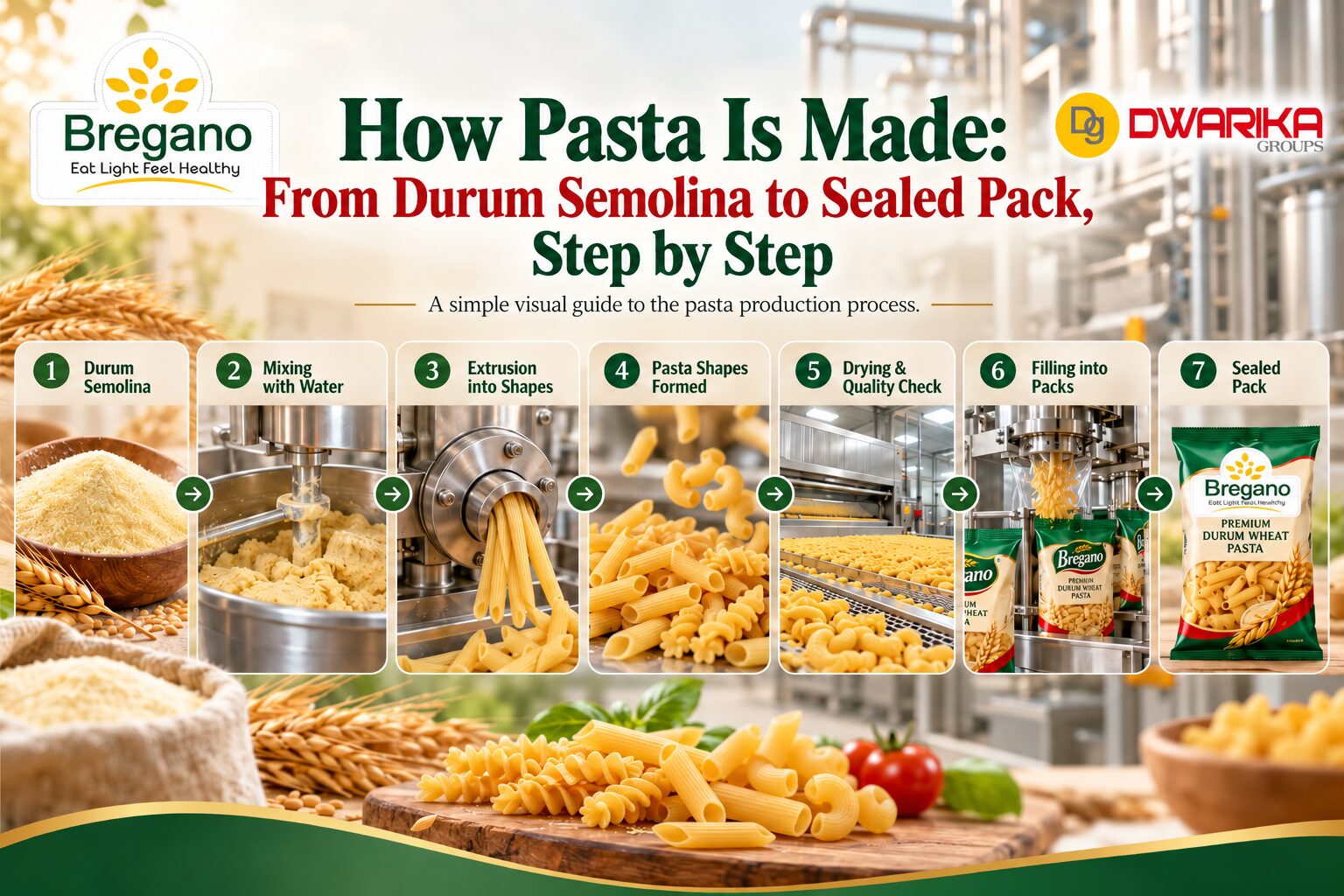
A pack of dry pasta looks simple: just semolina and water, shaped and dried. But turning those two ingredients into pasta that cooks evenly, holds its shape and stays fresh on a shelf takes a carefully controlled process. Whether you are a home cook curious about what’s in your pantry, or a brand or distributor sourcing pasta, understanding how pasta is made helps you judge quality. Here is how pasta is manufactured at commercial scale, step by step, from the raw material to the sealed pack.
Most premium dry pasta starts with durum wheat (Triticum durum). Durum is a hard wheat variety, and it is milled into a coarse, golden flour called semolina. Durum semolina is widely used for dry pasta because:
Not all pasta uses 100% durum semolina. Economy and blended variants in India are also made, legally and safely, with refined wheat flour (maida) or mixed flours. Checking the ingredient list on the pack tells you exactly what you are buying.
Semolina arrives at the plant and is checked before use. Typical checks include moisture, colour, particle size and the absence of foreign matter. It is then stored in silos or bins.
Semolina and water are measured precisely and mixed into a crumbly dough. Many modern lines mix under vacuum, which removes air from the dough during mixing. Less trapped air helps produce a denser pasta with a more even colour.
The dough is kneaded so the water spreads evenly and the gluten develops. This gives the pasta its structure.
The dough is pushed under high pressure through a metal plate called a die. The die’s openings decide the shape: tubes for penne, spirals for fusilli, curved tubes for macaroni. Rotating knives cut short shapes to length as they come out. For more detail on precision extrusion, see Bregano’s pasta manufacturing process.
Freshly extruded pasta is soft and sticky. A short pre-drying stage firms up the surface so pieces don’t stick together or lose shape.
This is the most critical stage. The pasta’s moisture is brought down in a controlled way, using carefully managed temperature and humidity. Drying too fast can crack pasta; drying too slowly can affect quality and hygiene. Well-controlled drying gives pasta a long shelf life and good cooking quality. Learn more about controlled drying in Bregano’s manufacturing overview.
The dried pasta is cooled to room temperature so it is stable before packing.
Pasta is checked for moisture, colour and shape. Broken, discoloured or misshapen pieces are removed. On automated lines, this inspection can happen continuously.
The pasta is weighed, filled into packs and sealed. Each pack is labelled with details such as ingredients, net weight, batch number and best-before date, ready for dispatch.
The same dough can become many shapes. What changes is mainly the die, the cutting and the drying settings.
| Shape | How it is formed | Drying note |
|---|---|---|
| Penne | Extruded as a tube and cut at an angle | Thicker walls need careful, even drying |
| Fusilli | A special die twists the dough into a spiral | Spirals must dry evenly to keep their shape |
| Macaroni | Extruded as a small tube that curves as it exits | Small size means it dries relatively quickly |
| Vermicelli | Pushed through many small holes into thin strands | Thin strands are fragile and need gentle handling |
To learn more about sourcing these shapes, read our guide to fusilli and penne supply and explore more manufacturing articles.
Alongside the process itself, a well-run pasta plant follows food safety practices at every stage:
If you are evaluating a manufacturer, ask to see how these practices work in their plant.
Bregano pasta is made by Dwarika Food Products in Rudrapur, Uttarakhand. According to Bregano’s manufacturing page:
Bregano’s Penne, Fusilli and Macaroni are listed on its online shop as made from durum wheat semolina.
| Myth | The reality |
|---|---|
| “All pasta is made from maida.” | Premium pasta is made from 100% durum wheat semolina, while economy or blended variants may use maida or mixed flours. The ingredient list tells you which. |
| “All dry pasta is the same.” | Raw material, extrusion and drying all affect texture, colour and how pasta cooks. |
| “Dry pasta is full of preservatives.” | Dry pasta stays shelf-stable mainly because drying removes most of its moisture. Check the label for the actual ingredients. |
| “Fresh pasta is always better than dry.” | They are different products. Dry pasta suits everyday cooking and many Indian-style recipes. |
You can’t see the factory, but the pack and the pot tell you a lot:
If you are a brand or distributor sourcing pasta, Bregano’s pasta manufacturing guide covers manufacturing capabilities and what to ask suppliers. If you want to understand formal manufacturing agreements, read our guide to contract pasta manufacturing.
Looking for an easy dish to try? Explore Bregano’s recipes and food guides for ideas, including masala macaroni.
Good pasta is the result of many small, controlled steps: the right semolina, precise mixing, accurate extrusion, careful drying, thorough inspection and secure packing. Each step affects how the pasta looks in the pack and how it behaves in your pot. Next time you pick up a pack, read the ingredients, look at the pasta and notice how it cooks. It will tell you a lot about how it was made.
How is pasta manufactured?
Semolina and water are mixed into a dough, kneaded, pushed through a shaped die (extrusion), cut, dried under controlled conditions, cooled, inspected and packed.
What is pasta made of?
Premium dry pasta is made from 100% durum wheat semolina and water. Economy or blended variants may use maida or mixed flours, so check the ingredient list.
What is the difference between semolina and maida?
Semolina is a coarse flour milled from durum wheat. Maida is a finely milled, refined wheat flour. They behave differently in pasta making, which is why the ingredient list matters.
Why is drying important in pasta production?
Drying lowers the moisture so pasta stays shelf-stable. How it is dried affects texture, colour and cooking quality.
What is pasta extrusion?
Extrusion is the step where dough is pressed through a die to form shapes such as penne, fusilli or macaroni.
Why does some pasta break in the pack?
Breakage can come from uneven drying, rough handling or transport. Well-dried, carefully packed pasta has fewer broken pieces.
How should I store dry pasta?
In a cool, dry place in a sealed pack or airtight container, within the best-before date.
Where is Bregano pasta made?
At the Dwarika Food Products facility in Rudrapur, Uttarakhand, on PAVAN pasta lines imported from Italy.