
Walk into any gym in a tier 2 city in India right now and you will find the same conversation happening near the lockers.
Someone asking about protein. Someone else recommending whey. A third person wincing at the price. And a fourth person, usually the one who has actually been training for three or four years, quietly mentioning soya chunks.
That fourth person is usually right. But they rarely have the numbers to back it up in the moment.
This blog is the numbers. And the context. And the honest answer about when whey makes sense and when it does not.
No supplement brand is paying for this. No incentive to push you toward either option. Just a comparison that treats you like someone who can handle actual information.
Start here because everything else is context around this.
Soya chunks protein per 100g is the number most people care about first.
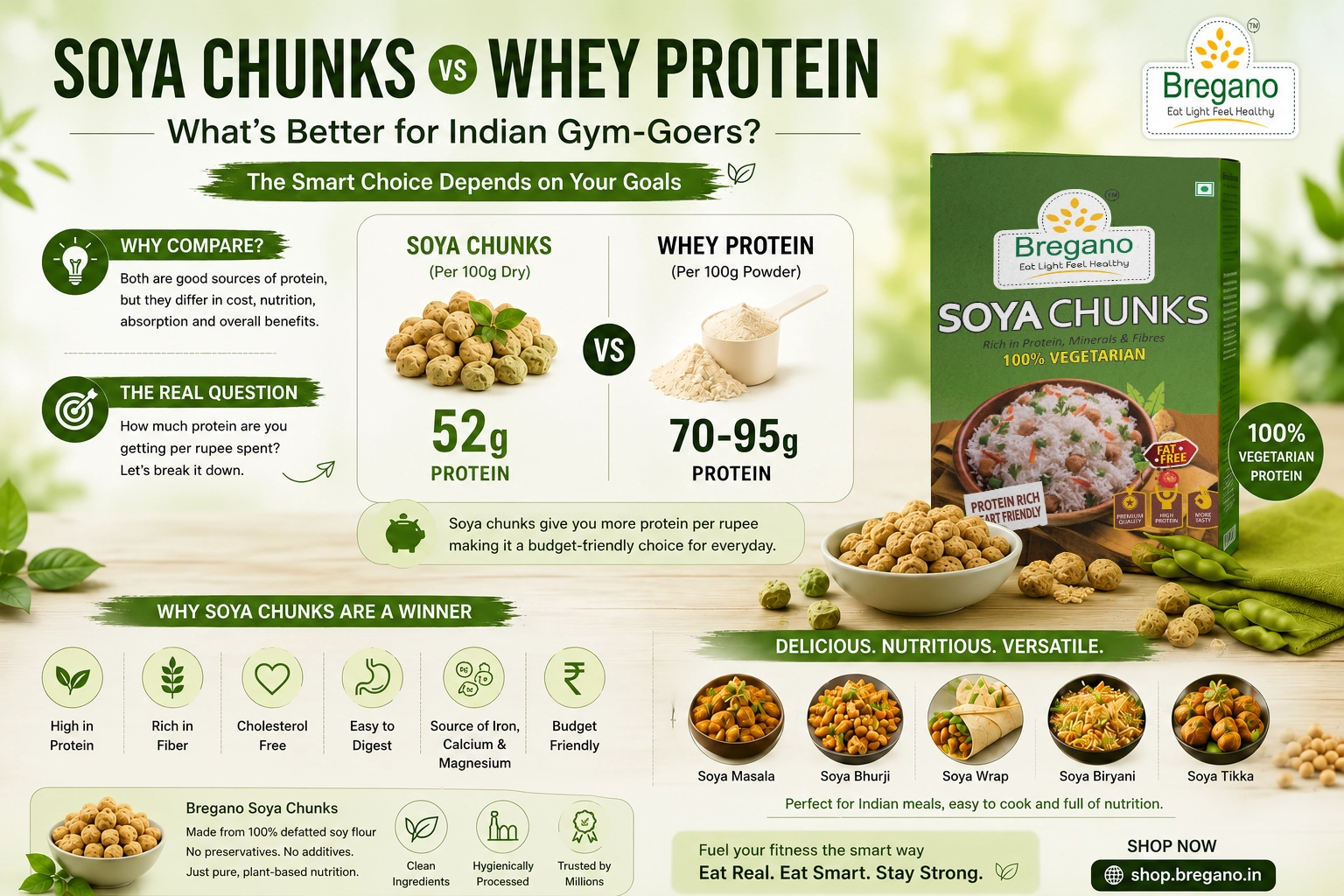
Soya chunks (dry, per 100 grams): 52 grams of protein.
Standard whey protein concentrate vs isolate (per 100 grams of powder): typically 70 to 80 grams of protein, depending on the brand and formulation.
Whey protein isolate (per 100 grams of powder): typically 85 to 95 grams of protein.
So whey wins on raw protein density per 100 grams of the product. That is not in dispute.
But here is the question nobody asks at the right moment: how much protein are you actually getting per rupee spent?
Bregano Soya Chunks delivers 52 grams of protein per 100 grams, made from 100% defatted soy flour with no preservatives and no additives. At a typical retail price, a 400-gram pack costs a fraction of what a month’s supply of whey costs. The math matters far more for most Indian gym-goers than the headline protein percentage.
Whey protein in India, imported and from reputable brands, runs between Rs 3,000 and Rs 5,000 per kilogram. Some premium isolates go higher. A serious gym-goer consuming the commonly recommended 25 to 30 grams of protein per serving, twice a day, gets through roughly 500 to 600 grams of whey powder per month. That is Rs 1,500 to Rs 3,000 per month on protein powder alone, before anything else.
Now consider soya chunks.
A 200-gram pack of Bregano Soya Chunks costs a fraction of that. And 100 grams of dry soya chunks, when soaked and cooked, roughly doubles in volume, giving you around 200 grams of cooked protein-rich food with 52 grams of total protein from that dry starting portion.
For someone eating one serving of soya chunks per day, roughly 50 grams dry, that is about 26 grams of protein from a food that costs maybe Rs 5 to 8 per serving.
The same 26 grams of protein from whey costs Rs 80 to 150 per serving depending on the brand.
That is not a marginal difference. That is a 10x to 20x difference in cost per gram of protein. For a gym-goer in a tier 2 city spending on food, rent, and a gym membership simultaneously, that gap is the difference between being able to hit protein targets every day and constantly falling short because the supplement budget ran out by the 20th of the month.
Being honest means saying this clearly: whey has specific advantages that soya chunks cannot fully replicate.
Speed of absorption. Whey is a fast-digesting protein. After a hard training session, the muscle repair and growth process is accelerated when amino acids arrive in the bloodstream quickly. Whey typically delivers its amino acids within 30 to 60 minutes of consumption. Soya protein, as a whole food, takes longer to digest, roughly 2 to 3 hours. For the specific 30 to 45 minute post-workout window that sports nutrition traditionally emphasises, whey has an edge.
Leucine content. Leucine and whey protein are often discussed together because leucine is the amino acid that most directly triggers muscle protein synthesis. Whey is exceptionally high in leucine relative to most protein sources, including soya. This is part of why whey has consistently outperformed other protein sources in short-term muscle synthesis studies. If maximising acute post-workout muscle protein synthesis is the goal, whey is the more efficient tool.
Convenience. A scoop of whey in water takes 30 seconds. A serving of soya chunks requires soaking for 15 to 20 minutes, draining, seasoning, and cooking for another 10 minutes. That is not a dealbreaker, but it is a real consideration for someone training early in the morning before work.
Digestibility. Whey protein is generally easier on digestion for most people. Some individuals experience mild bloating or digestive discomfort from soya protein, particularly when consuming large quantities. This varies significantly between people and is not universal, but it is worth noting.
This is the section that most supplement company blogs skip entirely.
Fiber Soya chunks are high in fiber which promotes gut health and aids digestion. Whey protein powder contains essentially zero fiber. If your diet is already fiber-deficient (most Indian gym diets are, because of the emphasis on rice, roti, and protein powder over vegetables and whole foods), soya chunks contribute meaningfully to that gap. Good gut health directly affects nutrient absorption, which affects how effectively you actually use the protein you are eating.
Cholesterol-free plant protein. Soy as a plant-based protein is naturally cholesterol-free, easy to digest, and eco-friendly. Whey comes from milk, so it contains some cholesterol and saturated fat. For gym-goers with a family history of cardiovascular issues, or anyone monitoring their lipid profile, soya protein’s plant-based origin is a genuine advantage.
Iron, calcium, and magnesium Soya chunks are a source of iron, calcium, and magnesium, alongside their protein content. Whey protein powder, unless specifically fortified, does not contribute meaningfully to mineral intake. For vegetarians who are already potentially low on iron and calcium from avoiding meat and sometimes dairy, soya chunks serve multiple nutritional functions simultaneously.
Satiety. Because soya chunks are a whole food with fiber and take longer to digest, they keep you full significantly longer than a whey shake. A whey shake is often gone from your hunger perception within an hour. A serving of soya chunks as part of a meal keeps you satisfied for 3 to 4 hours. For gym-goers who struggle with over-eating or late-night snacking, this matters practically.
Versatility in Indian cooking. Soya chunks absorb spices and flavors effortlessly, making them perfect for Indian cuisine. Soya masala, soya biryani, soya tikka wrap, soya bhurji, soya 65 with cornflour and spices. These are satisfying meals that happen to be high in protein, not a chalky shake that you force down because you know you should. Eating enough protein consistently over months is what actually builds muscle. Food you enjoy eating is dramatically more sustainable than food you tolerate.
One criticism you will hear about soya protein is that plant proteins are incomplete, meaning they lack some essential amino acids.
This was a more significant concern historically. The current understanding is more nuanced.
Protein quality of soy products is stronger than many people assume. Soya is actually one of the few plant proteins that is considered nutritionally complete. It contains all nine essential amino acids, including leucine, isoleucine, and valine (the branched-chain amino acids that matter most for muscle). The PDCAAS (Protein Digestibility Corrected Amino Acid Score), which measures how well a protein source meets human amino acid requirements, puts soya at or near the top among plant proteins.
It scores lower than whey on this scale, which is one reason whey has consistently performed slightly better in controlled muscle-building studies. But the gap is smaller than supplement marketing would have you believe, particularly when you are consuming adequate total protein through the day from varied sources.
After laying out everything above, the honest framework looks like this.
Soya chunks make more sense if:
You are vegetarian and price is a genuine constraint. The protein-per-rupee advantage of soya chunks is so large that for budget-conscious gym-goers, it is genuinely hard to justify expensive whey when the alternative delivers 52 grams of protein per 100 grams at a fraction of the cost.
You are building a sustainable high-protein diet for the long term, not just a 30-day cut. Habits built around whole foods tend to stick better than habits built around supplements. If the plan is to train consistently for years, building a kitchen routine around soya chunks, dal, paneer, and eggs is more sustainable than depending on a powder that runs out.
You want the ancillary benefits: fiber for gut health, iron and calcium for vegetarians, meals that keep you full rather than just temporarily sated.
You are training at an intermediate level with realistic goals, building a strong, healthy, functional body rather than competing on a bodybuilding stage. The marginal leucine advantage of whey matters more the closer you are to your genetic ceiling. For most gym-goers, the practical protein total you can consistently hit matters far more than the theoretical absorption advantage.
Whey makes more sense if:
You are a serious competitive athlete or bodybuilder where the marginal difference in post-workout muscle protein synthesis genuinely affects performance outcomes.
You cannot stomach large enough quantities of whole food protein during the day because your appetite is low or your schedule is genuinely chaotic. A shake is easy when eating is difficult.
You are doing two-a-day training sessions, extremely high volume, or cutting aggressively where precise protein timing is part of a structured protocol.
Your digestive system responds badly to soya. Some people do not tolerate soya protein well at large quantities. If you are one of them, whey is the obvious alternative.
The honest answer for most people:
Most Indian gym-goers do not need to choose between whey and soya chunks. They need to stop underestimating how much protein they are already getting from their existing diet (dal, curd, paneer, eggs, rajma, chana) and figure out what is actually missing.
If you are hitting 1 gram of protein per kilogram of body weight per day through regular food including soya chunks, you are probably doing fine. Adding whey on top of that for the post-workout window is a marginal upgrade, not a necessity.
If you are not hitting that target, Bregano Soya Chunks for fitness foodies are one of the most affordable and practical ways to close the gap, particularly for vegetarians where the protein-dense whole food options are more limited.
Knowing the nutritional case is one thing. Making it work in practice is another. Here is what actually helps.
Soak in hot water first. Always soak in hot water to ensure soya chunks are tender before cooking. Under-soaked chunks stay tough in the center. 15 to 20 minutes in hot water is the standard.
Drain and squeeze properly. After soaking, drain the water and squeeze out any excess liquid from the soya chunks. Then rinse in cold water and squeeze again. This removes the raw soy smell that some people find off-putting. If this step is skipped, the cooked dish often has an unpleasant taste even with good spicing.
Season generously. Soya chunks need to be well-seasoned to bring out their flavour. Underseasoning is the most common mistake. Garam masala, Kitchen King, and standard Indian spices work well. The chunks absorb flavour deeply, so the seasoning that goes in during cooking is what the finished dish actually tastes like.
Do not overcook. Overcooked soya chunks become mushy. Once soaked and going into a gravy or curry, 7 to 10 minutes of cooking time is typically enough.
Air fryer option. Air-frying soya chunks works. They become crispy and flavorful with minimal oil, which makes them a useful high-protein snack option when you want something more substantial than a shake.
Pre-workout vs post-workout timing. Because soya protein absorbs more slowly than whey, a soya chunks meal works better as a pre-workout meal 90 to 120 minutes before training, or as part of a full meal 2 to 3 hours post-workout. For the immediate post-workout window if you want fast protein, a smaller whey shake alongside a soya meal later in the day is a practical combination that manages cost without sacrificing the timing benefit.
Bregano Soya Chunks, as stated directly on bregano.in:
Made from 100% defatted soy flour, no preservatives, no additives. Delivers 52 grams of protein per 100 grams, ideal for active lifestyles and muscle recovery. Low in fat and cholesterol, supports heart health. High in fiber, promotes gut health and aids digestion. Plant-based proteins are cholesterol-free, easy to digest, and eco-friendly. Bregano Soya Chunks stand out as one of the richest vegetarian protein sources, making them perfect for Indian diets.
Available as: Bregano Soya Chunks and Mini Soya Chunks, pack of 2 x 200 grams.
The Mini Soya Chunks are the same nutritional profile, smaller size. They suit stir-fries, fried rice, and bhurji-style preparations where smaller pieces distribute better through the dish.
For people building a daily high-protein grocery routine, Bregano also offers a Healthy Protein Grocery Combo and a Power Protein Combo that fit naturally into Indian meals.
Part of Bregano’s broader range, backed by Dwarika Group’s food manufacturing legacy since 1992. Manufactured at a 7-acre fully automated facility in Rudrapur, Uttarakhand, with FSSAI, GMP, and GHP certifications.
Order from the Bregano Store or follow @breganoproducts on Instagram for recipes.
Whey protein is a genuinely effective supplement. The science behind it is solid.
But for the majority of Indian gym-goers, especially those in tier 2 and tier 3 cities where budget matters and food culture already revolves around plant-based proteins, soya chunks represent a more honest answer to the protein problem.
52 grams of protein per 100 grams. Zero cholesterol. High fiber. Versatile in Indian cooking. Costs a fraction of imported whey. Safe for daily consumption. And if prepared well, genuinely good to eat.
The supplement industry’s version of this comparison will always favour whey. That is not bias-free information. This is.
Use whey if it genuinely fits your training level, schedule, and budget. Use soya chunks if you are looking for a sustainable, affordable, whole-food protein source that works with Indian cooking rather than around it.
Most people reading this would benefit more from eating soya chunks consistently every day than from spending Rs 3,000 on a tub of whey they will run out of in three weeks and then stop using because the next month’s budget does not accommodate it.
Consistency wins over perfection, every time.
For most recreational gym-goers with realistic muscle-building goals, yes, soya chunks can form the backbone of a high-protein vegetarian diet without whey. The protein quality is sufficient, the amino acid profile is complete, and the cost efficiency is dramatically better. For elite competitive athletes where every marginal advantage matters, whey’s leucine density and absorption speed offer a meaningful edge.
A common starting point is 50 to 100 grams dry per day, spread across one or two meals. That provides 26 to 52 grams of protein from soya alone, which combined with protein from dal, curd, paneer, or eggs in the rest of the diet, can comfortably meet the protein intake for active individuals range of 1 to 1.6 grams of protein per kilogram of body weight.
Yes. Soya is a complete protein containing all nine essential amino acids, including the branched-chain amino acids relevant to muscle protein synthesis. Bregano Soya Chunks deliver 52 grams of protein per 100 grams, making them one of the richest vegetarian protein sources available in Indian kitchens. Multiple studies have found soya protein effective for muscle hypertrophy when total protein intake is adequate.
This concern comes up regularly and is worth addressing directly. The available evidence from soy and testosterone research and earlier soy foods and male hormones meta-analysis does not support the claim that normal dietary consumption of soya significantly reduces testosterone in healthy men. The phytoestrogens in soya (isoflavones) are structurally similar to estrogen but bind to receptors very weakly and do not produce the same hormonal effects. Clinical studies at normal consumption levels have not shown meaningful testosterone suppression. Eating one to two servings of soya chunks per day is not a hormonal concern for the vast majority of men.
Yes, they are safe and nutritious for daily consumption. Soy safety and health overview resources also show that soy foods are widely consumed and generally considered safe at normal dietary amounts. Soya chunks are a well-established food source across India and much of Asia, consumed regularly for generations without documented adverse effects at normal dietary amounts.
Both are valuable. Paneer provides roughly 18 to 20 grams of protein per 100 grams but also comes with significant saturated fat and calories from fat. Soya chunks provide 52 grams of protein per 100 grams dry weight with very low fat and zero cholesterol. For pure protein density and cost efficiency, soya chunks are superior. Paneer has a different culinary role and nutritional profile. Most vegetarian diets benefit from including both rather than choosing between them.
Keywords: soya chunks vs whey protein India, soya chunks for bodybuilding, soya chunks protein per 100g, is soya chunks good for gym, plant protein vs whey protein India, cheap protein sources India gym, can I replace whey protein with soya chunks, affordable protein for bodybuilding India, Bregano soya chunks protein, soya chunks muscle building, soya chunks daily consumption gym