
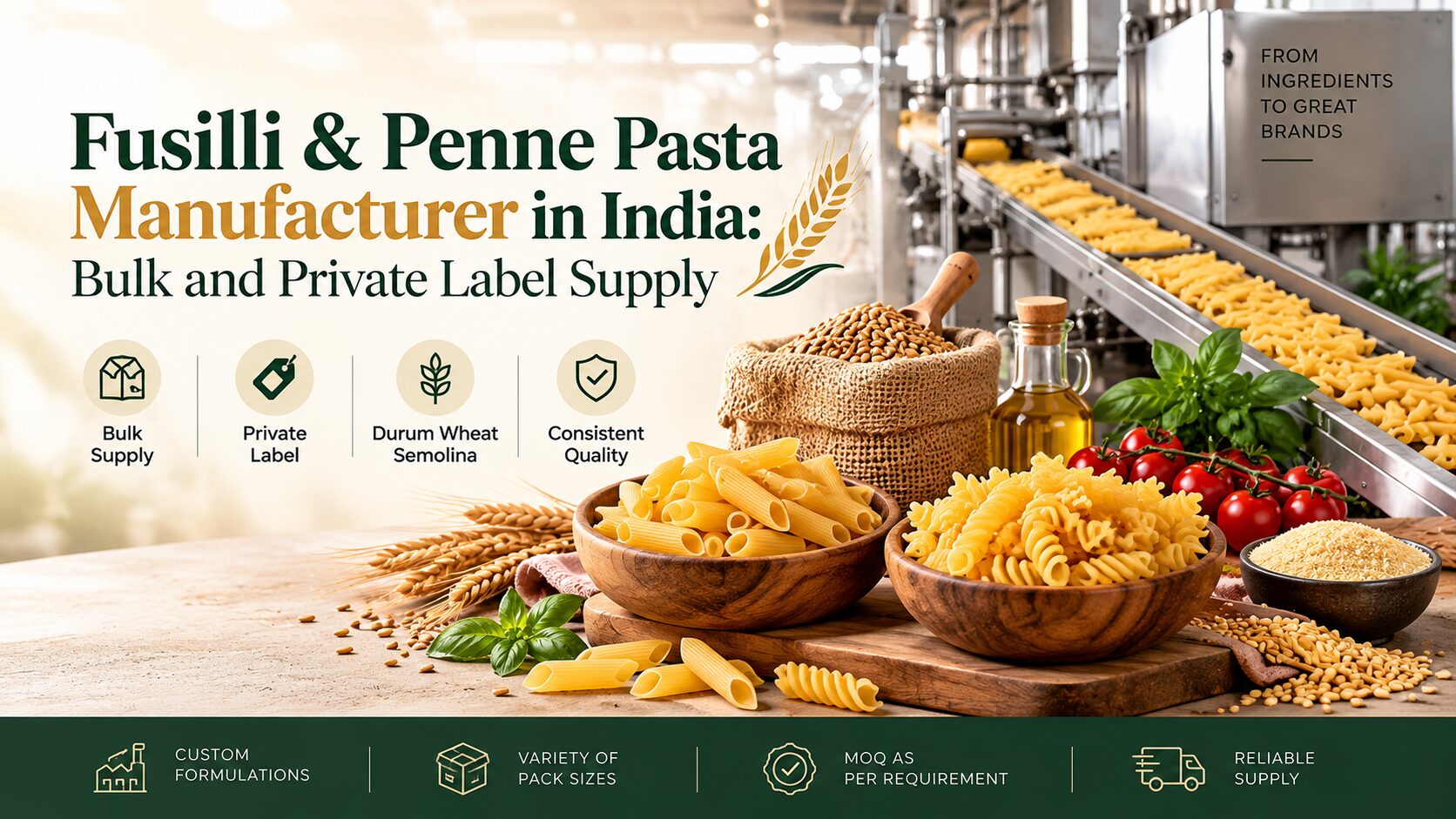
If you are sourcing pasta for a retail brand, a distribution network, a supermarket shelf or an institutional kitchen, two shapes will account for most of your volume: penne and fusilli.
Everything else is range depth. These two are the range.
That makes your choice of fusilli pasta manufacturer in India and penne pasta manufacturer in India a commercial decision, not a catalogue decision. The shape is standard. What varies between suppliers is the semolina behind it, the consistency across batches, the pack formats available, and whether the plant can hold your volume when demand spikes.
This guide covers both shapes in detail: what each one is actually good for, what separates a quality product from a cheap one, and how bulk, wholesale and private label supply works for each.
Indian pasta consumption did not follow the Italian pattern. Long shapes like spaghetti stayed niche. Short cut shapes took the market, because they suit how Indian households actually cook: mixed with masala, tossed with vegetables, cooked as a one-pot dish rather than served under a sauce.
Penne became the default. It is the shape most Indian consumers picture when they hear the word pasta, and it is usually the first SKU any new brand launches.
Fusilli became the natural second. The spiral holds masala and sauce visibly on the outside, it looks different on the shelf, and it performs strongly in the family and children’s segment.
For a brand, stocking both is not duplication. It gives you two shelf facings instead of one, a reason for the retailer to give you more space, and a range story for your distributor. For a fusilli and penne pasta supplier India relationship, it also means one manufacturing partner, one set of commercial terms and better combined volume pricing.
Penne is the angled tube shape, cut diagonally at both ends. Two variants exist commercially: penne rigate, which is ridged, and penne lisce, which is smooth. Rigate is the volume seller in India because the ridges hold masala and sauce better.
Retail consumer packs, the core household SKU
HORECA and cloud kitchens, where it is the default pasta on most menus
Institutional catering, canteens and hostels
Ready-to-cook and meal-kit manufacturers
Shape retention after boiling. The tube should stay open and firm, not collapse or split at the diagonal cut.
Wall thickness consistency. Uneven walls mean parts of the same pack cook at different rates, which is what makes a customer say the pasta is “half raw, half mushy.”
Breakage in transit. Excess breakage points to over-drying or weak packaging.
Cooking time consistency. Should be reliable batch to batch so your pack instructions stay accurate.
A serious penne manufacturer India should be able to state cooking time, moisture level and expected breakage tolerance, not just quote a rate.
Fusilli is the twisted spiral. Its surface area is its selling point: the twist grips sauce and masala where a smooth shape lets it slide off.
Retail consumer packs, particularly family and kids positioning
Pasta salads and cold preparations, where the shape holds dressing
HORECA menus wanting visual variety
Brands building range depth beyond a single penne SKU
Twist definition. The spiral should be well formed and consistent. Loose or half-formed twists indicate extrusion or drying problems.
Uniform length. Inconsistent lengths look poor in a transparent pack and cook unevenly.
Firmness after boiling. The spiral should hold its shape and bite, not unwind or turn soft.
Breakage. Spirals are more fragile than tubes, so packaging and handling matter more here.
A capable fusilli manufacturer India will produce a spiral with clean definition and consistent length across the entire batch, not just in the sample they sent you.
This is the section that decides whether your brand gets repeat purchases.
Quality dry pasta is made from durum wheat semolina. Cheap pasta is made from maida, or from semolina heavily diluted with refined flour. The two look almost identical in the pack. They behave completely differently in the customer’s kitchen.
Hold shape and structure after boiling
Stay firm rather than turning soft and sticky
Release less starch, so the cooking water stays relatively clear
Tolerate slight overcooking without collapsing
Have a firmer bite and a distinct pale golden colour
Turns soft quickly and clumps together
Loses shape definition, which is especially visible in fusilli twists
Clouds the cooking water heavily
Breaks more in transit
Gets returned, and stops repeat purchase
The commercial point: your consumer will never read your ingredient list, but they will notice the difference the first time they cook it. In a repeat-purchase category, one bad cooking experience ends the customer relationship.
When you evaluate any fusilli pasta supplier India or penne pasta supplier India, ask two direct questions. What percentage of the blend is durum wheat semolina, and where is the semolina sourced from. A vague answer is your answer.
Then verify it yourself. Ask for samples from two different production dates, cook them side by side on the same day, and compare colour, cooking time, firmness and water clarity. Our detailed guide on choosing a pasta manufacturer in India covers the full evaluation checklist.
For buyers working in tonnes rather than kilograms, the questions change. Product quality is the gate. Everything after that is about capacity, formats and landed cost.
Consumer packs, typically 250g, 500g and 1kg for retail
Bulk institutional packs for HORECA, catering and canteen supply
Master cartons configured for pallet and truck load efficiency
Decide your formats by channel. Retail needs consumer packs with strong shelf presence. Institutional buyers want larger formats and simpler packaging, since the pack is opened in a kitchen rather than displayed.
For genuine production-scale supply, fusilli pasta bulk supply and penne pasta bulk supply typically start around 10 metric tons. Suppliers offering very low minimums are usually repacking someone else’s output rather than manufacturing, which means the raw material is outside their control and outside yours.
Higher volume brings your per-unit cost down, which is what makes your retail pricing competitive. But match your order to what you can actually move within shelf life. Dead stock costs far more than the margin you save on a bigger slab.
Dry pasta is light and bulky, so freight is a real component of landed cost rather than a rounding error. Ask how many cartons fit a pallet, how a full truck load is calculated, and where the plant is located relative to your primary market. A well-placed plant frequently saves more than a distant supplier’s lower quote.
A bulk fusilli supplier or bulk penne supplier should be able to state daily output in metric tons and describe what happens during peak demand periods. Ask what their busiest month looks like and how they prioritise between clients. Anyone can fill your first order. The question is whether they can fill your twelfth during a festival season rush.
For a committed bulk fusilli pasta manufacturer India or bulk penne pasta manufacturer India relationship, discuss a monthly allocation and a rolling forecast rather than placing orders reactively. Scheduled offtake is cheaper for the plant to serve, and that usually shows up in your pricing.
Wholesale buying works on different logic from brand buying. Your margin comes from the gap between landed cost and secondary sale price, and your risk is stock that does not move.
For distributors. A penne pasta manufacturer for distributors relationship should give you slab-wise pricing, a predictable dispatch schedule, and clarity on territory terms. Ask what secondary sales support exists, what the credit terms are, and how the manufacturer handles near-expiry stock. Consistency matters more than the last rupee on price, because your retailers will not tolerate stockouts.
For retailers and chains. A fusilli pasta manufacturer for retailers must clear the procurement gate before anything else: correct labelling, Legal Metrology compliant declarations, valid FSSAI documentation, barcodes, and adequate remaining shelf life on arrival. Confirm all of this before you pitch a chain, not after they audit you.
For wholesale traders. A fusilli pasta wholesale supplier or penne pasta wholesale supplier arrangement lives on volume pricing and dispatch reliability. Ask for written slab pricing, confirmed lead times, and what happens when a batch fails your quality check.
Across all three, get the commercial terms in writing before the first order. Pricing slabs, payment terms, lead time, freight responsibility and the quality rejection process. A supplier who is disciplined about paperwork before the order will be disciplined about dispatch after it.
If you are building your own brand rather than reselling, both shapes work well as private label SKUs. Penne is the volume anchor. Fusilli gives you range and a second shelf facing.
Your branding on the pack. Brand name, your FSSAI licence number, ingredients, nutritional panel, net quantity as per Legal Metrology, veg mark, MRP, and space for batch and date coding.
Pack size flexibility. The same product across 250g, 500g and 1kg, so you can serve retail and bulk channels from one SKU family.
Packaging material. Barrier properties matter for dry pasta, since moisture ingress shortens shelf life and increases breakage. This matters more for fusilli, which is structurally more fragile than penne.
Artwork coordination. Who creates the design, who confirms print readiness and legal compliance, who owns the files, and what the printing minimum quantity is. Printing MOQ is often higher than production MOQ, which surprises first-time brands.
A pilot batch before full production. Approve physical output, not a mock-up. Check print quality, seal integrity, fill weight and the product inside the pack.
A private label fusilli manufacturer and private label penne manufacturer who handles both shapes under one agreement simplifies everything: one specification process, one artwork cycle, one dispatch schedule, and better combined volume pricing. Our complete private label guide covers the full process, costing and agreement terms.
Bregano is a food brand under the Dwarika Group, manufacturing from its unit in Rudrapur, Uttarakhand.
We produce pasta in penne, fusilli and other short cut shapes, alongside vermicelli, dalia, besan and semolina based products, for our own brand and for partner brands under private label and contract arrangements.
Because production is in-house, you deal directly with the plant. Specification, quality queries and dispatch schedules go to one place, with no trading layer in between.
We supply food brands, D2C and marketplace sellers, distributors, retail and modern trade buyers, HORECA and institutional buyers, and exporters. Engagements start from 10 metric tons, with slabs through 25 MT, 50 MT and above.
durum wheat semolina percentage in the penne and fusilli blends, exact pack sizes available for each shape, daily production capacity in MT, certifications held (FSSAI number, ISO 22000 / HACCP if applicable), stated shelf life, cooking time per shape, cartons per pallet, typical lead time in days, states and export markets served. Delete any line that cannot be verified. Do not publish semolina percentages or cooking times that have not been confirmed by the plant.
Penne is an angled tube cut diagonally at both ends, usually ridged. Fusilli is a twisted spiral. Penne is the higher volume retail shape in India. Fusilli holds sauce and masala on its twisted surface and performs well in family and kids positioning. Most brands stock both.
Production-scale bulk supply typically starts around 10 metric tons. Very low minimums usually indicate repacking rather than manufacturing. At Bregano, enquiries start from 10 MT and move through 25 MT, 50 MT and above.
Durum wheat semolina gives pasta its firm bite and lets it hold shape after boiling. Pasta made largely from maida turns soft and sticky, loses shape definition, and clouds the cooking water. In fusilli the difference is especially visible, because a weak spiral unwinds.
Yes. Both shapes are commonly supplied on a private label basis, with your brand name, FSSAI number and design on the pack. You will need your own FSSAI licence, artwork, and to confirm pack sizes and printing minimums before production.
Consumer packs typically run 250g, 500g and 1kg. Bulk institutional formats are available for HORECA, catering and canteen supply. Choose formats by channel rather than by preference.
Ask for samples from two different production dates and cook them side by side on the same day. Compare colour, cooking time, firmness after boiling, shape retention and water clarity. Also ask for the FSSAI manufacturing licence and check the plant address on it.
Yes, and it is usually the better arrangement. One partner means one specification process, one set of commercial terms, one dispatch schedule and better combined volume pricing across both shapes.
Penne, in most cases. It has the highest household recognition and the fastest offtake in Indian retail. Fusilli works well as the second SKU, giving you range depth and a second shelf facing without changing your recipe.
The shapes are standard across the industry. The semolina, the batch consistency and the plant’s ability to hold your volume are not.
Check the durum wheat semolina content. Cook samples from two production dates. Confirm the supplier manufactures rather than trades. Get your pack formats, slab pricing and dispatch terms in writing. These four checks separate a supply relationship that works from one you will be renegotiating in six months.
Sourcing fusilli and penne in bulk, for wholesale, private label, distribution or export?
Share your product, estimated quantity and purpose through our enquiry form. Our team will respond with specifications, pack options and commercial terms. Enquiries start from 10 metric tons.