
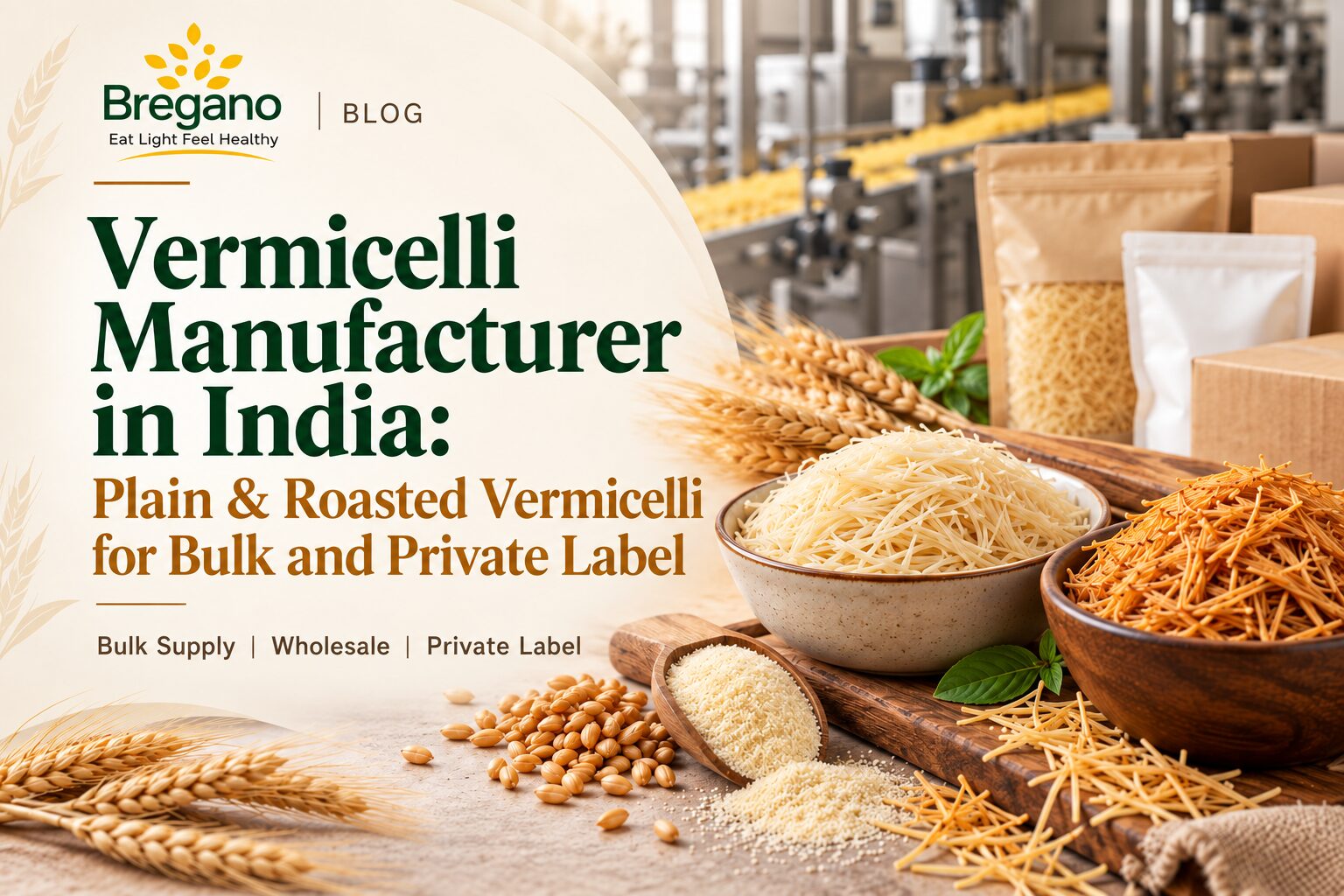
Pasta gets the attention. Vermicelli moves the volume.
If you are building a food brand, running a distribution network or supplying retail in India, vermicelli deserves a harder look than most brands give it. Household penetration is far higher than pasta. It sells across every region, in both sweet and savoury preparations. And unlike pasta, it carries a festival demand cycle that can double offtake in specific months.
That combination makes choosing the right vermicelli manufacturer in India a commercial decision with real consequences. The product looks simple. What separates suppliers is the semolina behind it, roasting consistency, breakage control, and whether the plant can absorb your seasonal spike without pushing you to the back of the queue.
This guide covers plain and roasted vermicelli in detail: what each variant is used for, what to check on quality, and how bulk, wholesale and private label supply works.
Why Vermicelli Is a Stronger Volume Bet Than Pasta
Household penetration is wider. Vermicelli is already in the Indian kitchen. It does not need to be introduced, explained or positioned as a Western product. Pasta still does, in large parts of the market.
It sells in both directions. Sweet preparations like kheer and sheer khurma, and savoury ones like upma. Very few staples cover both a dessert and a breakfast occasion, and that dual use is what keeps offtake steady across the year.
It sells across every region. South Indian kitchens use it heavily for upma. North Indian kitchens use it for kheer and seviyan. Western and eastern markets use both. There is no region where you have to build the category from zero.
Festival demand is real and predictable. Vermicelli offtake spikes hard during festival periods, particularly around Eid, Raksha Bandhan, Navratri and Diwali. This is the single most important planning fact for anyone in this category, and it is covered in the bulk supply section below.
It is the smartest second SKU for a pasta brand. If you already run pasta, adding vermicelli means one more shelf facing, a stronger range conversation with your distributor, and better combined volume pricing from a pasta and vermicelli manufacturer in India who can supply both under one agreement.
Plain vs Roasted Vermicelli: What Each Variant Is For
Both variants sell. They serve different buyers and different price points, and most brands eventually stock both.
The standard unroasted product. It needs roasting in the kitchen before cooking, which is how traditional households have always used it.
Where it sells
What a good product looks like: uniform strand thickness, consistent length, low breakage in the pack, and a clean pale colour with no dark or burnt specks.
A plain vermicelli manufacturer should be able to hold strand thickness consistently, because uneven strands roast unevenly at home and the customer blames the brand, not the pan.
Pre-roasted at the plant, ready to cook directly. This is the convenience product, and it is the faster-growing variant in urban and modern trade.
Where it sells
What a good product looks like: even golden-brown colour across the entire batch, no burnt or under-roasted strands mixed in, distinct roasted aroma, and strands that stay separate rather than clumping.
Roasting consistency is the entire quality question for this variant. For product-use context, see Bregano’s 7 roasted vermicelli recipes. Uneven roasting is the most common defect, and it is immediately visible in a transparent pack. When evaluating a roasted vermicelli manufacturer in India or roasted vermicelli supplier in India, ask how roasting is controlled, whether it is a continuous or batch process, and how they check colour consistency between lots.
Also ask about shelf life. Roasted vermicelli behaves differently from plain in storage, and packaging barrier quality matters more.
Semiya, Seviyan, Vermicelli: Same Product, Different Names
Worth being clear on this, because it affects how buyers search and how you label your packs.
Semiya is the common term in South India, mainly used for upma and payasam. A semiya manufacturer India and a vermicelli manufacturer are the same thing.
Seviyan is the North Indian term, associated most strongly with kheer and sheer khurma. A seviyan manufacturer India supplies the same product under a regional name.
Vermicelli is the English commercial term used on most packaging and in B2B trade.
Practical implications:
Raw Material and Quality: What Actually Separates Suppliers
Durum wheat semolina. Quality vermicelli is made from durum wheat semolina. Bregano also explains the ingredient and nutrition context in its vermicelli health guide. Cheaper product uses maida, or semolina diluted heavily with refined flour. The difference shows the moment it is cooked. Good vermicelli holds strand structure and stays separate. Maida-heavy vermicelli turns pasty, clumps into a lump, and releases starch that makes kheer cloudy and upma sticky.
In vermicelli this matters more than in pasta, because the strands are thin. There is less structure to begin with, so weak raw material collapses faster.
Ask any vermicelli manufacturer and supplier two direct questions: what percentage of the blend is durum wheat semolina, and where is the semolina sourced. Vague answers here become customer complaints later.
Breakage. Vermicelli is the most fragile product in the dry pasta family. Excessive breakage means an unattractive pack, poor cooking behaviour and consumer rejection. Ask about the breakage tolerance and check it yourself in the sample. Also ask how it is packed and handled in transit, since a lot of breakage happens after production, not during it.
Strand uniformity. Consistent thickness and length. Uneven strands cook at different rates, which produces the half-raw, half-mushy result that ends repeat purchase.
Moisture control. Determines shelf life and breakage. Ask for the stated moisture level and shelf life, and the storage conditions those assume.
Batch consistency. Ask for samples from two different production dates. Cook both on the same day. Colour, cooking time, strand integrity and clumping behaviour should match. For roasted vermicelli, also compare roast colour side by side. Our full evaluation checklist is covered in our guide on choosing a pasta manufacturer in India.
Bulk Vermicelli Supply
Pack formats
Note that vermicelli retail packs tend to run smaller than pasta packs, which means more packaging cost per kilogram. Factor that into your costing rather than assuming pasta economics carry over.
Minimum order quantity
For genuine production-scale supply, bulk orders typically start around 10 metric tons. A bulk vermicelli supplier or bulk roasted vermicelli supplier offering very low minimums is usually repacking rather than manufacturing, which puts the raw material outside their control and outside yours.
Higher slabs bring per-unit cost down. But match your order to what you can move within shelf life, especially for roasted vermicelli.
Plan for the festival cycle
This is the part most buyers get wrong, and it costs them every year.
Vermicelli demand does not sit flat across the year. It spikes sharply around festival periods, and every distributor, retailer and brand in the category wants stock in the same weeks. Plants run at capacity. Lead times stretch. New buyers get scheduled after committed ones.
If you are working with a bulk vermicelli manufacturer India relationship, book your festival volume in advance with a rolling forecast rather than placing an order when demand arrives. A committed monthly allocation costs you nothing and guarantees you are in the production queue when it matters. Ask your supplier directly how far in advance festival orders need to be placed, and treat that answer as a hard deadline.
Freight and capacity
Vermicelli is light and bulky, so freight is a genuine component of landed cost. Ask cartons per pallet and how a full truck load is calculated. Also ask the plant’s daily output in metric tons and what their peak season load looks like, so you know whether they can hold your volume when it grows.
Wholesale Supply for Distributors and Retailers
For distributors. A vermicelli supplier for distributors relationship should give you slab-wise pricing, a predictable dispatch schedule, and clarity on territory terms. In this category, ask specifically about festival season allocation and near-expiry stock policy. Your retailers will not tolerate a stockout in the weeks that matter most.
For retailers and chains. A vermicelli manufacturer for retailers must clear procurement requirements before anything else: Legal Metrology compliant declarations, valid FSSAI labelling documentation, correct barcodes, and adequate remaining shelf life on arrival. Confirm this before pitching a chain, not after the audit.
For wholesale traders. A vermicelli wholesale supplier India or roasted vermicelli wholesale supplier arrangement runs on volume pricing and dispatch reliability. Get slab pricing, lead times, freight responsibility and the quality rejection process in writing before the first order.
Across all three, a supplier who is disciplined about paperwork before the order will be disciplined about dispatch after it.
Private Label Vermicelli
Vermicelli works well as a private label SKU, and for many brands it is the better starting point than pasta, because the category needs no consumer education.
What a private label vermicelli manufacturer arrangement should cover:
Both variants under one agreement. Plain and roasted from the same partner, so you cover traditional and convenience buyers with one specification process and one dispatch schedule.
Your branding on the pack. Brand name, your FSSAI licence number, ingredients, nutritional panel, net quantity as per Legal Metrology requirements, veg mark, MRP, and space for batch and date coding in line with applicable FSSAI Labelling and Display Regulations. Consider carrying the regional term alongside the English one for regional targeting.
Pack size flexibility. Smaller retail formats plus bulk options, so you can serve retail and institutional channels from one SKU family.
Packaging quality. This matters more for vermicelli than for pasta. Fragile strands need packaging that protects against both moisture and physical breakage in transit. Ask what material is being quoted and what its barrier properties are.
A pilot batch before full production. Approve physical output, not a mock-up. Check roast colour consistency, breakage level in the pack, fill weight, seal integrity and print quality.
A vermicelli manufacturer for private label who also produces pasta lets you build a fuller range under one relationship, with better combined pricing. Our complete private label guide covers the full process, costing and agreement terms.
Vermicelli Supply from Bregano
Bregano is a food brand under the Dwarika Group, manufacturing from its unit in Rudrapur, Uttarakhand. More about the facility and manufacturing setup is available on the About Bregano page.
We produce vermicelli alongside pasta, dalia, besan and semolina based products, for our own brand and for partner brands under private label and contract arrangements.
Because production is in-house, you deal directly with the plant. Specification, quality queries and dispatch schedules go to one place, with no trading layer in between.
We supply food brands, D2C and marketplace sellers, distributors, retail and modern trade buyers, HORECA and institutional buyers, and exporters. Export-focused buyers can review Bregano’s export manufacturing capabilities. Engagements start from 10 metric tons, with slabs through 25 MT, 50 MT and above.
whether Bregano currently produces plain, roasted, or both variants, durum wheat semolina percentage in the vermicelli blend, strand thickness variants available, exact pack sizes, daily production capacity in MT, certifications held (FSSAI number, ISO 22000 / HACCP if applicable), stated shelf life for plain and roasted separately, breakage tolerance, cartons per pallet, festival season lead time and order cut-off, states and export markets served. Delete any line that cannot be verified. Critical: if Bregano does not currently produce roasted vermicelli, this blog must be restructured before publishing. Do not run a co-primary keyword on a product that cannot be supplied.
Frequently Asked Questions
What is the difference between plain and roasted vermicelli?
Plain vermicelli is unroasted and needs roasting in the kitchen before cooking. Roasted vermicelli is pre-roasted at the plant and can be cooked directly. Plain suits traditional retail and price-conscious buyers. Roasted suits modern trade, e-commerce and convenience-focused urban households.
Is semiya the same as vermicelli?
Yes. Semiya is the South Indian term, seviyan is the North Indian term, and vermicelli is the English commercial term. All three describe the same product. Strand thickness preferences vary by region, so confirm which variant suits your market.
What is the minimum order quantity for bulk vermicelli in India?
Production-scale bulk supply typically starts around 10 metric tons. Very low minimums usually indicate repacking rather than manufacturing. At Bregano, enquiries start from 10 MT and move through 25 MT, 50 MT and above.
Why does durum wheat semolina matter in vermicelli?
Because the strands are thin, raw material quality shows up faster than it does in pasta. Durum wheat semolina keeps strands separate and structurally intact after cooking. Maida-heavy vermicelli turns pasty, clumps together, and clouds kheer or makes upma sticky.
Can I get vermicelli manufactured under my own brand?
Yes. Both plain and roasted vermicelli are commonly supplied on a private label basis, with your brand name, FSSAI number and design on the pack. You will need your own FSSAI licence, artwork, and to confirm pack sizes and printing minimums before production.
How far in advance should I order for festival season?
Earlier than you think. Vermicelli demand spikes sharply around festival periods and plants run at capacity, so lead times stretch and committed buyers are scheduled first. Book your allocation in advance with a rolling forecast, and ask your supplier for their specific festival order cut-off date.
What causes breakage in vermicelli and how do I check it?
Over-drying, poor handling and inadequate packaging. Check the sample pack for the proportion of broken strands, and ask the supplier for their breakage tolerance and how the product is packed for transit.
Can one manufacturer supply both pasta and vermicelli?
Yes, and it is usually the better arrangement. One partner means one specification process, one set of commercial terms, one dispatch schedule, and better combined volume pricing across the range.
Sourcing Your Vermicelli
Vermicelli is an easier category to sell into than pasta, because the demand already exists. What it is not is an easier category to source well.
Check the durum wheat semolina content. For roasted, check colour consistency across two production dates. Check breakage in the actual sample pack, not just the spec sheet. Confirm the supplier manufactures rather than trades. And book your festival volume before the season, not during it.
Sourcing vermicelli in bulk, for wholesale, private label, distribution or export?
Share your product, estimated quantity and purpose through our enquiry form. Our team will respond with specifications, pack options and commercial terms. Enquiries start from 10 metric tons.