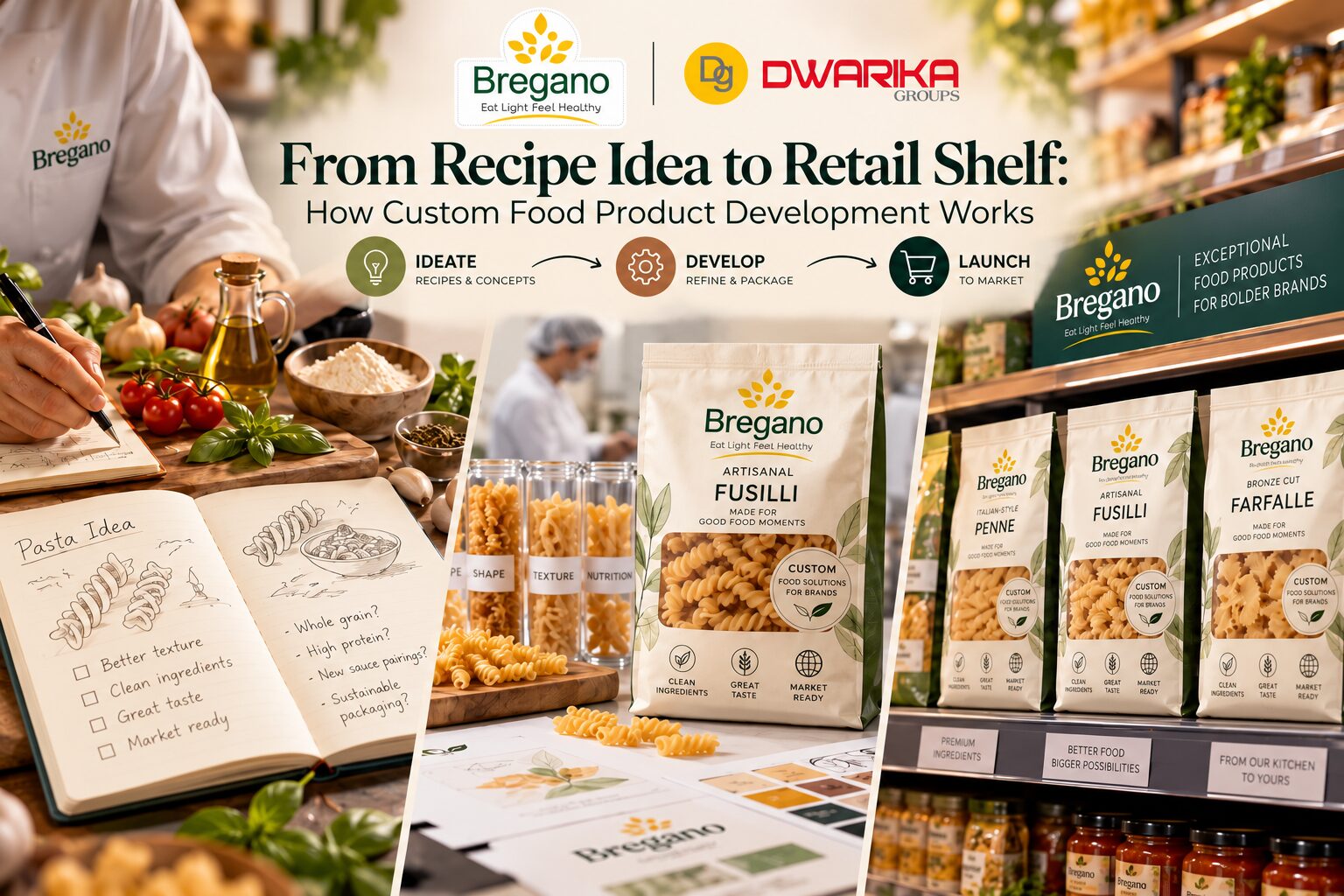
Many food brands begin with a single idea: a high-protein pasta, a quick-cooking staple, a regional snack made for modern kitchens. Turning that idea into a consistent, safe, shelf-ready product is the hard part.
That is where a custom food product manufacturer comes in. This guide explains how custom food product development works, what each stage involves, what it costs, how to protect your recipe, and how to prepare before you approach a manufacturer.
What is custom food product development?
Custom food product development is the process of creating a food product to your specification, then producing it at commercial scale under your brand.
It differs from simple private labelling. With private label, you put your brand on a product the manufacturer already makes. With custom development, the product itself is adjusted to your brief: the formulation, the size, the pack, or all three. If you only need a ready product under your own brand, our guide on private label pasta manufacturing explains that route.
A food contract manufacturer in India that offers custom development usually supports you from the first sample to regular production.
Why brands choose custom development
- A product that stands out: a custom formulation, size or format gives customers a reason to choose you over similar products.
- Fits your customer exactly: you can build the product around a specific need, such as taste, pack size or cooking time.
- Stronger brand ownership: a product made to your specification is harder for competitors to copy than a standard private label item.
- Room for a range: once the first product works, the same development process can be used to extend your range.
- No factory investment: you get a unique product without building or running your own plant.
The development journey, stage by stage
Every manufacturer has its own process, but most custom projects move through these stages.
1. The brief
You share what you want to make: the product, target customer, price point, pack sizes, sales channels and any must-have ingredients or claims. The clearer your brief, the faster the next stages go. A vague brief usually means more sample rounds and a longer timeline.
2. Feasibility check
The manufacturer checks whether the product can be made on its lines, with available raw materials, at a cost that fits your target price. This is also when you learn what can and cannot be changed, and what the minimum order quantity is likely to be.
3. Sample development
The manufacturer prepares samples based on your brief. Expect a few rounds of feedback on taste, texture, appearance and cooking performance. Test samples the way your customers will use them, not just straight from the pack.
4. Sample approval
Once a sample meets your expectations, you approve it as the standard every production batch must match. Keep a written record of the approved specification so there is no confusion later.
5. Packaging and labelling
Your artwork is finalised with all mandatory label details. The manufacturer verifies technical print parameters and confirms the pack material and format work on its packaging machines. As the brand owner, you hold final legal sign-off on label declarations such as net quantity, MRP and mandatory disclosures under FSSAI and Legal Metrology rules. Any claims on the pack, such as nutrition or health claims, should be supported by test reports and comply with FSSAI rules on claims.
6. Trial production
A trial batch is run on the commercial line to confirm that the approved recipe performs the same way at scale. Small-batch samples don’t always behave the same on a full production line, so this step matters.
7. Commercial production
After the trial is signed off, regular production begins according to your agreed order quantities and delivery schedule.
8. Ongoing quality checks
Each batch is checked against the approved standard so every pack your customer buys is consistent. Agree in advance on how quality issues and complaints will be handled.
What you can customise
| Element | What it covers |
|---|---|
| Formulation | Ingredients, ratios, flavours and add-ins |
| Grammage | Net weight per pack, to suit price points and channels |
| Packaging | Pack format, material, size and artwork |
| Branding | Your brand name, logo and design on every pack |
| Product format | Shape, size or cut, depending on what the line can produce |
What a manufacturer can change depends on its machinery and raw materials, so confirm the options during the feasibility stage.
Costs to plan for
Custom development involves more than the per-unit product price. Ask your manufacturer which of these apply and budget for them early:
- Sample development: some manufacturers charge for sample rounds, especially for complex formulations.
- Packaging setup: printing plates or cylinders for custom packaging, and minimum print runs for pouches or cartons.
- Trial batch: the cost of running the first batch on the commercial line.
- Testing: lab reports for shelf life, nutrition values or any claims you want to print on the pack.
- Minimum order quantity: the first commercial order must meet the manufacturer’s MOQ per SKU. MOQs vary by plant, line and product, so compare them across your shortlist.
- Compliance: trademark registration, your own FSSAI licence or registration as the marketer, and label review.
Knowing these costs upfront helps you set a realistic launch budget and avoid surprises.
Protecting your recipe and brand
When you share a product idea with a manufacturer, protect it from the start:
- Sign a non-disclosure agreement (NDA) before sharing your detailed brief or recipe.
- Define ownership in writing: your manufacturing agreement should state who owns the formulation, artwork and brand.
- Register your trademark for your brand name and logo.
- Keep your own records of the approved specification, sample approvals and artwork versions.
Clear terms protect both you and the manufacturer, and make it easier to scale or switch suppliers later.
Common challenges, and how to handle them
| Challenge | How to handle it |
|---|---|
| Sample tastes great, but cost is too high | Revisit pack size, ingredients or packaging material before changing the core product |
| Recipe behaves differently at scale | Always run a trial batch on the commercial line before full production |
| Claims you want on the pack aren’t supported | Get lab tests done first, or remove the claim |
| MOQ is higher than your launch budget | Start with fewer SKUs or a single pack size |
| Long back-and-forth on samples | Write a clearer brief with reference products and specific feedback |
What to prepare before you approach a manufacturer
- A one-page product brief: what the product is, who it is for and why they will buy it.
- Reference products: two or three products on the market that are close to what you want, and what you would change.
- Target price: the shelf price you want, and the margin you need after channel costs.
- Expected volumes: realistic monthly quantities for the first six to twelve months.
- Sales channels: where you plan to sell, because this affects pack sizes and packaging strength.
- Brand assets: your brand name, trademark status and any packaging design work already done.
Arriving with this information helps the manufacturer give you accurate samples, pricing and timelines. Our guide on how to choose the right manufacturing partner lists the questions to ask during your first conversations.
Final thoughts
A good product idea is only the start. Custom food product development turns that idea into something consistent, safe and ready to sell, through a clear brief, careful sampling, a proper trial run and a written agreement.
Choose a manufacturer that can explain each stage clearly, show you its capabilities, and grow with your volumes. For more on working under a formal agreement, read our guide to contract pasta manufacturing in India.
Custom food manufacturing with Bregano
Bregano is made by Dwarika Food Products in Rudrapur, Uttarakhand, and offers contract manufacturing and private labelling for food brands, including custom products.
Based on Bregano’s published information:
- Customisation: custom formulation, packaging, grammage and branding.
- Categories: pasta and vermicelli, staples (atta, besan, dalia, sooji), soya chunks, boondi, hing, and custom or other products.
- Pack range: from 10g sachets to export cartons.
- Production: PAVAN pasta lines imported from Italy, with automated vacuum mixing, extrusion, drying and packaging.
- Inspection: automated moisture, colour and shape inspection removes defects before packaging.
- Certifications: FSSAI licensed, with GMP, GHP and Halal certification.
You can try Bregano’s own products through the Bregano online shop.
Frequently asked questions
What does a custom food product manufacturer do?
It develops a food product to your specification, then produces and packs it at commercial scale under your brand.
How long does custom food product development take?
It varies with the product, the number of sample rounds and packaging approvals. Ask your manufacturer for a timeline after the feasibility stage.
Who owns the recipe in custom manufacturing?
Ownership should be defined in your manufacturing agreement. Agree on it in writing before development starts.
Can I start with a small order?
Most manufacturers set a minimum order quantity per SKU, and it varies by plant and product. Ask for MOQs early so you can plan your launch budget.
What is the difference between custom manufacturing and private label?
Private label puts your brand on a product the manufacturer already makes. Custom manufacturing adjusts the product itself, such as its formulation, size or pack, to your brief.
Who is responsible for the label on a custom product?
The brand owner. The manufacturer can check technical print parameters, but as the marketer you need your own FSSAI licence or registration and hold final legal sign-off on label declarations under FSSAI and Legal Metrology rules.
Do I need lab tests for my custom product?
If you plan to print nutrition values, shelf life or other claims on the pack, they should be supported by test reports. Your manufacturer or a food compliance consultant can advise on what is required.
Should I sign an NDA before sharing my recipe?
Yes. A non-disclosure agreement protects your idea while you discuss it with potential manufacturers.
Does Bregano make custom food products?
Yes. Bregano lists custom or other products among its contract manufacturing categories, with custom formulation, packaging, grammage and branding.